The Seam in the Fire
Story
THE SEAM IN THE FIRE
Kharu's Ember Traverse, the closing hours of the third heatshift, eons before the Age of Earth
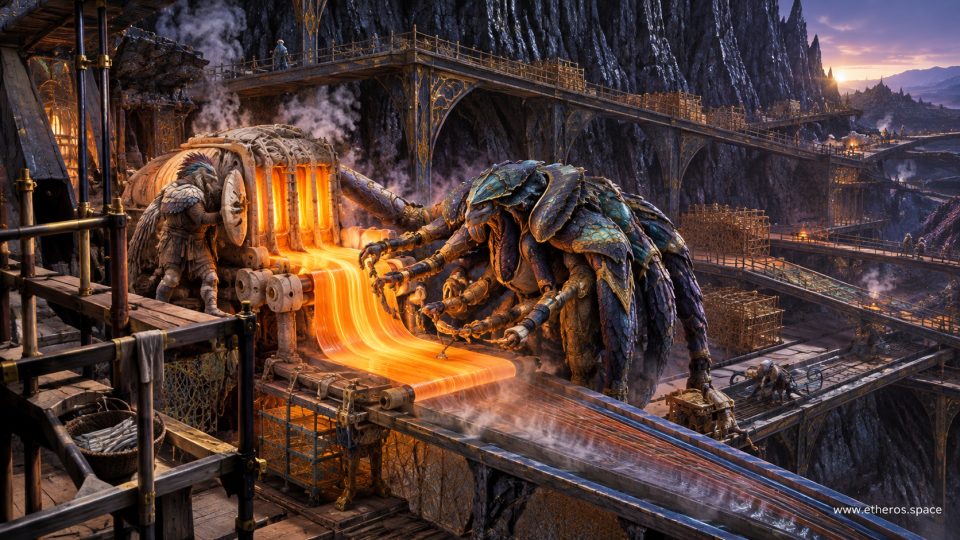
The glassworks had no bell loud enough to be heard over the mountain. When it was time for the workers to change places, someone raised a hand along the upper bridge and the signal traveled from one torchlit balcony to the next. Far below, the furnace sent a bright, continuous ribbon onto its long descending bed. For an instant the molten surface looked like a road made of sunrise.
Vorren stood at the side of it, almost twice the height of the feather-crested keeper by the firebox. The ridges of his blue mineral shell overlapped like old roofing, and his several slender working arms moved independently above the blazing sheet. He had been born to a carapaced line that could endure the dry radiant heat longer than most Etherosi, but even his inner joints could blister. He never laid a bare tip upon the orange surface. His work was to follow its edges, find a drift before it grew, and warn the press to slow.
That evening he warned it three times.
Talek, at the left-hand hearth, had turned the heavy regulator until both hands trembled. The new living rollers had been fitted two days before. Their muscle-woven sleeves gripped the glowing mineral evenly, drawing twice the length of amberglass in a shift while consuming less fuel at the throat. The terraces of Kharu needed panels before the highland cold: roofs for the sleeping galleries, inspection windows for the granary, wind screens for those who crossed the open bridges. Any extra length mattered.
But as the ribbon moved past Vorren, a faint narrow dark line followed the same place on each new panel. It appeared where the cooling bed bent toward the lower scaffold. From the upper walks it would have been invisible. From beside the heat it looked like the shadow of a thread trapped beneath ice.
"We can polish it," Talek called through the roar.
"We may be able to polish what we can see," Vorren answered.
He used his lower arm to point, holding his other hands clear of the radiant sheet. A small laborer named Iln crouched beside the downstream track, where the returning shoes clattered over their guides. Iln was a rail-fitter, a patient worker with stone-grey fingers and a habit of listening through metal instead of against it. She leaned toward the support rail, heard the repeated dry click, and looked up.
"The bed is shifting," she said. "One tooth of the return comb takes the load a little too early. The sheet stretches over it before the cooling has finished."
From a higher walkway, a supervisor called for them to keep the furnace running. A delivery party was due before the next dusk. Three villages had already agreed on the price, and one more stopped heatshift would mean wages no one could recover. The supervisor was not cruel; her own household owed a share of those wages. Neither, she argued, should a flaw be declared dangerous without a test.
Vorren knew she was right about the uncertainty. Nobody had broken a cooled panel yet. Nobody had tested one, either. His father had once taught him to feel a seam by laying the flat of a protected shell against the safe, dark end of a cooling plate. This new living press had made that touch unnecessary on good days. It had not made the old skill useless.
So he proposed a measure rather than a quarrel. Mark six panels from the present run. Let them cool all the way to the bridge air. Put one under load, leave another outside through the cold, and keep the others to compare with hand-guided pieces. Continue the furnace at reduced draw until they knew what the line meant. Iln would reset the comb while Talek held the regulator steady; the supervisor could witness the tests and record the material lost.
It cost them the best hour of production. The great sheet moved more slowly, and the glowing rollers gave a deep, less hurried sound. They did not entirely stop. By the time the upper lamps were lit, Iln had adjusted a worn rail shoe; Talek had found the gentlest pressure his regulator could sustain; Vorren had tied a thin copper thread to the first of the six marked pieces.
In the cool inspection alcove, one test panel survived its weight. Another cracked with a quiet, abrupt report that carried farther than the roar of the furnace. The flaw was not a catastrophe, but it was real. Its cause was not proven by a single break, and the new machine was not condemned. They would repeat the test after the comb had been reset and compare the next day's panels against the old ones.
The supervisor put her seal beside the results. The wages lost were written down, and so was the possible cost of roofs that failed in the night. Neither number was allowed to erase the other.
When Vorren finally lifted his arms from the heat, their joints ached. He watched the distant torchlights cross the high bridges, small figures carrying work home between the dark walls. He did not wish to stop the new rollers. They could spare the apprentices years of dangerous furnace labor. He wanted something harder: a machine fast enough to help the settlement, a guild patient enough to test it, and a place for the hands that still knew when to ask it to slow.
Below him, the orange ribbon continued over the corrected bed. Its light was almost beautiful enough to be trusted.