The Square No One Owned
Story
THE SQUARE NO ONE OWNED
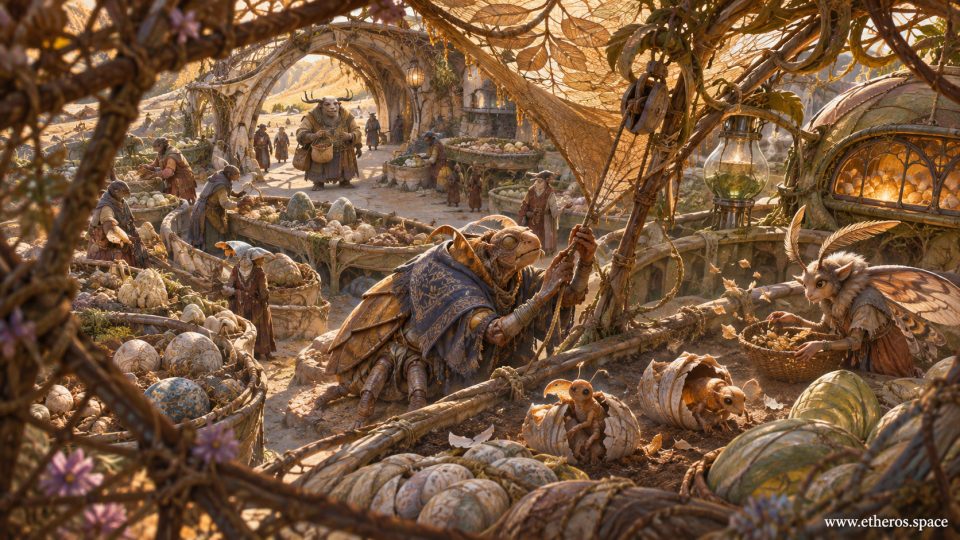
Orraal's Market Court, a dry late morning in primordial Etheros
The first move belonged to Orrun, but the morning did not.
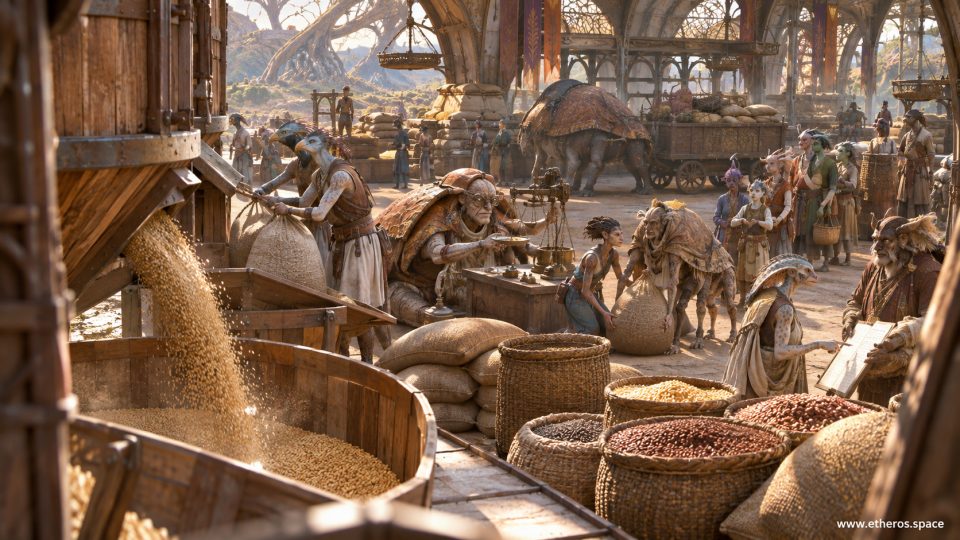
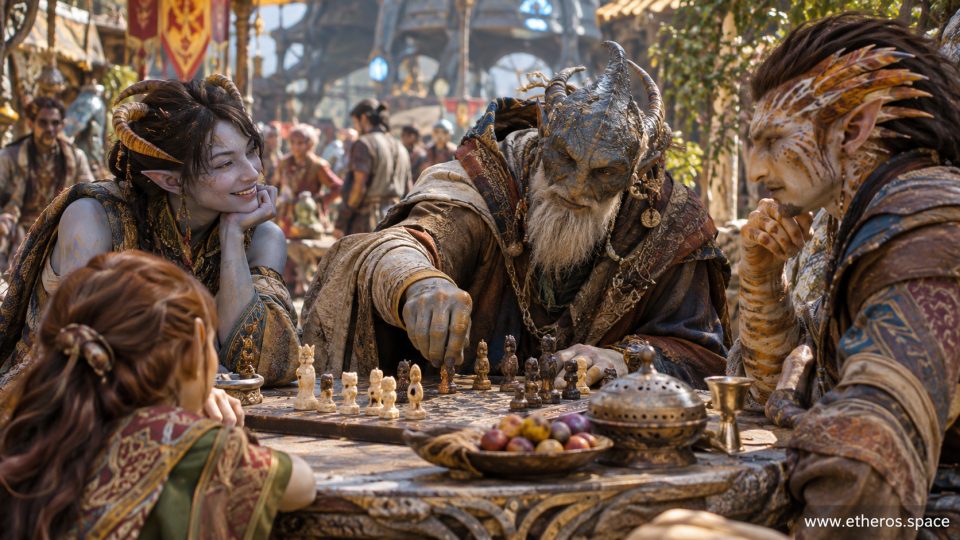
Around the narrow game table the whole market continued without them. Somewhere behind the bright banners a cooper argued about handles; a trolley scraped against old limestone; vendors counted the last fruits of a small upland harvest. A child might have crossed the square and thought the four people at the table had been sitting there since the city was built. Only the movement of Orrun's long, grey fingers proved otherwise.
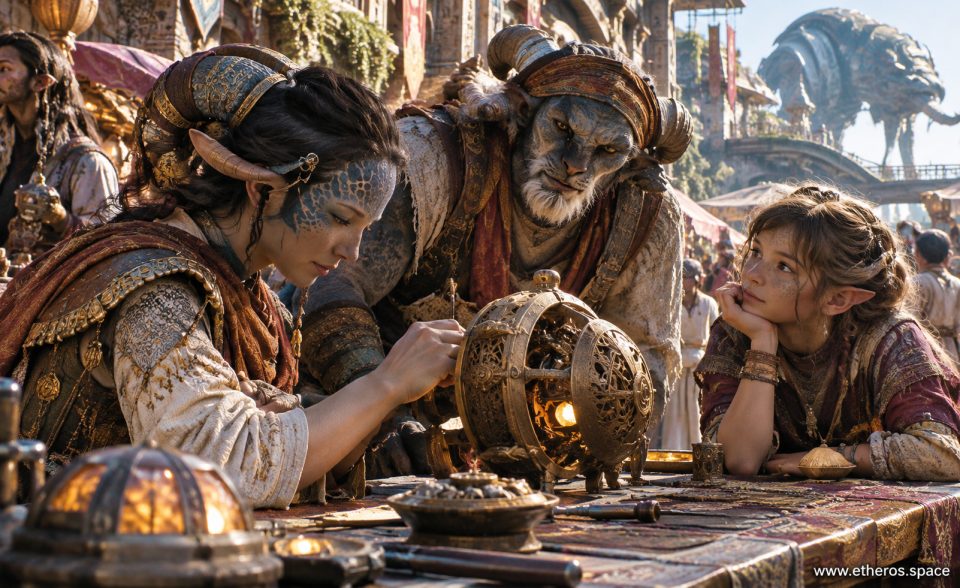
He leaned over the carved board and set a dark figure one square forward. There was a white beard beneath his ridged chin, a pair of curled horns behind his temples, and a weathered face that carried more patterns than the pieces. He was old enough to remember when Orraal's public court had been a roofless patch of hard earth. His students knew that he sometimes remembered things incorrectly too; they were learning to correct him without making him feel less old.
Across from him, Kesh watched with his chin propped on one hand. The young striped-faced trader had come to buy a set of brass hinges and stayed because Orrun had finally agreed to play. Beside the board, pale-blue-skinned Venra rested her cheek against her folded fingers, smiling in anticipation rather than victory. Her curved horns nearly touched the shadow of the hanging vines. Her smile was the expression that troubled Orrun most. It meant she had already noticed the gap in his formation.
At the near corner a child named Iri sat with her back to the flow of customers, close enough to see the painted edges of the pieces and far enough away not to upset the fruit dish. She had no stake in the game. At least, that was what the others had said when she first arrived.
The board was called the Folded Roads. Its pale figures began on the side of the open table, while the dark figures waited between Orrun's bracelets and a hammered metal pot. A player could win by carrying one messenger across the center or by keeping a pathway open while the rival ran out of safe moves. The game was old, and so were the arguments about what counted as a pathway. Generations of travelers from different anatomies had altered its rules. Some wanted every path straight. Others considered the possibility of turning around its most important lesson.
Kesh had learned the costly form of the game in the private rooms above the trade hall. There each lesson required a stamped copper token. He did not resent paying: the instructors had families, and skilled teaching could not be conjured from gratitude. But he had seen apprentices leave at the door, holding tools they could barely afford to replace. The token bought attention. It also decided whose mistakes were allowed to become knowledge.
Venra taught in the afternoon whenever her own work was done. She never charged at the public table. She had begun to suspect that giving everything away without asking for help might eventually leave her with no hours to give.
"There's a road you haven't closed," she told Orrun.
"I know," he answered, reaching for a second figure and then withdrawing his hand. "It isn't mine to close."
Kesh straightened. "You moved a gate into danger."
"I moved a gate where someone could see it."
Iri, who had been studying the little white figures more closely than any of them knew, pointed toward the center. "If that one is a messenger, why does he have to take the longest road?"
The three older players fell silent. Orrun looked at the child, then at the square she meant. A vendor's call rose behind them and dissolved in the crowd. It was an ordinary interruption, yet for Orrun it changed the shape of the game. Iri had found the move they had all avoided because the rules they knew made it look unimportant.
"Show us without touching," he said.
She traced a crooked route in the air. The road used two squares that had seemed useless and crossed a space Kesh had regarded as empty. Venra stopped smiling for an instant, not from displeasure, but because the child was right: the messenger could arrive without capturing a single piece.
Kesh considered the board. He could object that Iri was not a registered player. He could also argue that her route depended on a rule adopted in distant districts and never accepted here. Both objections would be accurate in some version of the game, and neither would make her observation less real.
"We need a second board," he said at last, surprising himself.
Venra shook her head. "We need one table where the first question costs nothing. After that, someone must pay for the hours spent answering the difficult ones."
"With whose money?" Kesh asked.
"We haven't solved that," Orrun said. "We have only learned what the problem is."
By the time the market bells sounded their uneven noon measure, the four had tried Iri's route, disputed three rules, and agreed to ask the neighboring stalls for help repairing the public board. Kesh offered one evening each market cycle. Venra promised to teach him the variations she had learned from caravan players. Orrun said he would write down the rules that contradicted his own recollections, and Iri insisted that there be enough space at the near side for small hands and large claws alike.
No decree was made. No one was crowned the keeper of the game. Behind their shoulders the city kept selling, eating, laughing and moving on. But when the next child stopped to watch, Iri turned her seat outward and made a little room.
Later, when Orrun tried to remember the best move of the morning, he could recall neither its beginning nor its end. He remembered only the empty square in the middle: a square that had belonged to nobody, until somebody was invited to look at it.