The Wind Had Room for All of Them
Story
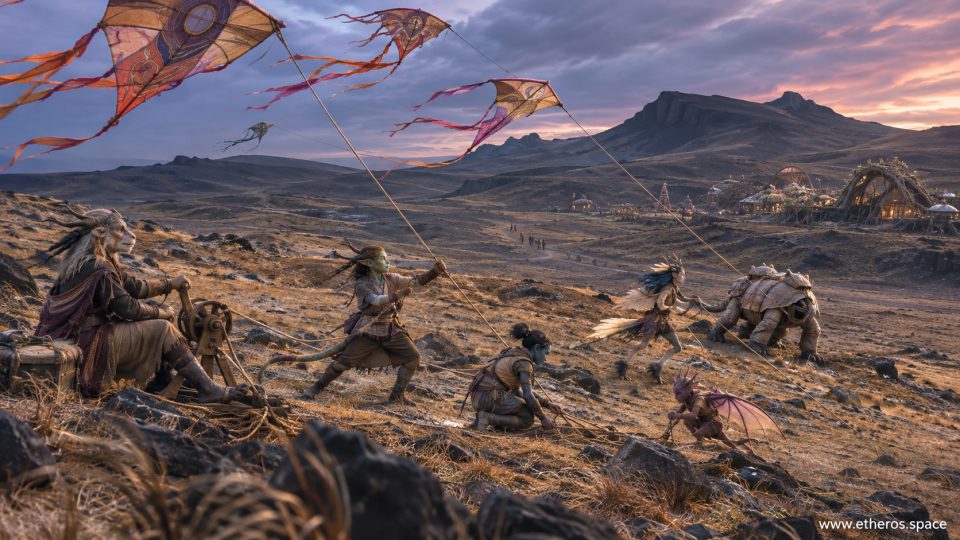
The first kite lifted before the little settlement of Uvren lit its evening lamps. Seen from the far ridge, the silk looked like a rust-colored leaf fighting the entire sky. The long red tails trailed over rock and tawny grass, and then, as the wind changed, began to stream west in one clean gesture.
On a low stone seat, old Veyran kept one hand on a wooden winch and the other near its brake. He had worked with wind-lines long before his left knee grew stiff and the ridges became difficult to climb. His pale hair had escaped its bindings, and the wheel beside him made a dry, patient clicking. He could feel each tug through the handle: a change in tension, a momentary slackness, the sharp pull that warned him a gust was finding a new direction.
A few paces away, Thessa, green-faced and long-tailed, leaned back with both boots braced against the rough earth. The great painted sail above her had risen higher than any of the afternoon's trials. Her grip was firm, but not fierce. If she hauled too hard, the narrow bamboo spars would buckle; if she let the line run, its streaming tails would cross the neighboring tether. She kept adjusting, listening to Veyran's quiet calls.
There had once been competitions on this ridge. Winners received bronze knots, and their families took the high wind for themselves until sunset. That custom was older than any living judge. It rewarded skill, so its defenders said, and prevented tangled lines. It also meant that children with unfamiliar bodies, elders unable to sprint, and families who could not afford a sound kite seldom got more than a glimpse of the sport.
This season, the settlement had tried an Open Wind evening instead. Anyone could learn the rigging. Anyone could take a turn, provided they helped mend the equipment afterward. The arrangement was only three evenings old, and already half the village had opinions about it.
Neril crouched in the scrub at the base of the cords, anchoring a smaller tether into a socket between two stones. His dark, close-fitted work coat carried dust from his day's labor. The peg needed to sit deep enough to resist a sudden pull, but not so deep that the fragile skin of the ridge would tear when it was removed. The tether ran over a padded guide to protect both line and hands. Every useful wind had a load path; a beautiful sail could still be a dangerous thing if no one accounted for that force.
Beyond him, fleet-footed Sairen, whose feathers rose into a crest, ran toward the broad-backed shell-beast Morga. The animal was standing squarely with its weight distributed over the uneven ground, wearing an ordinary pulling harness. Its patient strength steadied a separate practice line, while Sairen checked that no strap rubbed against its plated shoulder. They had agreed that Morga would work for only a short interval before being led back to graze. The animal was not a machine, and its tolerance mattered as much as the sturdiness of the knot.
The youngest participant, little Pirri, knelt near the last low cord. Her folded pink wing membranes were too small to bear her weight in this wind. She was not trying to fly herself. She wanted to learn how the smallest purple kite could stay aloft while the larger sails wandered. She had spent the afternoon tying knots that slid apart. Now she pressed the loose end beneath her palm and tried one more time.
From Uvren's warm root-arched houses, a procession of late arrivals made its way across the plain. Some had hands suited to small tools, others gripping feet, jointed claws or broad padded limbs. Not all could manage a sprint, a high tension line, or the steeper part of the climb. Veyran had expected the new festival to solve that problem. Instead it had exposed how much work remained: stable footholds, more than one kind of handle, and a place where those who could not run could still direct the sky.
Thessa's sail dipped. Its taut line began to draw across the path to the settlement. She called for a little slack; Veyran eased the brake one notch. Sairen slowed beside Morga and checked the harness. Neril put a hand on his anchored guide. For three breaths the kites quivered, each answering a different current. Then the long tails turned together, and the lines separated again without a tear.
Pirri laughed. No one had fallen, and no prize had been awarded. Veyran found that he liked the sound of the laugh better than the bronze knots.
Later, as the light drained from the ridge, the argument came back. A few villagers wanted the old timed contests restored; the evenings were too crowded, they said, and repairs were expensive. Others insisted the shared sessions should continue, but could not agree who ought to pay for fresh cloth, the safer anchors, and Morga's rest days. Both sides had facts worth hearing. The competition had taught generations to respect a difficult wind. The new gathering was teaching them to notice who had been kept outside it.
Thessa proposed a trial: two marked hours for skilled flights, two for shared lessons, and a separate calm line operated from Veyran's seat so that smaller children and slower-moving neighbors could take part. Neril would keep a public record of broken spars and the time needed to mend them. Sairen would watch for wear on Morga's harness, and Pirri volunteered to count the low kites, though she could only count up to twelve without help. The council would decide whether to pay for more line after seeing the results.
Nothing was settled that evening. The safe route up the ridge still needed work, and the old champions were not convinced. But when Veyran began to reel in the first sail, Pirri came to sit beside him. He let her rest one hand on the wooden handle and feel the enormous, invisible pressure passing through it.
Above them, the remaining kites held the last light. Far across the grassland, Uvren shone under the deepening violet sky. Between the high ridges and the patient little houses, the wind moved without asking who owned it. The people, who had to live together after the kites came down, would have to find a way to share what the wind could do.