The Weight of the First Loaf — Dawn at Clayrise Ovenhouse
Story
THE WEIGHT OF THE FIRST LOAF — DAWN AT CLAYRISE OVENHOUSE
Primordial Etheros, in the dry uplands of the Amber Thresh
There was a moment each morning when the stones of Clayrise were cold but the bread was already awake.
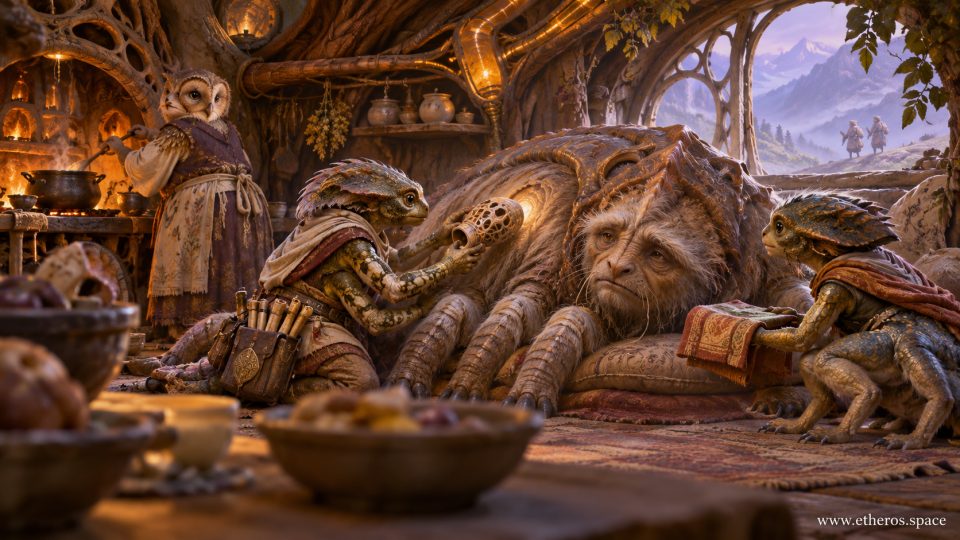
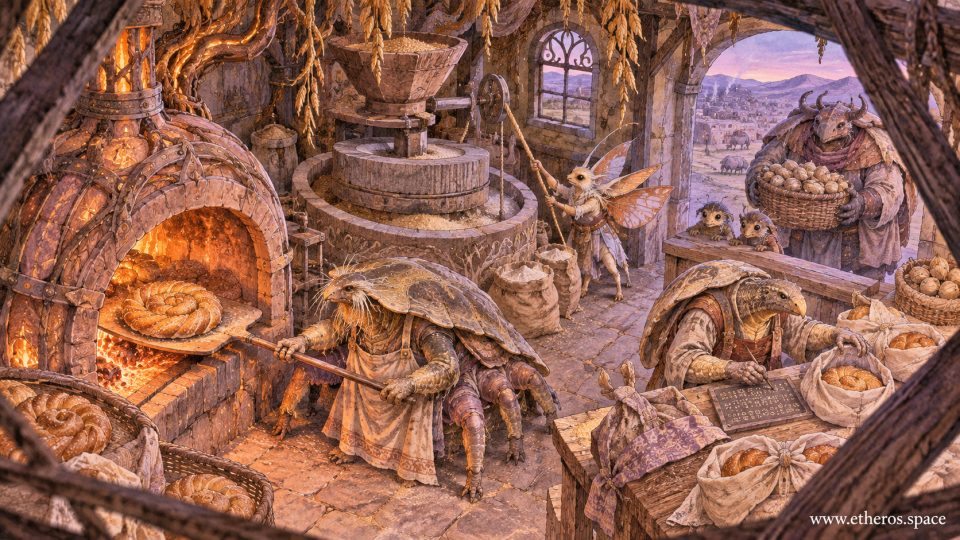
Through the rough timbers of the ovenhouse roof one could see the whole arrangement: the old round mill, its wooden bowl fed with pale grain; the arch of the fire, orange as a buried sunset; the flour sacks crowded under the wall; and, beyond the open doorway, a hillside town still colored violet by the retreating night. The kiln's living root-conduits held their heat inside an armored masonry shell. Nothing in the building floated. Every hinge, cord, claw and loaf had weight.
Dorven stood where he had stood for forty-three harvests, with his broad shell turned toward the furnace and two of his working hands firm around the long wooden peel. White bristles at his beaked muzzle shone in the firelight. The first spiral of bread was golden enough to resemble a little sun, yet he did not look pleased. He watched its bottom instead, measuring the time it would take to slide the hot slab back without catching the oven lip.
At the mill behind him, Kiri-Sen leaned backward against a cord. She was young, small and pale-furred, with thin amber-veined wings that were useful for balance but not for lifting a loaded stone. When she drew the cord, the ratcheted drum pulled the upper grinding wheel one careful increment. Then she relaxed her hands and reset her feet. The gears were heavy; no one pretended that a child ought to turn them alone. Dorven had made her promise to stop when her shoulders shook. She had promised, and was secretly counting the pulls anyway.
The grain price had fallen at the last hill fair. The price of bread had not.
Outside, callers had been arguing about this since the second star faded. The farmers said the larger harvest should leave something in the pockets of hungry households. The oven keepers replied that the roof still needed mending, fuel still needed gathering, and a baker who worked before sunrise could not be paid with congratulations. Both had reason. Neither could see the other's tally from the street.
Balek, a sharp-beaked clerk whose own shell bore the scratches of many journeys, sat beside cloth bags of finished bread. On a dark tablet he marked four little groups of strokes: grain, kiln, hands and reserve. He had been asked to post a single price. Instead he wrote how the price was made. If the new grain stayed cheaper through another turning, the figures would change. If the kiln-root cracked again, they would change as well. The ledger would remain where anyone could examine it.
A horned pack-carrier named Orris arrived in the doorway with a woven basket piled high with seed loaves. He had brought a load from the western slope and would take the cooled bread down toward the narrow houses. His journey was not a gift. Wheels were dear in the dry months; he traveled by foot. The town had once called such travel unskilled, until the day no one could keep food on a shelf without it.
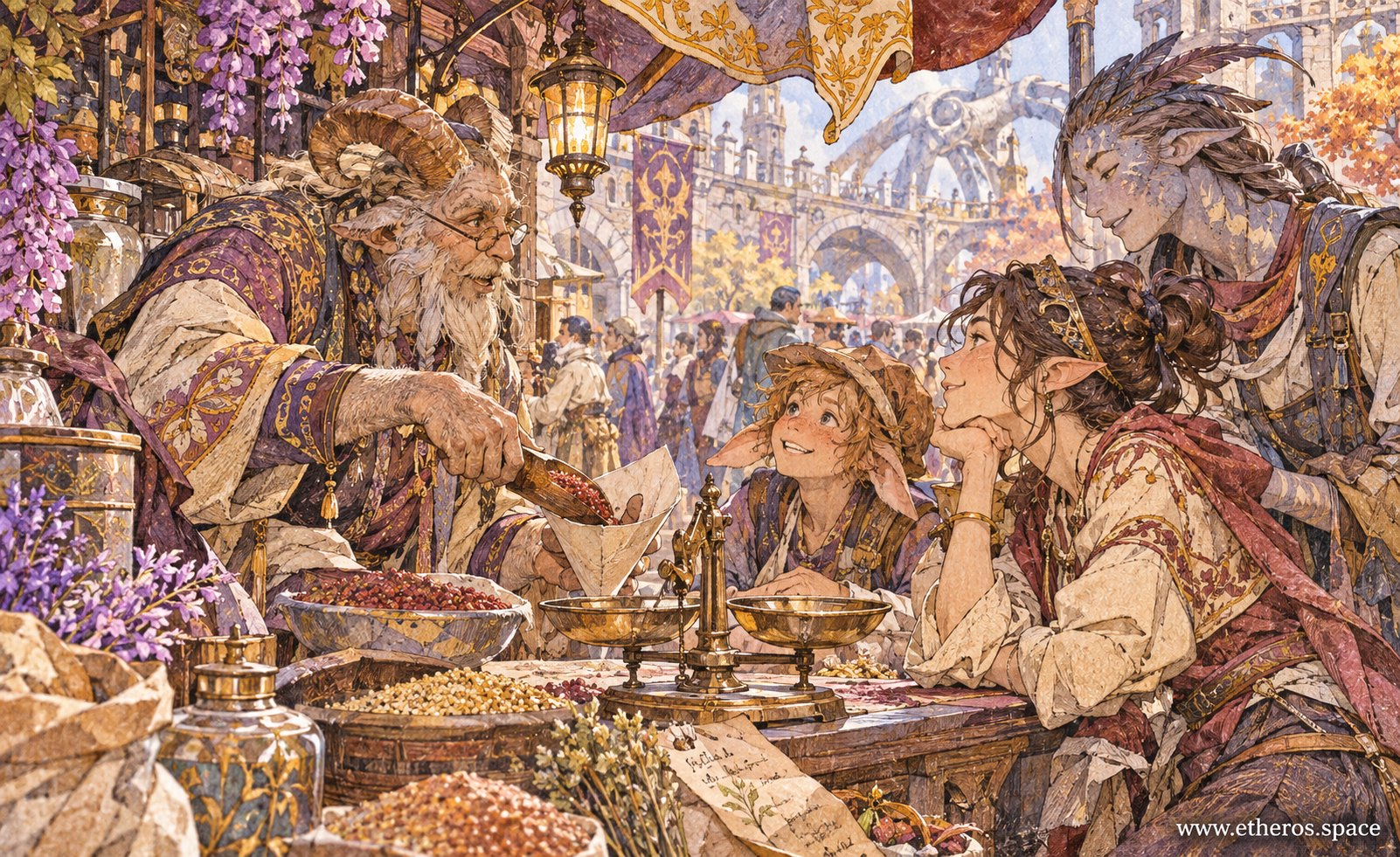
Two small faces rose above the low rail to watch the first spiral emerge. The elder was Miv, all watchful eyes and a crooked fringe; beside her, little Tenn had fallen silent for the first time since waking. They were not waiting for a miracle, only the smell that told them a day had begun. Their household had enough for one full loaf and perhaps another by the end of the week. Their mother had asked them to come early, before the best crusts vanished.
Dorven set the peel on its stone rest. He allowed the loaf to finish settling, then broke off one small end for Kiri-Sen to taste. She had pulled the mill all morning, and he wanted her to understand the result rather than only the strain. Her wings gave a single involuntary twitch. She said it needed a little more salt. Dorven considered this seriously.
Balek reached for his tablet again. There was still no easy arithmetic that would make the poor solvent and the workers rested. So they chose a smaller, durable thing. Clayrise would sell halves without charging a penalty for cutting them; the hearth would publish its costs; and the first share of each morning's bread would be reserved at the same weight for the households unable to reach the counter before the shift bell. The difference would be covered openly by a modest contribution from those who chose to pay it, never by subtracting a baker's wages in secret. Whether this would hold through winter remained uncertain.
Orris nodded once and shifted his basket against his heavy forearms. Miv was still looking into the oven. Tenn had begun to count the rings in the crust. Behind them the pale dry fields waited for their own work, and the hill town brightened a window at a time.
The first loaf did not solve the hunger of Clayrise. But on the day when grain became cheaper and life somehow did not, it gave the neighbors a reason to ask one another what everything truly cost—and whose hands had carried it.