The Shadow That Made Room
Story
THE SHADOW THAT MADE ROOM
A rehearsal at the Lantern Hollow, Senvar, primordial Etheros
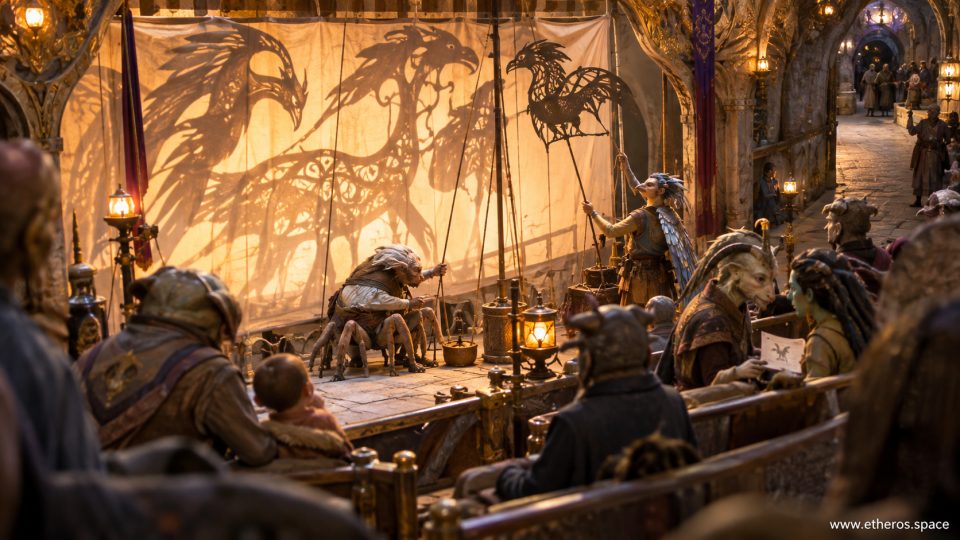
The great cloth had been patched so many times that nobody in Senvar remembered its first color. Tonight the lamplight made it honey-gold. Beyond it, unseen hands held a long-necked creature, a hook-beaked traveler, and an enormous feathered shape against the light. Their shadows covered the screen nearly to the carved stone arches. When a wing moved, the whole audience seemed to breathe with it.
This was the Lantern Hollow's first open rehearsal of the season, which meant there were nearly as many opinions as seats. Horned elders leaned over the rails; a parent at the front held a drowsy child against a woven wrap. At the side of the benches, Sorun showed Ila the small drawing printed on a folded program. They disagreed about the shape of the tallest creature. A stranger might have mistaken their quiet argument for hostility, but Sorun had bought Ila a place beside him, and neither intended to leave before the lamps burned low.
Behind the front line of light, Eshran sat with six short, armored limbs folded around a stool. The old puppeteer worked from a web of fixed rods and suspended cords, its small counterweights made from worn riverless quarry stone. His left hand drew the long neck upward. His right adjusted a bird's hooked beak. Nothing moved without a pull, a pivot, or a weight somewhere else giving way. He knew every knot because he had tied half of them after the hall roof was repaired.
Vess, the feather-crested performer at the right of the screen, lifted a jointed bird-mask on a pole. She had learned the old version from Eshran: the three sky creatures fought for a bell that was said to wake a sleeping hillside. The first seized it, the second stole it, and the third vanished with it. In Eshran's family the last creature was a thief. Vess had spent the previous winter performing in a dry eastern settlement where the same silhouette was remembered as the one who hid the bell from a greedy collector. Her new listeners were not mistaken. They simply inherited a different ending.
During a pause Vess asked the audience which creature had carried the bell home. Hands rose in several shapes. Some pointed with claws, some unfolded paired feelers, and a small child answered by making a circle with both arms. Eshran could not make sense of all the gestures from the stage. He was accustomed to spoken calls in the hollow tongue; several visitors could not form those sounds comfortably, and others had never learned the words. Sorun looked from his paper to Ila and realized the little program did not help either of them understand the gestures on the cloth.
'You are changing the story,' Eshran told Vess, not loudly enough to interrupt the waiting families. The old master was worried that he would leave behind a tale no one recognized. She answered that the cloth had always changed: new patches, new rods, different lamps. The people it sheltered had changed too. Yet she would not paint over the old ending or claim his ancestors wrong. She asked only for a second shadow sequence, in which the bell passed from one creature to another, so the audience could recognize the places where their accounts diverged.
At first Eshran refused. It was not stubbornness alone. A second sequence meant three more joints, an extra hand on the counterweight, and a longer rehearsal; the hall had already promised its lantern fuel to a neighborhood workshop. Vess offered to repair the pole fittings herself. Sorun, who made simple tally marks for local transporters, volunteered to draw two versions of the sequence without requiring everyone to read his handwriting. Ila said she could demonstrate the shapes to children from the upper terraces who learned through movement rather than words. None of them promised a solution they had not yet built.
Then a child in the front row stretched one arm toward the cloth. The tallest creature's shadow slipped awkwardly across the brightest patch as a cord caught under a stage peg. Eshran felt the snag through his fingers. He steadied the load, shifted the peg, and let Vess move the bird-mask slowly over the others. For a heartbeat the three shadows shared the same sweep of wing and neck. The audience answered with a low rustle: pleasure, recognition, and disagreement mixed together. No one had to settle the legend to enjoy that moment.
They tested the new movement only once. A joint chattered, and Eshran marked it for repair. The additional lantern would consume more resin than they could afford every night. The council would still have to decide whether the hall could offer free daytime rehearsals as well as paid evening performances, and whose languages and gestures deserved a place in its teaching boards. An old story might grow richer through sharing, but sharing still required skilled labor, a stable roof, safe steps, and someone willing to trim the wicks.
When the crowd began to leave, the youngest spectators kept their eyes on the suspended creatures. Sorun folded his program around Ila's sketch rather than throw it away. Eshran remained on the stool, weighing a new knot in his fingers. Vess lowered her pole before her arms grew tired. The screen was only cloth and shadows, and the hall only a room of stone and labor; yet for one evening it held more than one memory without breaking either. Tomorrow there would be another rehearsal, provided somebody found enough lamp resin. That question, at least, belonged to everyone.