The Map Without a Gate
Story
THE MAP WITHOUT A GATE
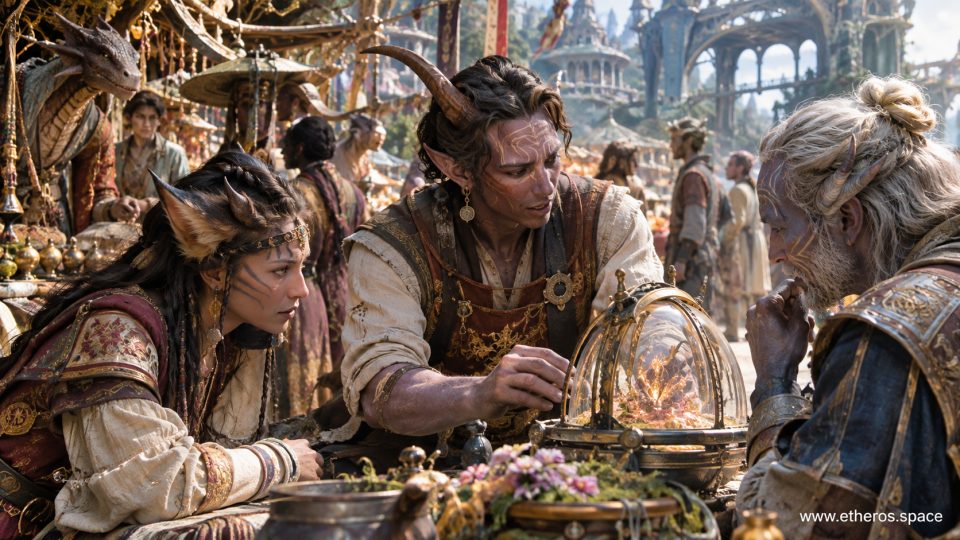
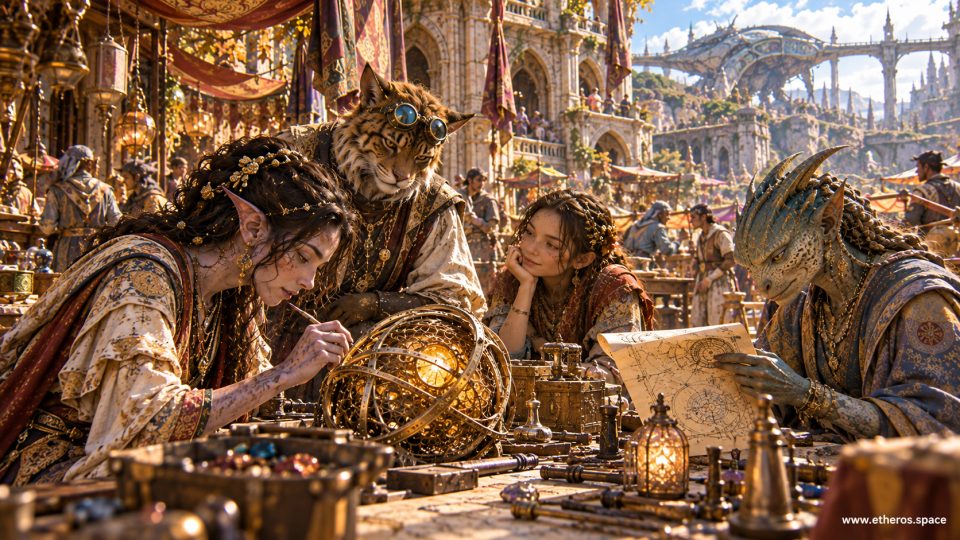
There was no quiet place in Veyra to test a public invention. The morning market shook with cartwheels, stall-keepers calling prices, the rasp of linen canopies, and footsteps passing beneath pale towers. Beyond the crowded arcades, the curved ribs of an immense articulated structure crossed the far skyline. Whatever work it served up there was too distant to make out. Here, at a bench half hidden behind brass lamps and open crates, four people were attempting something more modest: to agree on a way through the city.
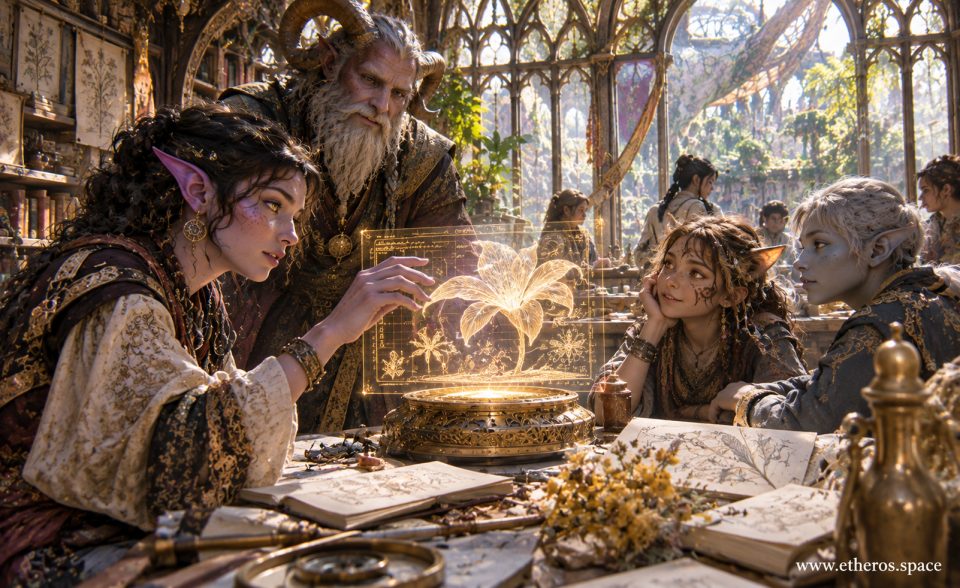
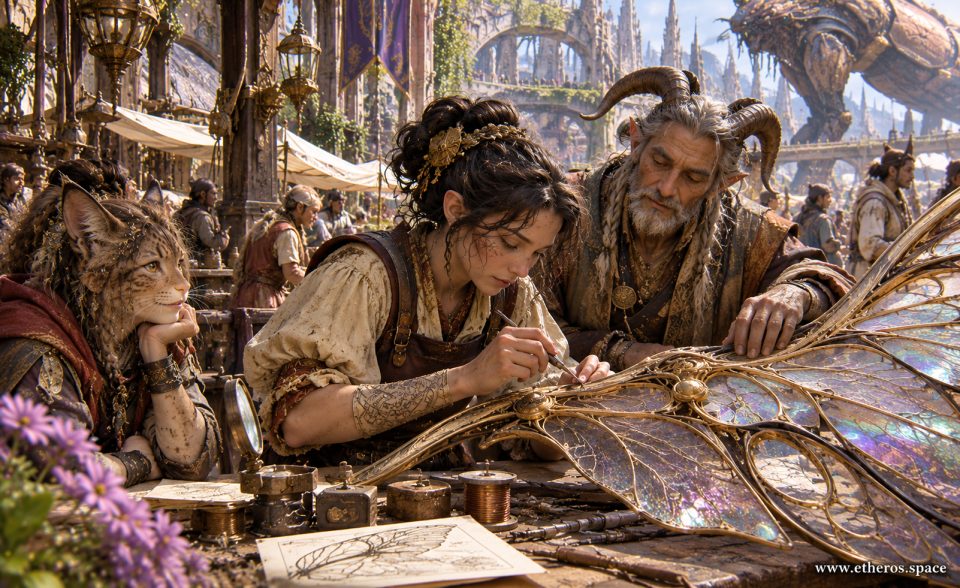
Serin worked with a narrow pointed tool, her dark hair bound by small gold ornaments. Between her fingers sat an intricate circle of bronze and glass, nested rings surrounding an amber light. A tiny touch altered one of the inner vanes. Opposite her, Thessa, whose blue-green scaled face bore ridges like folded leaves, followed an arc on a sheet of drafting parchment. Urric, a striped feline surveyor with viewing lenses pushed up on his brow, watched in silence. Dema had the patience to sit with her chin in her hand, but the restless fingers of her other hand were tapping out the steps of a street crossing.
It was called a way-ring. The old models belonged to caravan guilds. Turn a ring toward a tower, follow the little bright marks, and a courier could find the safest cart passage between the upper stone bridges. The guild considered the bearings proprietary. They were not wrong to fear a loss of income: generations of surveyors had made a living by reading the city, and a ring that answered anyone might undercut them.
But the route it described was not everyone's route. Urric traveled lightly on padded feet and could descend a steep side stair without thinking. Thessa's long tail required clearance behind each turn. Dema moved supply baskets with both hands occupied; she could not read a dial while carrying them. And the low side door beside the old eastern arch was too narrow for the broad-bodied families who brought grain to market. A map made for one body and sold as a map for all was a quiet form of error.
Serin had proposed opening the device to the district. Her first prototype glowed beautifully and was nearly useless. It blinked whenever a sightline to the high bridge was clear, even if that bridge ended in stairs. On an earlier trial, Dema had led a basket train halfway across the square before discovering that the 'open' route had no room for two people to pass. Nobody was hurt. It was the kind of small failure that could be forgiven once, and repeated until somebody finally was hurt.
This morning Thessa had brought revised drawings, annotated with the turning spaces that merchants actually used. Urric had spent three unpaid evenings walking every proposed path without his surveyor's shortcuts. Dema had persuaded five stall families to tell her which turns exhausted them, which passages frightened their children, and where a delivery slowed enough to leave both hands free. Serin put those observations into the gearing. The light was to be only one signal. A shallow ridge would rise under the finger for a step-free route; another notch would mark room to turn; an audible click would announce an obstruction. None of the signs would depend on a single species' hearing, eyesight, or stride.
Then the little amber center shone steadily when it should have pulsed.
Urric lowered his goggles. Thessa compared the parchment to the brass. Dema stopped tapping. Serin had not made a careless mistake: she had copied a guild bearing that described the arch as it existed thirty years earlier. Since then a stone balcony had been added, leaving a dangerous blind bend. The drawing was accurate to the old city and false to the living one.
'If we erase that number,' Urric said, 'the guild will say their archive has been altered.'
'If we leave it,' replied Thessa, 'someone will trust it.'
For a while neither spoke. A market bell rang nearby, drowned by voices. Serin turned the ring so the disputed vane could be lifted clear. Instead of scraping out the old reading, she set a second marker beside it, dated in the city's local reckoning, identifying the new obstruction and the witnesses who had measured it. History was preserved; its authority was no longer absolute. Dema tested the ridges without looking at the glowing center. For the first time, her fingers could distinguish the safe turn.
They did not declare the ring finished. Urric insisted that the guild surveyors be paid to check the public bearings. Thessa required a place for corrections from anyone who used the roads. Dema asked that the first copy stay at the shared market desk, not in a merchant's locked cabinet. Serin asked who would repair it once the novelty had faded. Their answers were incomplete, and so was the instrument.
By noon people would still pass the bench without knowing what had changed. They would see only a woman bending over bright brass, a striped engineer watching the work, a thoughtful young neighbor, and a scaled reader holding a sheet of lines. Above them, the immense distant structure would continue its slow labor beyond the rooftops. On the table, however, there was a new and stubborn idea: a route was not made public merely by drawing it. It became public when those who had to travel it were allowed to say where it truly went.