The Door That Did Not Choose
20261105T082731710114Z_091percent.png
Story
THE DOOR THAT DID NOT CHOOSE
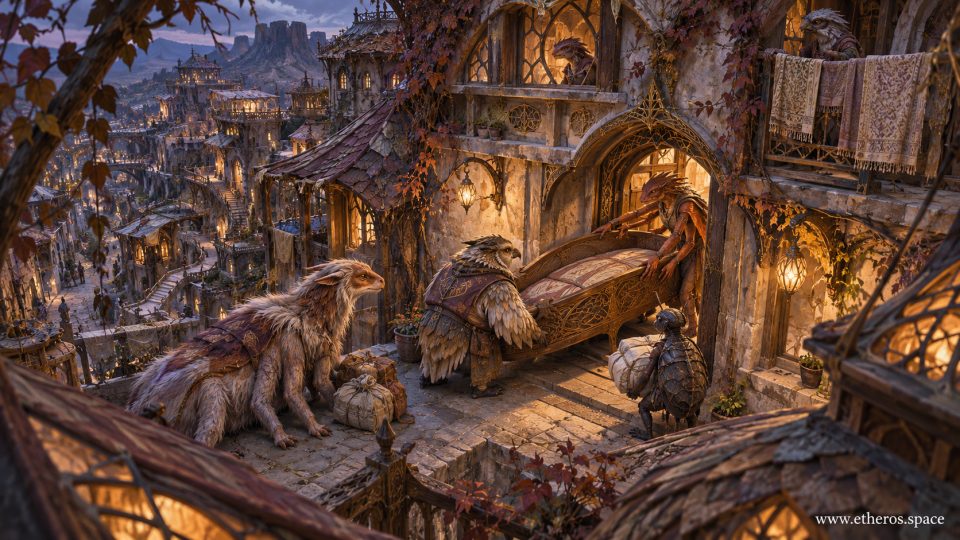
In Ilinth the most celebrated buildings were those that made arriving look effortless. Thin stone bridges leapt between the upper terraces, flowering roofs hung over streets like small forests, and old gold-framed windows curved around the cliff as though the mountain had once grown them. Every apprentice architect knew how to draw an entrance grand enough to astonish a visitor. Very few had ever been asked to draw an entrance that would welcome every visitor.
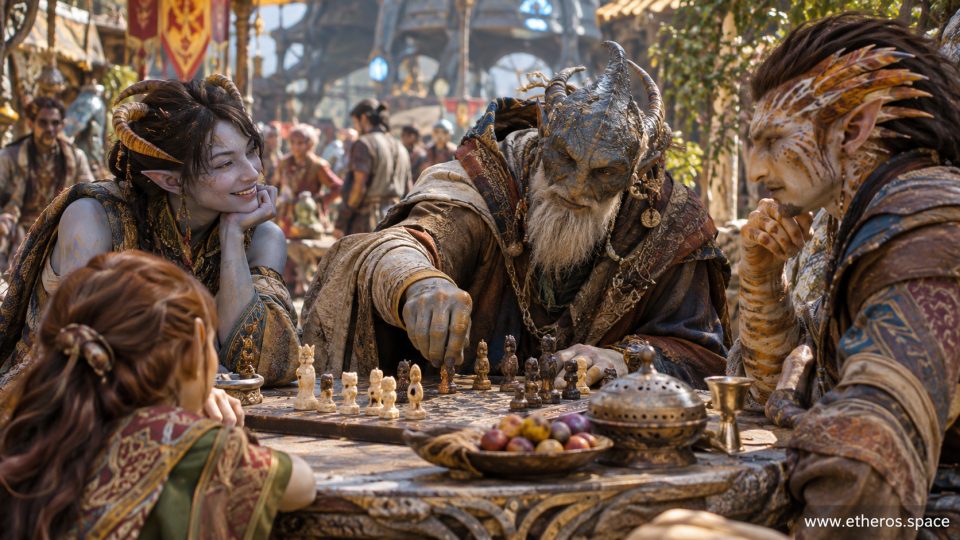
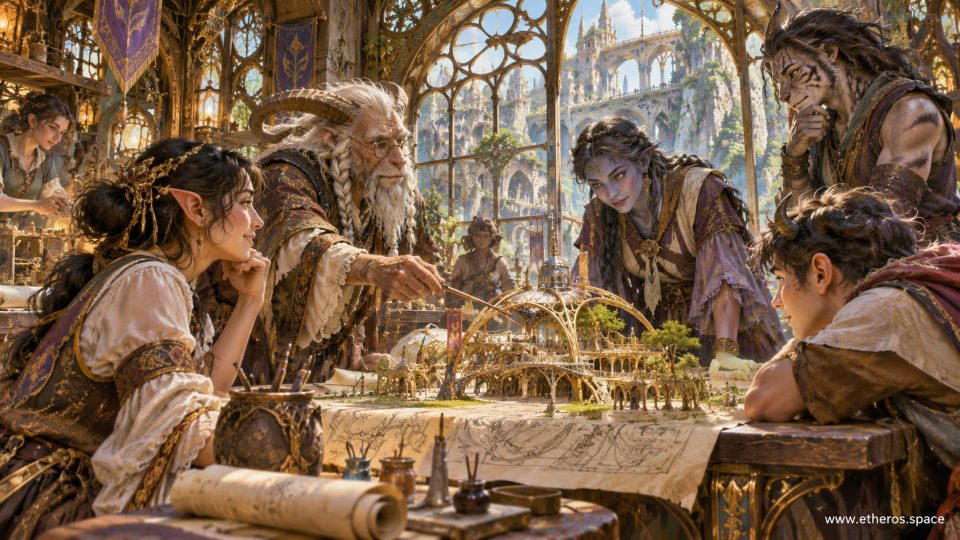
At the studio above the east stair, the afternoon light entered through a window whose intersecting ribs cast pale patterns across a crowded worktable. At its center stood an elaborate miniature: delicate arched galleries, a domed hall, planted courts, open passages and tiny trees rooted in removable beds. A dark-haired young designer named Miri rested her chin on one hand. Beyond the model, the horned elder Karek studied a passage with a long pointer. Across from them, lavender-skinned Sael leaned forward to see the interior, while tall striped Othal watched from beside the window. On the right, the youngest participant, Noll, sat over the drawings with an expression halfway between worry and wonder.
It was supposed to be the new public learning house. The first design had won approval almost immediately: elegant, economical in stone, and able to serve four hundred students at the principal level. Karek had built temples and civic halls for seven decades. He was proud of the graceful central staircase, which rose from the street to the library's circular entrance like a ribbon woven out of light.
Noll had asked only one question when the plans were unveiled.
'Where do the rest of us come in?'
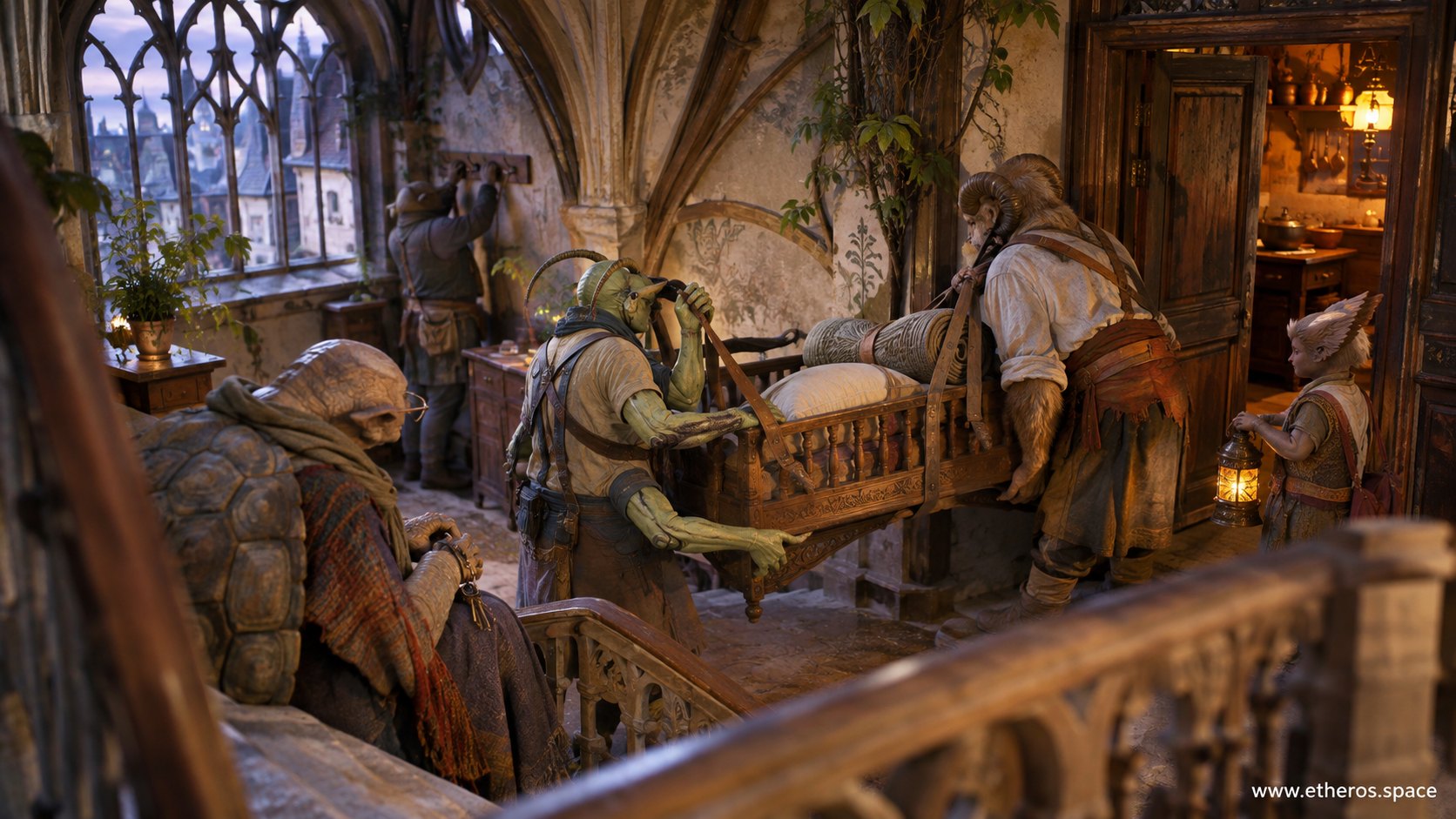
The planners had thought the question was about the side gates. In fact, it was about bodies. Some of the children of Ilinth had broad protective shells and needed wide turning spaces. Others moved on six short limbs, or balanced themselves with heavy tails, or relied on a companion when their sight failed in the bright upper streets. The roof passages suited the nimble cliff-climbing lineages beautifully. They punished everybody else.
The first committee proposed separate teaching hours for the difficult-to-accommodate students. It was not a proposal born entirely of cruelty: the stone budget was finite, the old retaining walls already carried substantial loads, and a single new access bridge could take years of labor. But Noll had heard the adults discussing who was 'difficult' long enough to recognize the word's true meaning. Someone had drawn a place for learning and then decided which learners fitted the drawing.
Now the designers were gathered to change it. Sael indicated a lower arcade that could curve around the central garden at a gentle, continuous gradient. Othal wanted resting places at intervals; his daughter could climb, but her breathing slowed in the high dry air. Miri proposed moving one of the small planters inward, creating a clear approach without sacrificing the shade grown for the classrooms. Karek measured the additional span with his pointer and frowned.
'The load has to go somewhere,' he said.
'It already does,' Miri replied. 'It is simply being carried by the students who cannot use the stairs.'
They did not pretend that compassion made stone weightless. The new gallery would need a deeper buttress, a longer load path into the cliff, less ornamental stone at the upper parapet, and an inspection walkway for the living root-braces that held the planting beds. Sael calculated how a series of shorter arches could pass the force into existing foundations. Othal suggested keeping the older stairs for those who preferred them. Not every difference required one universal solution.
On the table lay a packet from the botanical teachers of distant Solenvale, whose public naming register had begun gathering observations from people previously excluded from the official guild. Sereth Vaal had sent notes on hardy shade plants with root systems unlikely to pry apart the new joints. That small correspondence was enough to remind Miri that making room did not always mean making everything the same.
Karek studied the miniature again. The descending galleries now formed a loose wreath around the central court. Through their openings the tiny trees remained visible. Visitors could approach from more than one level, meet beneath the dome, or enter through the garden without first passing an elevated ceremonial threshold. The building had lost some of its commanding silhouette. It had gained a conversation between its parts.
'Will the council call it less magnificent?' the elder asked.
'Probably,' Sael answered.
Noll looked at the little routes between the painted trees. 'Then they should be invited to walk them.'
The group laughed, not because the suggestion was childish, but because none of the experienced architects had made it. Before the next meeting, they agreed to construct temporary pathways at full scale. Students and caretakers of different bodies would test the turns, steps, resting places and door heights, and the builders would change what did not work. The children would not be asked to adapt themselves to an untouchable drawing.
As the light shifted, Miri added a small mark beside the dome: not a monument or a flourish, but the first shared arrival court, where a late learner might meet an early one and neither would need to explain why they were there. Karek put down his pointer. Outside, bridge traffic crossed the sunlit cliff without noticing the modest revolution inside the studio.
Noll reached for the drawing. This time, when they traced a route from the street to the classroom, the line did not stop at the stairs.
In the years to come, the people of Ilinth would disagree about the cost of that change. They would debate repairs, teaching priorities, and who had given up what to build the new passages. But the building's oldest lesson had already been learned in the workshop: an entrance is not truly open merely because the door has no lock. It is open when the people on the other side can reach it.