The Oven's Second Bell
20261104T223520700897Z_032percent.png
Story
THE OVEN'S SECOND BELL
In the volcanic uplands of Cinderglass Ridge, there was a bakery whose ovens had not required a flame for three hundred seasons. Its neighbors called this a convenience; its oldest keeper preferred the word obligation. Heat rose through ceramic-lined seams in the living basalt, passed a stone chamber beneath the floor, and entered the bread vault only after a weighted valve had tempered it. No one drew more warmth than the conduits could safely carry.
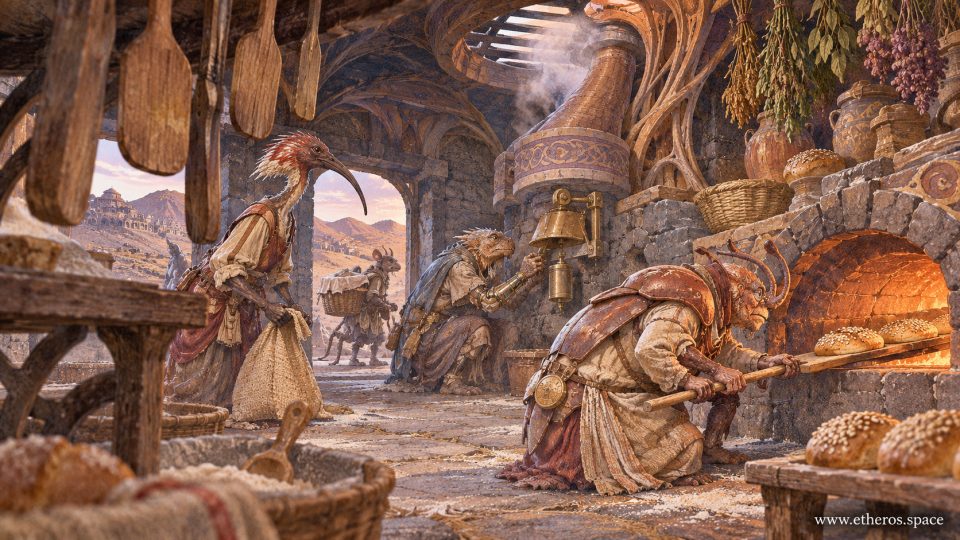
Before sunrise, Nesh was kneeling at the oven mouth with a long wooden peel. He had a plated, copper-colored carapace and hornlike feelers that never quite cleared the low vault. The loaves rested in an orderly row on the peel, seeded and almost ready. He used both hands to keep its weight level so the bread would not slide into the glowing chamber.
Kerren, a long-billed, rust-crested apprentice, stood beside the worktable with a rough sack of meal. Beyond the left arch, hills lay dry and pale. A delivery worker carrying a covered basket was passing outside, between the village's old stone buildings. Hanging wooden paddles cut across the near view; dried herbs rested above the masonry, well away from the oven's hot air.
Olen was the third person in the room: an elderly scaled heatkeeper with a weathered mechanical forearm, seated beside the high bronze flue. He had his hand on the small lever beneath its bell. The mechanism was not decoration. It moved when the internal weight rose against a change in duct pressure, and it gave the village its first warning that the deep passage had begun to behave differently.
The bell had sounded twice that morning. Usually it sounded once.
Nesh eased the peel back, looking for a blackened crust. None had formed. Kerren suggested the bell might have aged out of true. Olen examined the rod, its bearing, the counterweight and the narrow channel of escaping vapor. The rod remained straight. The rising plume above it was faint but steady. It might have meant a passing pulse in the underground seam, or a blockage beyond their sight. The heatkeeper could not yet tell.
Old instructions prescribed closing the bakery after a second ringing. Forty households, however, depended on its morning loaves, and grain deliveries had been uneven for several days. Closing would protect the masonry but leave the youngest and oldest neighbors hungry. Keeping the oven at full temperature might make a familiar concern into an unfamiliar danger.
Kerren lowered the flour sack. 'Does all the heat have to travel through this room?' the apprentice asked.
Olen remembered a second, almost forgotten passage: a ceramic branch beneath an empty storage chamber that returned toward the ridge. Its masonry was sound on the last inspection, but nobody had tested it under this morning's conditions. If its counterweight moved too quickly, the bakery might lose all its warmth. If it did not move enough, pressure might continue rising.
Nesh removed the heavy loaves. Kerren prepared smaller trays that could bake more slowly and set down the sack so the flour would remain clear of moving fittings. Olen took the bell lever between his old hand and his brass-supported one and opened the alternate branch one increment. They waited for the chimney to answer. Its vapor thinned. The bell trembled, then settled. They adjusted the valve once more, no farther.
Some of the bread rose unevenly. Two trays needed another quarter-hour. But the stone vault remained steady, and no new warning sounded. They marked the unfamiliar position with a strip of violet thread and noted the counterweight's displacement in the shop's record. Nobody spoke of taming the ridge. A living world's warmth could be shared; it could not be presumed obedient.
When the first customers arrived, the three explained why the loaves were smaller and why the afternoon batch could not yet be promised. One resident complained that the bread had been underpriced for years. Another asked whether the upper terraces would lose heat next. Both questions deserved an answer, and neither could be settled by the scent of fresh crust. Olen asked for neighboring heatkeepers to examine the underground return before further use; Nesh reserved a loaf for the late delivery worker.
At the bottom of the basket, Kerren discovered a little note from a family whose elder could no longer climb the ridge. They had asked not for a special loaf but for one that would be easy to cut. Nesh used a smaller mold, pressed the dough just enough to split gently, and sent it with the next cart. Nothing about the gesture solved the questions inside the mountain. That was why it mattered.
The morning sunlight moved across the arch. The second bell did not sound again, but Olen refused to pronounce the problem finished. Beneath their feet the deeper chambers might have altered for a season or for a century; observation would have to precede certainty. They would inspect the return, limit demand, share their measurements and revise the rule only after a safe test.
Long after the customers had gone, the baker touched the warm stone with the back of his hand. The village had received another day's bread. For the moment, that was enough. On Etheros, care rarely arrived as a revelation. More often it was a patient adjustment made while others still needed breakfast.