The Stone That Would Not Answer
20261105T210152088269Z_100percent.png
Story
The Stone That Would Not Answer
The excavation above Kareth had begun with an ordinary problem: the west footpath was slipping toward the ravine. Every dry season, workers brought stone and timber to the escarpment and strengthened the route used by farmers, schoolchildren and the small caravans carrying clay from the plateau. This year, beneath a loosened retaining wall, the repair crew uncovered a broad sheet of carved rock.
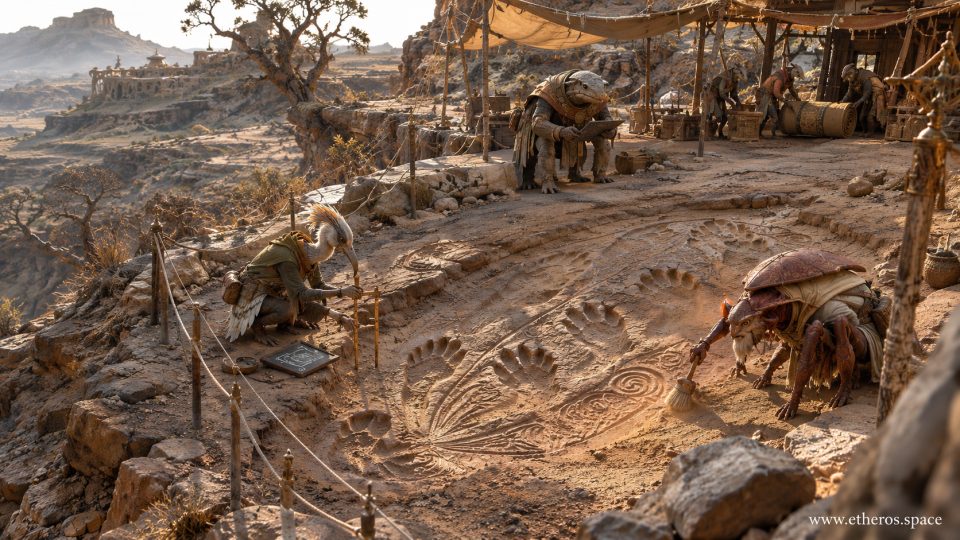
By evening, a canvas awning had been tied to posts, rope marked the unsafe edges, and three specialists had arrived with their tools. From the distant village the site looked like any other road repair. Up close, the earth was crowded with impressions.
Semmet, a low-slung conservator with a coppery shell and slender brush-holding forelimbs, worked at the lower edge of the exposed stone. Under the loose dust lay a spiral, then several deep, fan-shaped tracks, then a narrow crossing line that seemed to cut beneath them. He brushed in short strokes, moving the grit into a shallow wooden bowl rather than letting it fall back into the grooves.
On the opposite side, the feather-crested surveyor Vekri measured the distance between two stakes. Her beak nearly touched the cord as she checked its alignment against the marks in her slate. Above them, Rovar, the older broad-backed supervisor, studied a tablet in the shade. Behind Rovar, other workers rolled a padded cylinder used to protect fragile casts on the climb down.
The first rumor reached Kareth before the second rope was fixed. Someone said the tracks belonged to the Seven Walkers, legendary founders who had supposedly crossed the ridge together long before the present city was built. By supper another person insisted the spiral was a map of an ancient passage beneath the cliffs. A third claimed the site had been fabricated by a mason hoping to attract pilgrims.
Vekri had grown up hearing the story of the Seven Walkers, too. She wanted very much for it to be true. Yet the stone showed at least three different kinds of mark, and none of them named its maker.
'How old?' Rovar asked.
'Older than the retaining wall,' Vekri answered. 'That is all I can prove today.'
Semmet found a shallow place where one broad impression overlapped a carved curve. He paused before sweeping it. The apparent crossing might mean that one was made after the other; it might also mean that wind and hard grit had removed a fragile ridge from between them. He set his brush aside and marked the spot with a small clay bead so it could be photographed in the morning light.
The council had promised to reopen the west path in four days. Its closure already cost the hillside growers an extra climb over the northern steps. One household had stopped sending its old grandmother to the communal kitchen because the detour was too steep for her. The commissioner of roadworks had sent instructions to save what could be saved and clear the foundations for new supports.
Rovar read the message twice. He had spent enough years protecting old things to know that preservation could become a way of ignoring living people. A beautiful relic could not carry a basket up an unsafe hill. But he had also seen too many inscriptions broken into paving stones because someone had declared, without looking closely, that they were merely decoration.
At sunset a messenger from the village arrived with a second instruction. The family that kept the ridge shrine objected to lifting the slab. They did not claim to know who had made it. They asked why the village should remove a piece of ground to which so many stories had attached themselves.
The debate continued beneath the awning. Some workers favored taking a cast and building over the rock. Others worried that the cast would capture the visible pattern while destroying the wear, depth and sequence that might one day explain it. A temporary timber detour was possible, but it would take labor from the winter roof repairs. The expenses were real, whichever choice was made.
Semmet returned to the spiral with his brush. He noticed one tiny depression that resembled the point of a narrow claw. For a moment he imagined a child making a mark beside the prints of larger creatures. He did not announce the thought. Imagination was useful for asking questions; it was a poor substitute for evidence.
At last Rovar proposed three mornings of careful measurement, a braced pedestrian passage on the stable inland side, and a public accounting of the timber and working hours diverted to the excavation. Vekri would show the village the unfinished drawings and record different interpretations without presenting any of them as certainty. The shrine family could visit under supervision; the road crew would have a clear date to decide whether the slab could remain where it was.
No one called this a solution. It was an agreement to preserve the possibility of one.
When the lamps were lit in Kareth, the surveyors finished anchoring the ropes. Across the ravine the inhabited arches turned amber. The three specialists sat among their bowls, tablets and measuring cords while the wind moved gently through the canvas. In the dust below them, great footprints and small ones seemed to converge upon the same worn curve.
Vekri looked at the stone, then at the far footpath where the evening travelers were making their long detour. She could not yet say what the ancient marks meant. She knew only that the next mark this place received should be made with care.