The Light That Stayed for the Last Customer — A Day at Sable Arch
ETHEROS_066_20261103T212314704924Z_066percent.png
Story
The Light That Stayed for the Last Customer — A Day at Sable Arch
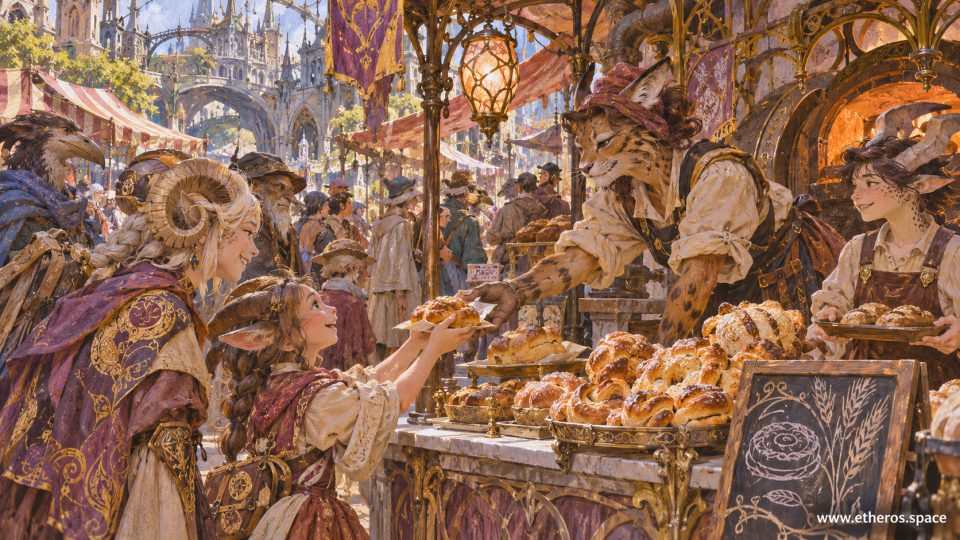
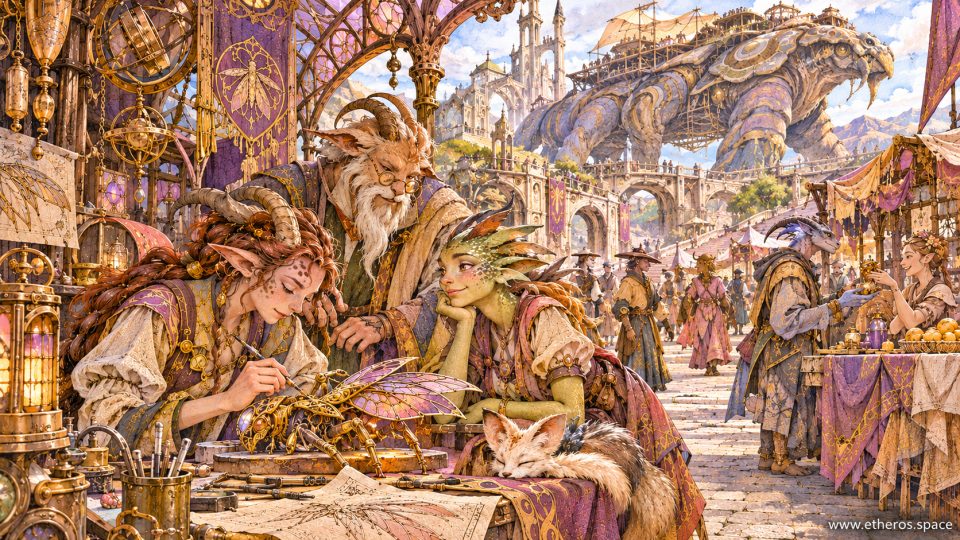
The afternoon trade had begun to thin in Sable Arch, although no one would have guessed it from the noise. A line of porters still climbed the stone steps beyond the gilders’ tables, cloth merchants called prices beneath burgundy awnings, and an airship moved slowly between the distant towers. The narrow passages of this district were older than most of its residents. Every bannister, window frame, and carved arch carried evidence of repairs made by people who had long since moved away.
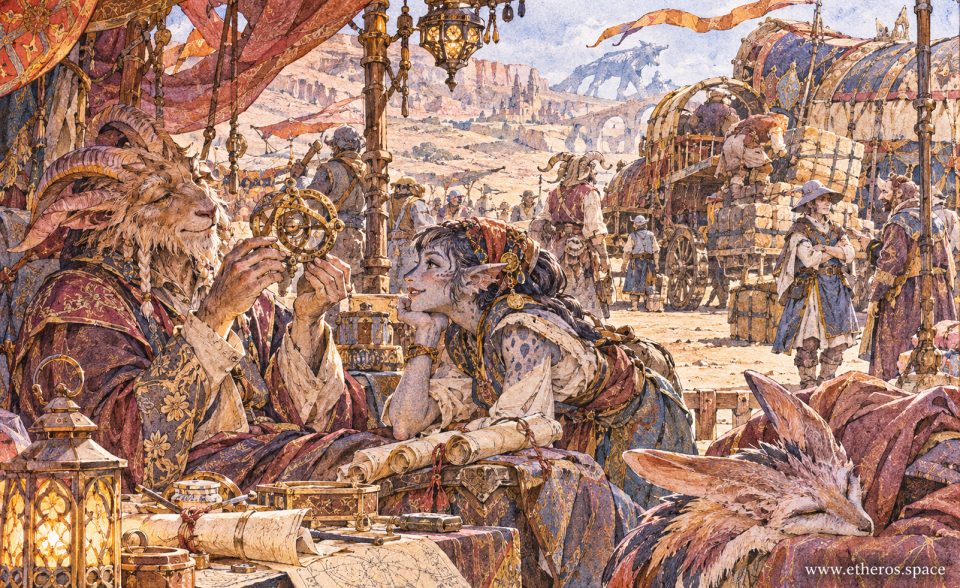
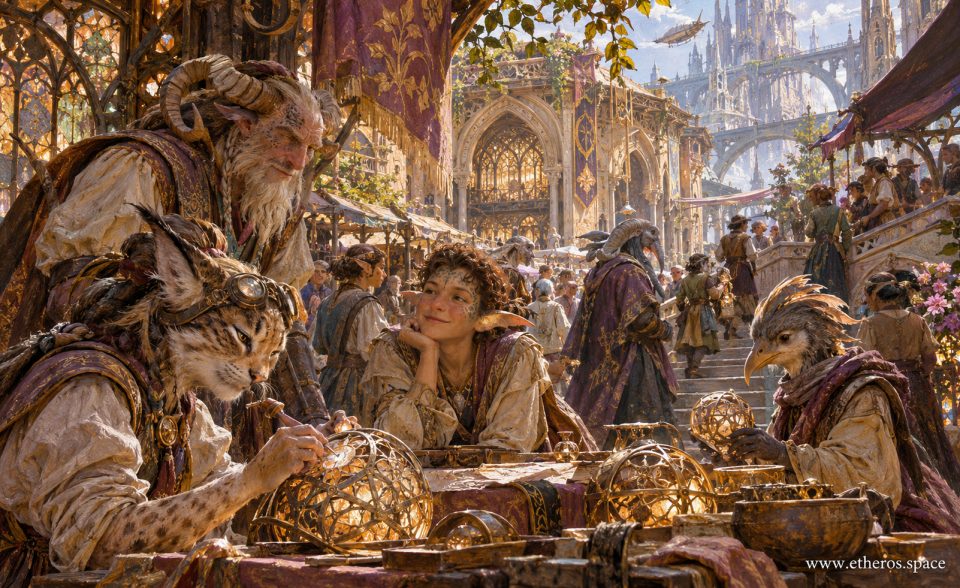
At the last table before the central stair, Harel Aven bent over an unfinished lantern. Harel was a spotted, tuft-eared artisan, broad-pawed and short of patience whenever the delicate joining pins refused to sit flush. The ornament was unusually fine: dozens of small brass ribs curved around a pale inner globe, leaving just enough space for air to reach the living luminant sealed inside. A lamp like that was not a furnace. It lived on a measured exchange of oxygen and nutrient gel, and the outer cage both protected its membrane and directed its light onto the stones below.
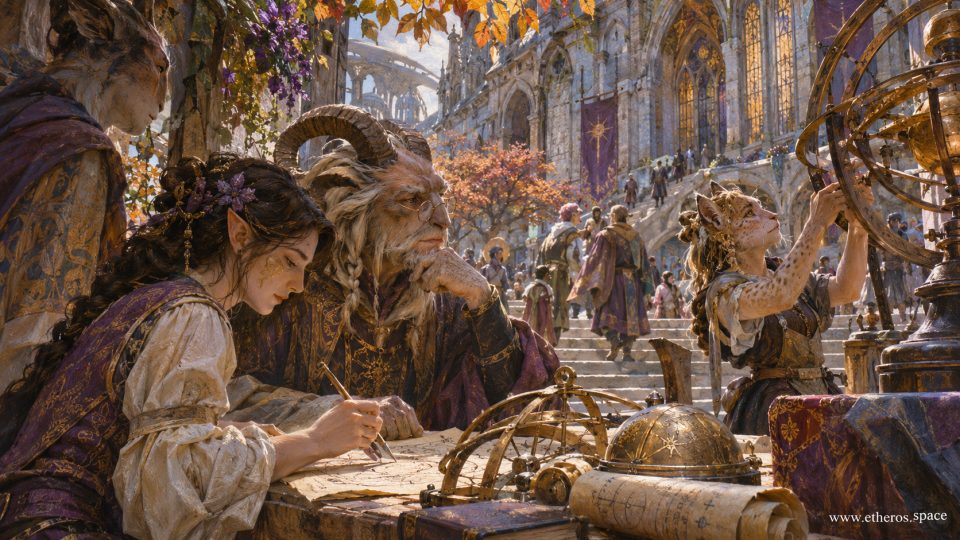
Master Bevrin stood close behind him, his long white beard nearly touching Harel’s shoulder. The old horned craftsman had taught him to make the ribs light enough to spring under a careless touch without bending permanently. That was the trick: an ornate device meant for an ordinary street still had to survive rain, carts, elbows, falling crates, and the occasional frightened animal. Bevrin watched the tool in Harel’s paw rather than Harel’s face.
“Another quarter turn,” he said.
“I know.”
“Then why are you stopping?”
“Because the membrane is breathing too fast.”
Across the narrow table, a curly-haired young neighbor named Oren rested his chin on one hand. He had been sent to collect the repaired lantern on behalf of the residents of Third Stair. He was old enough to understand that the neighborhood could not afford an entirely new fixture and young enough to believe that waiting beside a maker might persuade the work to go faster. He watched Harel’s wrist turn in the afternoon light. The little globe brightened, then settled to a quieter gold.
The bird-headed courier, Sel, had already brought a second lantern in a cloth-lined tray. Sel held it carefully, its open metal ribs catching the sun, while looking from the globe to the thinning crowd behind them. She had three other deliveries before the evening bell. But this one mattered more than the others, and everyone at the table knew why.
Third Stair was steep. Its upper landing turned sharply behind a blind stone pier, and the oldest residents disliked descending it even in broad daylight. Two nights earlier, its lamp had gone dark. A cart driver had struck the mounting bracket, bending one of the gas-exchange shutters and starving the luminant of air. Nobody had been badly hurt, but a woman named Sereth had sat at the landing for an hour because she no longer trusted the last eight steps.
Oren had seen her waiting. She had once carried him up those same steps when he was a child, and he was ashamed that he had passed her before noticing. He had promised her there would be light by the next evening. He had not asked what such a promise might cost.
Harel tested the shutter again, lifting the lantern so a line of gold slipped through the filigree onto the workbench. The light should have been enough. Bevrin disagreed. The old maker took a shallow breath and pointed to the underside of the cage.
“See that narrow shadow?”
Harel changed the angle. A sliver of darkness crossed the bench.
“A rib is still out of true,” Bevrin said. “She’ll see that line on a stair tread and think it’s a crack.”
The apprentice did not answer immediately. It was easy to measure a lantern by how brightly it shone; harder to remember that people judged the ground by what the light allowed them to see. Harel loosened the upper pin, straightened the rib against a small brass gauge, and tightened it again. This time the shadow broke into a soft continuous wash.
Around them the market continued, indifferent in the way a healthy city often appears indifferent. Porters carried bundles toward the elevated bridge, schoolchildren slipped between shoppers, and Sel shifted the weight of the second lantern to her other hand. No planetary behemoth filled the street or towered over the work. Its machinery was made of other scales today: valves the width of a fingernail, a membrane thinner than parchment, and the careful attention of people who would never be thanked by name.
Oren leaned forward. “Can it go back now?”
“Not quite,” Harel said, surprising himself with his gentleness. “We need to know what happens when the wind comes through the arch.”
Bevrin smiled faintly. Sel angled the lantern toward the draft that crept up the open stairway. Inside the cage the living globe pulsed once, drew breath through its restored shutter, and kept shining.
Oren’s shoulders lowered. Sel wrapped the base in cloth, lifted it into the tray, and prepared to leave. The staircase would be lit before nightfall, and Sereth could return home without counting the steps by touch.
Harel turned back to the next bent bracket on his table. For the first time that afternoon, he understood why Bevrin had never called their work ornamental, no matter how much gold they used. A lantern was a promise made out of matter, and promises required maintenance.
Below the great carved arches, among a hundred unrelated errands, the little shop stayed open a while longer.