The Arch That Left a Way Through
20261106T020125472994Z_100percent.png
Story
THE ARCH THAT LEFT A WAY THROUGH
On the dry lower terraces of Merath, the city was being repaired while its inhabitants were still using it.
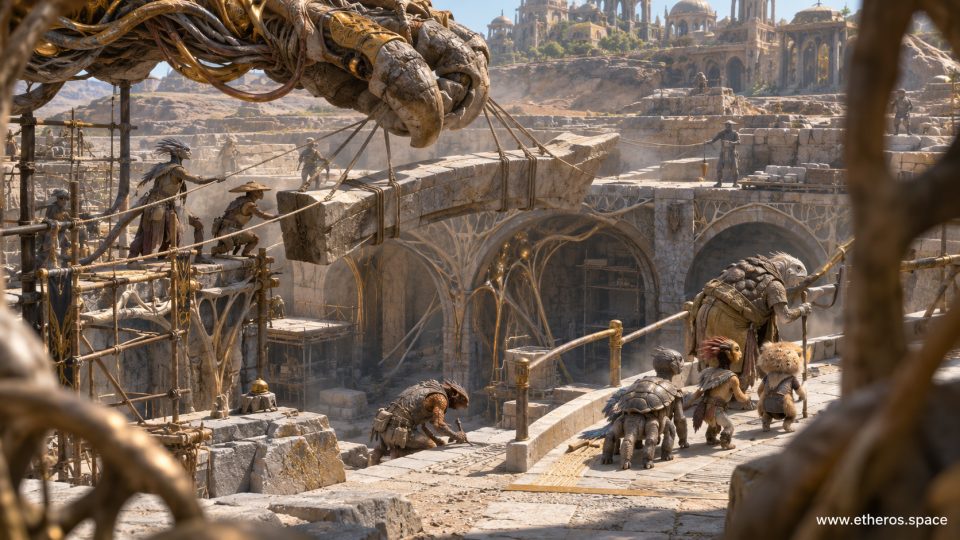
A long broken crown-stone hung above the old freight passage, cradled in woven lifting straps. The moving claw that bore its weight entered from somewhere beyond the picture of the street: a plated, root-cabled limb belonging to one of the planet-born builders whose bodies were too large to fit between Merath's inner walls. Its curved gripping surfaces held the rigging steady rather than touching the brittle stone. The actual pressure passed through four broad slings, into the dense hooked tendons above, and from there through a living structure braced against the plateau. Workers on the left-hand scaffold kept the stone from twisting as the claw moved.
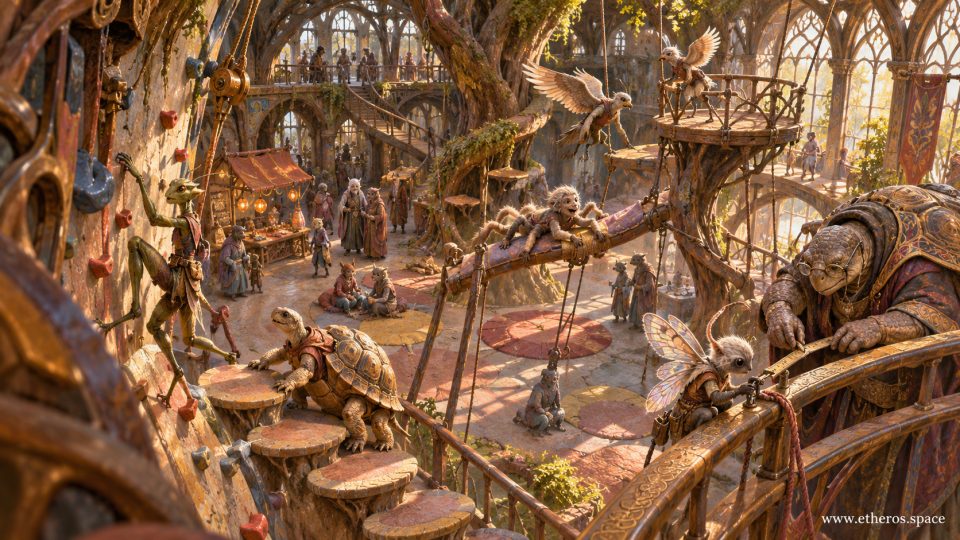
The new crescent was not yet a bridge. It could not carry the weight of a loaded cart or even an impatient pedestrian. Below it, where the ancient arch met a second tier of rooms, temporary wooden planks showed the only safe places to stand. A rope-worker with a dark feathered crest stretched one hand along a taut guiding line; farther along, a smaller colleague crouched to feed it over the railing. Neither could see both ends of the stone at once.
Their foreman, Kelren, had been asked to finish the replacement before the next freight bell. The merchants had pressed hard for that deadline. A closed arch made grain, ceramic medicines and winter cloth travel twice around the upper ridge, and the southern ward could not afford delays indefinitely. He knew their complaint was real. He also knew that the new stone had begun to rotate slightly when the behemoth lifted it clear of the staging blocks.
"Hold the left line," he called to the crest-bearer, Jessa. "Not tighter. Just hold it where it is."
The enormous claw stopped. Dust hung between the ropes. The stone's pale upper edge hovered an arm's length above the new seat, close enough to suggest that the hardest work had already ended. This was the dangerous part: when completion looked visible long before it had been proved.
Beneath the suspended arch, a different passage remained open. It had been laid along an older parapet, with a low stone rail and a band of textured markings beside the feet. It was narrow, dusty, and hardly worthy of the city's celebrated architecture. Yet it allowed neighbors to continue crossing while the freight opening was rebuilt. At its bend, Perren, a shell-backed grandmother with a patched cloak, helped two children past a low joint in the paving. One child had a crest of red feathers and moved too quickly; the other, smaller and soft-furred, hesitated at every unfamiliar sound. A compact shelled pack-creature followed without needing to be pulled.
Perren glanced up at the great lifted stone. What frightened her was not its size. She had lived long enough to trust the careful builders that Etheros raised from its own body. Her worry was the narrowness of the detour. The children's school had moved to the lower ward for the season, but the repaired walkway still expected everyone to step easily, see each mark, hear each shouted warning, and keep pace with faster neighbors.
At the midpoint, the red-crested child, Tavi, stopped to read the texture beneath their feet. Its raised stripes ended at the place where a mason had substituted smooth, uncut stone. Beyond that was another narrow gap at the railing. Tavi reached back for the smaller child without being told.
"Is this the new way?" Tavi asked.
"Only the way for now," Perren answered. Then she watched the younger child test the unmarked step and wondered why temporary paths were permitted to treat some bodies as temporary citizens.
A worker crouched on the landing below the rail, carving grooves into a stone slab. His name was Varro, and he had been assigned to repair the old drainage edge after the heavy blocks were secured. He saw Tavi counting the grooves and lowered his chisel. Before this day, he had imagined the children as an inconvenience to his work. Now he could see that their slow progress was one of the few reliable measurements of the detour's shortcomings.
Varro picked up a narrow offcut, set it across the uneven joint, and marked where a safer ramp might join the two levels. He did not install it; a loose piece would create another hazard. Instead he carried his measurements to the site clerk and added a proposal to the ledger. The clerk objected that the ramp would require material already promised to the freight arch. Varro agreed that the shortage was genuine. That did not settle whose travel should be made difficult.
Above them, Jessa felt the guide line slacken and then tighten as the claw corrected its angle. Kelren measured the new seat again. They would need one more stone shim, three fresh straps, and another interval for the braced roots to transfer their weight safely. He revised the bell-time instead of hiding the delay. A merchant on the far landing shouted that the city could not run on endless caution. Kelren answered that a fallen crown-stone would shut the passage longer than a careful repair.
Perren and the children reached the other side while the builders were still holding the load. No bell celebrated them. The pack-creature shook dust from its shell, and the younger child went back to looking for the next raised stripe. Behind them, the vast claw remained suspended above a sunlit web of arches and ladders: powerful enough to move a stone no citizen could lift, but powerless to decide who would be able to cross beneath it.
That decision belonged to the people who would use the road.
When the freight bell finally sounded, the old passage was still closed. At the site's edge, a new set of measurements had been placed in the ledger beside the great beam's weight: a child's reach, an elder's pace, the width required for a low-shelled traveler, and the missing grooves on the temporary route. Kelren had not promised that Merath could afford every improvement immediately. He had promised only that nobody would erase those measurements when the stone was seated.
In the open air above the city, the builder waited for the next signal. The arch had not yet been completed. The road, for one small morning, had begun to belong to more of its people.