The Feather That Would Not Balance — Study Hour at Larchglass
ETHEROS_20261104T001050114831Z_033percent.png
Story
The oldest rule at Larchglass Academy was never to trust a drawing simply because it was beautiful.
Master Cevri had repeated the rule for forty-three years. Nevertheless, every autumn his students produced exquisite diagrams in which each feather lay perfectly aligned, every bone hinged without resistance and every injured wing could be made whole by tightening another screw.
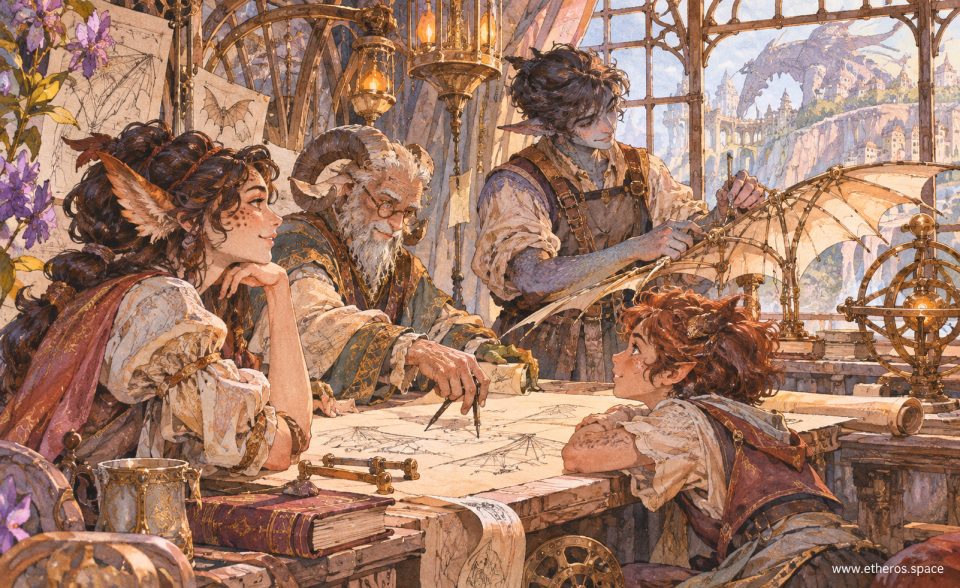
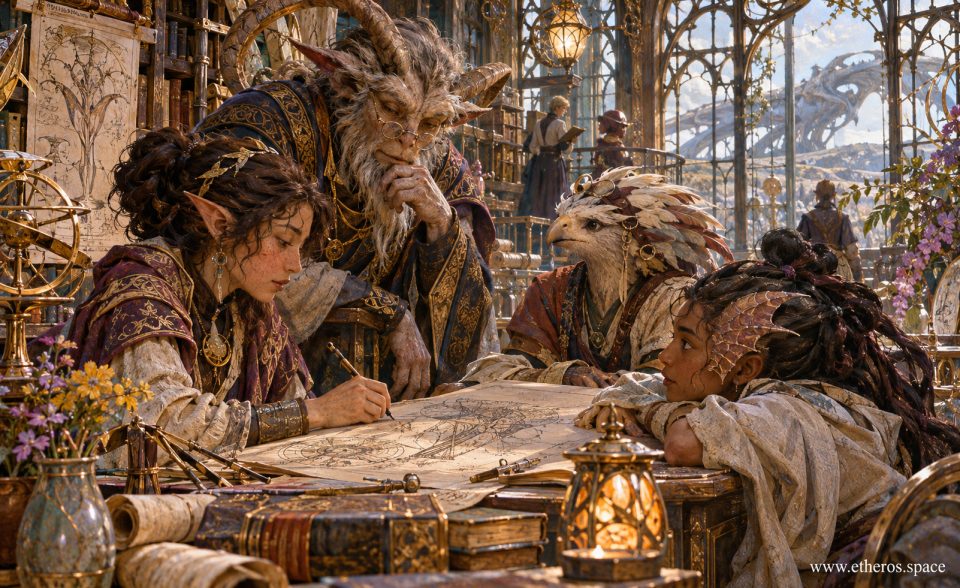
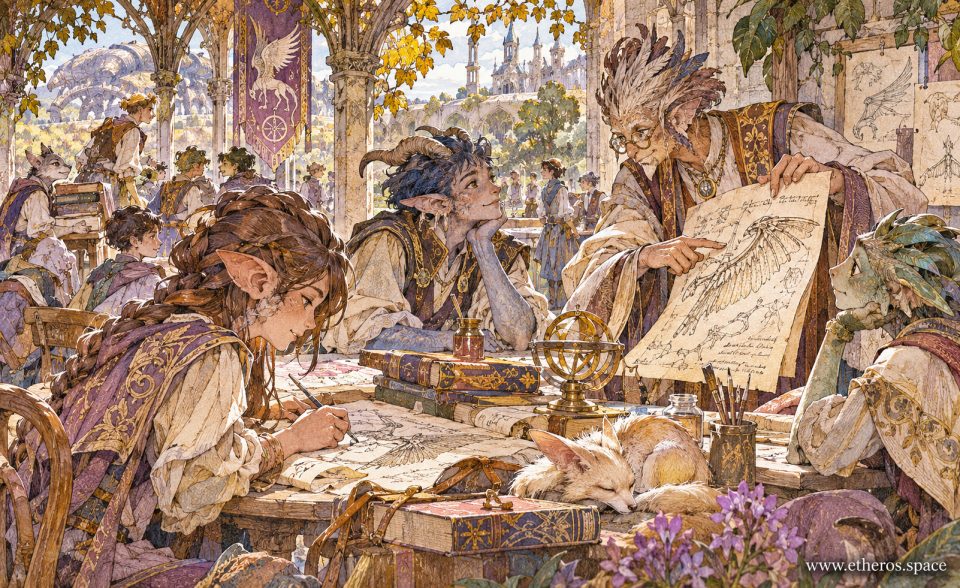
This afternoon the lesson occupied a long worktable beneath an open Gothic arcade. Leaves turned gold above the arches. A purple academy banner stirred over students trading books in the courtyard. The pages on the table showed the anatomy of an immense mountain glider: branching bones, articulated feather roots, and the tendons that bent the whole assembly without breaking it. Tava, whose dark braid had escaped its ribbon, worked low over a separate sheet with her quill. Blue-skinned Orrel leaned on one elbow and watched. Green-scaled Sanek sat at the far end while the professor lifted the master drawing toward the daylight. The little fox Mallow slept on the manuscripts as though lectures were invented for the comfort of animals.
Three weeks before, a wild glider had been brought from the stone escarpment beyond town. It had survived a violent mountain wind but not its rescuers' first attempt at a support brace. The brace was handsome: polished ribs, balanced gold clasps, a hinge so precise it scarcely made a sound. It had also held the creature's wing so straight that it could no longer twist when a gust struck.
Cevri put his finger beside a row of fine curved lines. 'The wind did not ask the wing to be stronger,' he said. 'It asked it to give way, for an instant, in the right place.'
Tava did not look up. Her pen traced a seam on the parchment. 'Then why did we copy the old design?'
'Because the old design looked finished,' Cevri answered. 'We confused looking finished with working.'
Orrel turned a small brass teaching instrument slowly, following the movement of its rings. Its forces were easy to trace: a hand supplied torque, the axle carried it, bearings distributed the load, and the mounting returned it to the table. A living wing required an even more careful path. Sudden pressure had to travel along a length of membrane and tendon rather than stop violently at a single pin.
Sanek studied the wide anatomical sheet. She was the daughter of a cliffside roofer and had spent half her childhood watching scaffolds sway during storms. 'The brace's outer fastening is its only stiff point,' she said. 'Every gust would pull against that one joint.'
'Or against the healing bone beneath it,' said Cevri.
Beyond the classroom, other students passed between the columns, some carrying ink and others rolls of fabric. A huge segmented form, perhaps one of Etheros's working behemoths, lay partly visible through the outer arches and yellow foliage. At that distance nobody at the table could tell whether it was moving or what service it might be performing. The academy went on with its small, exacting work.
Tava drew a shorter rigid rib and set two flexible connections where a single metal clasp had been. Orrel worked out how the angle would change under load. Sanek suggested a woven filament that the local silk moths shed each season, and added a warning: it must be tested dry, damp and cold, because a mountain glider would meet all three conditions before it reached home.
They disagreed about the length of the lower attachment. Tava thought Orrel's dimensions too heavy; Orrel worried that her lighter arrangement would twist before the wounded bone had healed. Neither objection was foolish. Cevri allowed their argument to wander and then asked each student to draw the direction of the force they feared.
Their arrows met at the same vulnerable point.
For a moment the only sound at the table was Tava's pen scratching through a mistake. Mallow twitched one pale ear. The professor lowered the large drawing until it leaned against a pile of reference books, and Sanek moved her hand away so the paper would not crease.
Tava crossed out the central fastening. Instead, she distributed the connection along three gently separated contact pads, each cushioned against the skin. A thin flexible tendon ran between them. The arrangement would not abolish the force; it would spread the impulse through a longer motion and release it slowly enough for the healing joint to survive.
'It may still be wrong,' Orrel said.
'Almost certainly in one of the details,' Cevri replied. 'Now we can discover which.'
They made a small test plan. First they would load a model wing with weights, record how far its tip moved, and see whether the tendon returned without fatigue. Only afterward would the healers consider fitting anything to the patient. Sanek volunteered to watch the glider's behavior, because its willingness to move mattered at least as much as the diagrams. Tava would draw each failed version rather than erase it. Orrel would keep the measured loads, not merely the successful ones.
The bells sounded across the courtyard. Nobody at Larchglass paused to celebrate. No wing had yet healed; nothing had been proven. A lesson had simply become a better experiment.
Cevri remembered the first year he had taught here, when he had believed students needed answers from him more than questions. Now he knew the opposite. He watched Tava shift the inkpot away from the sleeping fox, Sanek gather the loose parchments and Orrel catch a heavy book before it slipped from the table.
Outside the arches, the city continued beneath its autumn canopy. Somewhere beyond the academy a wounded creature waited, not for an elegant solution, but for one that would allow it to remain itself.
Tava made one last small adjustment to the drawing: a place where the brace could bend before the bone was asked to. Nobody noticed it except Cevri. He said nothing. The work would speak when it was tested.