The Step That Counted as a Crossing
20261106T212731968862Z_066percent.png
Story
THE STEP THAT COUNTED AS A CROSSING
The Lower Span of Veyr, first blue evening of the long dry season, primordial Etheros
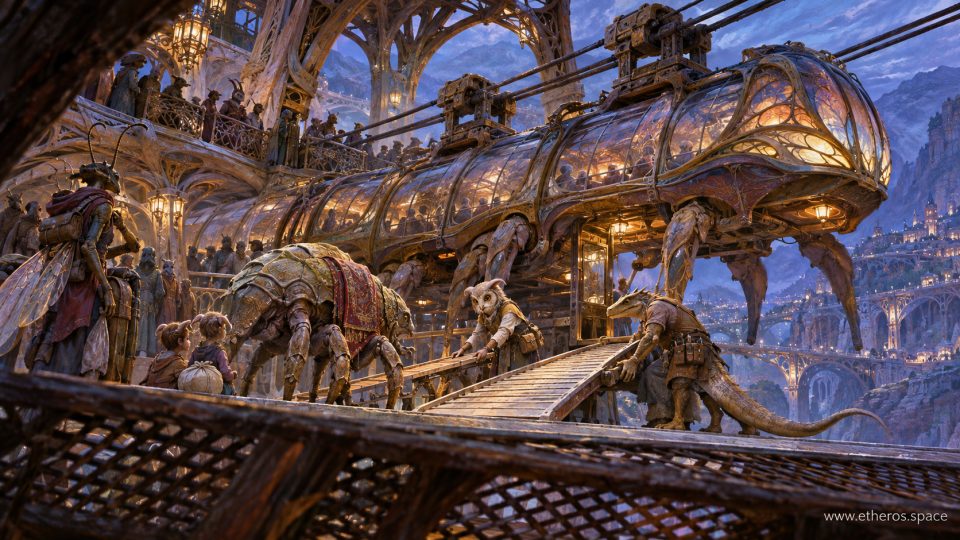
The car had arrived with all its windows full, and that was why nobody at first noticed the problem with the steps. Above the station, the suspension cords hummed through their old stone drums. Golden light moved inside the curved glass shell of the Veyr cable-car, where passengers stood beneath the living ribs, holding baskets, parcels, and each other. Across the ravine, dwellings burned like small embers in the many tiers of the city.
The problem waited at the open boarding gate. A folding ramp had to span the narrow space between station floor and vehicle. It had been made for the quick feet of upright travelers, and its timber slats lay at an angle that was tolerable only to those who could lift their bodies over the first edge. A young scaled station mechanic, Esh, held one end; at the other an owl-faced attendant, Sori, bent forward to lower it gradually. The ramp would not settle. Its lower pin caught against the platform stone, and its upper edge rocked under the load of Esh's hand.
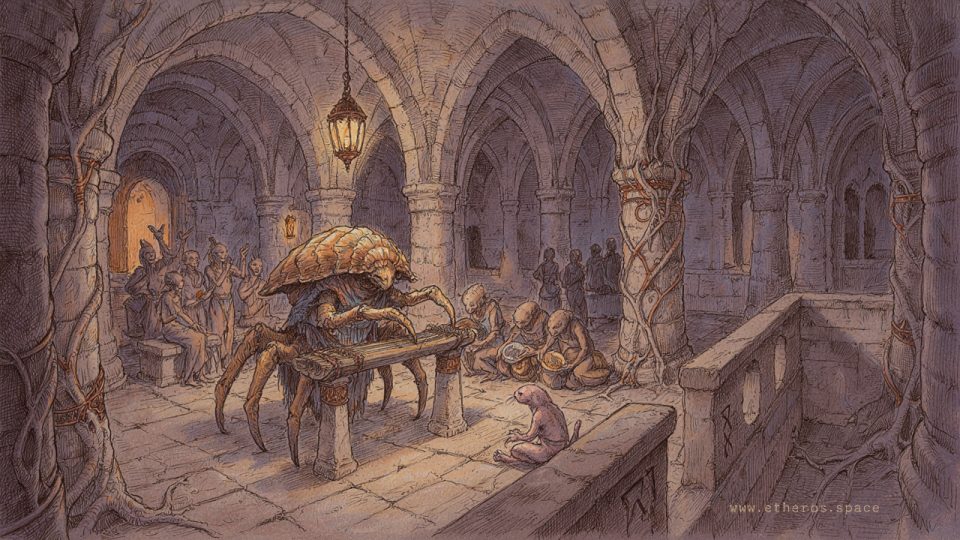
Behind them stood a large plated traveler named Urren. He had six heavy supporting limbs, a travel shawl fitted over his arched carapace, and two bundles fastened along his back. He had walked the upland approach without complaint, though his joints were weary. On the platform at his side sat two small companions with a single cloth bag between them. Neither child knew whether a car could depart while someone was still looking at its entrance.
A horned voyager at the rail offered to help lift Urren's bundles. Urren thanked her but did not move. It was the passage, he explained, not the weight of the luggage. If the ramp tilted beneath one of his middle limbs, his body would twist sideways into the narrow gate. The injury was not certain; the risk was real. He had crossed enough ridges to know the difference.
Esh wanted to replace the pin, close the gate and send the car. The next ascent was already overdue. There were families waiting at the higher stations, and the living suspension cords did not hold their tension forever without maintenance. Sori argued that a boarding device was not safe merely because it had served the most common body shapes for a hundred years. They had both spent the day keeping the line useful. Neither was being careless.
At last Sori knelt to inspect the hinge instead of arguing across the platform. She saw that the pin itself was sound, but the bottom bracket had been set against the wrong face of the stone sill during the previous repair. The broad ramp was trying to pivot around a corner instead of resting on its load-bearing foot. Esh loosened the little locking collar. Together they lowered the bracket by one notch and swung the foot onto flat masonry. The slats now formed a gentler, stable incline, yet the joint still needed a loaded test.
Urren waited while Sori placed a sack of freight stones on the middle of the ramp. Esh watched for the slightest shift between wood and metal; above them the crowded passengers stopped murmuring. The foot held. Urren stepped onto the first slat, then another, carefully transferring his weight through all six limbs. The waiting children rose, but did not rush him. When he reached the sheltered interior, their faces turned toward the light as though it had been lit for them alone.
The conductor did not ring the departure chime at once. On the wall ledger, Sori marked the bracket's revised position and the missing inspection that had allowed it to be set incorrectly. She asked Esh to take the measurement to the other lower stations before the next shift. A new pin, she wrote, would not correct a bad assumption about whose bodies the line must carry.
Esh added the delay to the day's log. Delays cost wages and wear, and she would not pretend otherwise. Sori added something smaller, an entry she had learned from the old caretakers: 'The route is not the distance a car travels. It is the passage a traveler is able to make.' It was not an ancient law, only a practical station saying whose author no one remembered.
When the doors finally closed, Urren pressed his broad palm against the amber glass. Far below, the dry city paths wound beneath the cables, and across the gap the terraces held their ordinary lamps. The children counted the bridges passing beneath them. Sori stayed on the platform with Esh, their shoulders close in the cold air, watching the creature's six steps become a journey. Nothing spectacular had occurred. In Veyr, that was sometimes the clearest evidence that a public machine had done its work.