The Error the Brass Remembered

Story
THE ERROR THE BRASS REMEMBERED
Rhaun's Thatch Court, a dry-season afternoon in primordial Etheros
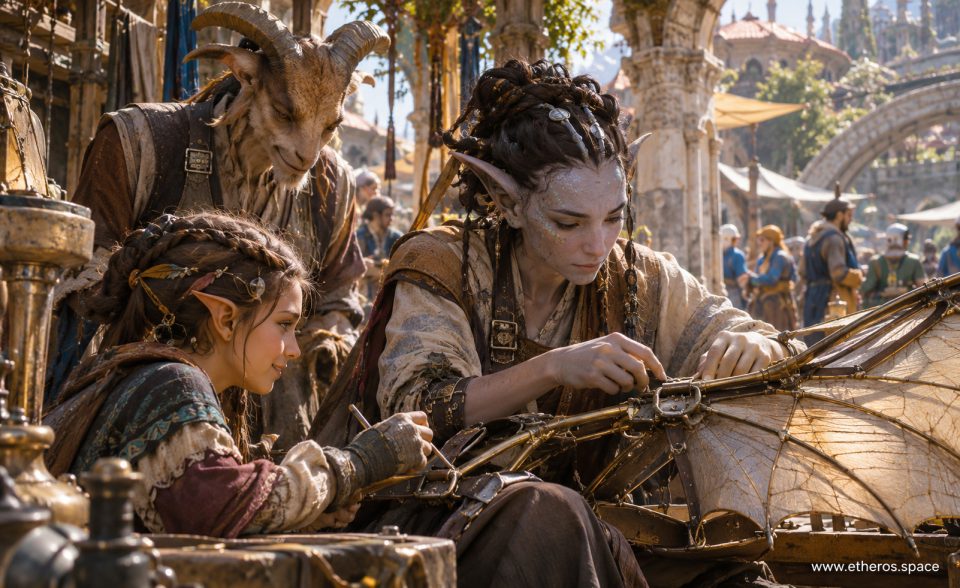
From the alley the court looked like every other place where someone might buy a buckle, a bit of wire, or a promise. Sunlight fell through the reed roofing in narrow streaks. Finished wares shone along the tables. Buyers paused in the path, and apprentices hurried between stools with bits of metal cupped in their palms. Beneath one low canopy a young craftsperson was bent so close to a circular brass instrument that the crowd seemed to have fallen silent around her.
Her name was Lethri. Dark hair fell across her cheek as she steadied the rim with one hand and worked the point of a slender tool into the instrument's innermost track. Its fine gold-colored rings held a pale, uneven gleam. A second, covered fitting lay at her right; filings, cord, pliers and measuring rods crowded the rest of the work surface. Nothing floated. Each ring rode on a tiny pinned bearing, and the brass housing rested on a broad wooden base that absorbed every careful turn of her wrist.
The device was called a return-dial, though it did not know how to return anyone home. It held measurements collected by other people: the height of a crossing, the angle of a scree slope, the width of a passage between two broken walls. An operator set its inner scales against a paper route and read the allowed clearances through a small window. That was all. The old traders called it truthful because it could be built to repeat a measurement precisely. Lethri knew that repeating a measurement was not the same thing as asking the right question.
Three mornings earlier the dial had been carried to a roadside lodging-house. A family traveling with a broad-bodied elder and two low-shelled children asked which way across the uplands was quickest. The guild clerk entered the usual walking height, drew a finger around the brass track and named the narrow eastern lane. The family took it. They returned at dusk, still together but exhausted, because the lane admitted the clerk's body easily and their elder's body not at all. No one had lied. A calculation had simply been made for someone who was not there.
The guild asked Lethri for a replacement dial with smoother motion and a narrower case. The work would pay her rent. It might also make the same careless answer easier to produce. On the day shown in the court, she was trying a less profitable revision: a second ring that could be set for the traveler's actual width and supported gait, and a small stop that would prevent the pointer from indicating a passage for which no suitable measurements existed. Not a new map, not a machine that could smell danger—only a way for a person to say, before another person left, *we have not checked that path for you*.
Beyond the table the market went about its business. A worker at the next bench tightened a clamp. A distant shopper stood beneath a lattice of dried fibers. Someone called for a missing tool. None of them could see the failure Lethri had found in the guild's assumptions, and most had work of their own to finish. She had once resented that ordinary indifference. Today she was grateful for it. A decision could be made without an audience applauding whichever answer sounded brave.
She tried the new index. The outer ring moved smoothly until it met the unmeasured eastern lane; there the stop caught with a dry click. She backed it off, touched a second notch with the tool and tried again. A faint blue reflection passed through the central glass. The stop held. There was no revelation, only the familiar relief of a mechanism obeying a limit imposed for a reason.
It would cost more. A wider housing used more metal, and surveyors would have to collect different clearances along the same route. The guild could rightly say that no instrument could bear every possible body or burden on its scales. A free public copy could also be copied badly, misread, or left uncorrected. Lethri wrote these objections on the underside of a scrap board. She wanted them in the argument, not hidden beneath the bright rings.
She imagined the travelers arriving again: the elder setting the dial for the breadth of their shell, one child tracing the available crossings, the other asking why the eastern lane had no answer. She could already hear the child complain. She could also imagine the clerk saying, with some embarrassment, that a missing answer was not a prohibition against travel; it was a request for a survey and perhaps a better path. That would be progress enough for one afternoon.
Lethri put down the tool and called across the bench to the nearest metalworker for a second pair of eyes. Before she took the guild's money, she wanted someone who had not built the device to find the place where its new certainty broke. She would charge for the labor and argue separately about what the finished instructions should cost. The road belonged to many kinds of feet, but the people who maintained it still needed to eat.
The brass did not decide the argument. It lay in the sunlight, imperfect and testable, while market voices rose and fell beyond the table. For the first time since the lodging-house complaint, Lethri felt less tempted to make the dial beautiful. She wanted it to remain useful when the travelers came back with a question its maker had never imagined.