The Spiral That Would Not Speak — Evening at Mareth Cut
Story
THE SPIRAL THAT WOULD NOT SPEAK — EVENING AT MARETH CUT
Primordial Etheros, the basalt shelves of the western dry country
The first thing Issen found was not a bone. It was a line.
It curved out of the pale cliff, crossed a band of iron-red stone, and vanished beneath an older layer that nobody at Mareth Cut had thought worth examining. The quarry crews had been taking building blocks from this ledge for two generations. By the time the sun reddened the mesas, everyone was calling the line a shell, though Issen had carefully refused the word.
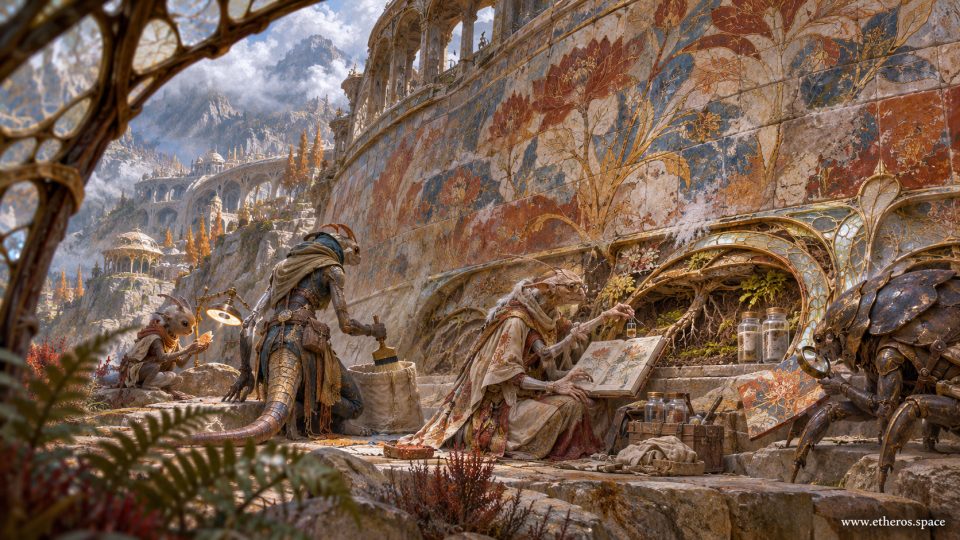
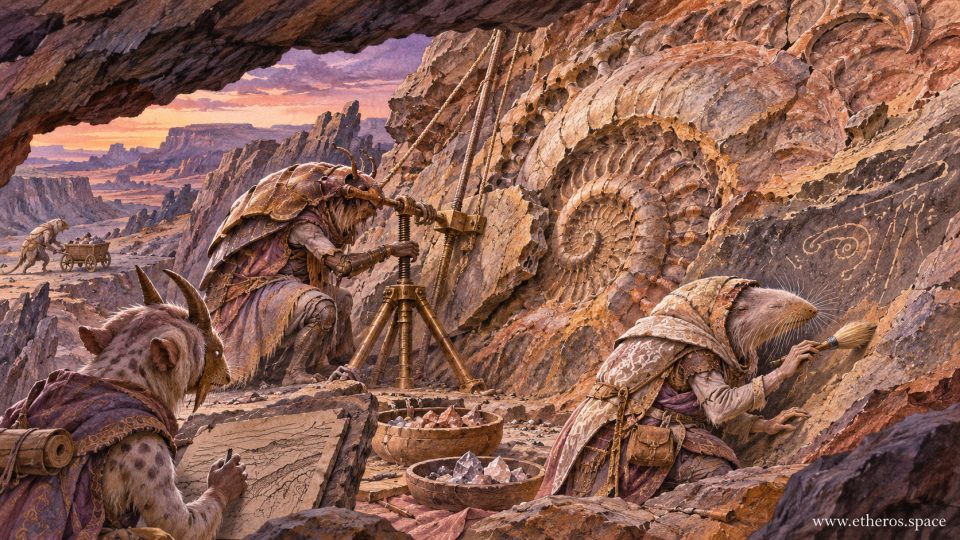
Under the low roof of rock, the old, whiskered conservator knelt with one hand against the slope and a brush in the other. Each stroke loosened a dusting of mineral grains. The immense spiral above her had ridges like nested ribs, chambers set one behind another, and a broken outer lip that seemed to climb into the ceiling. If it had once been part of a creature, it was a creature no living resident could name. If it had grown as part of Etheros itself, that fact was not written clearly in the rock either.
“Can we call it alive once?” asked Tirra.
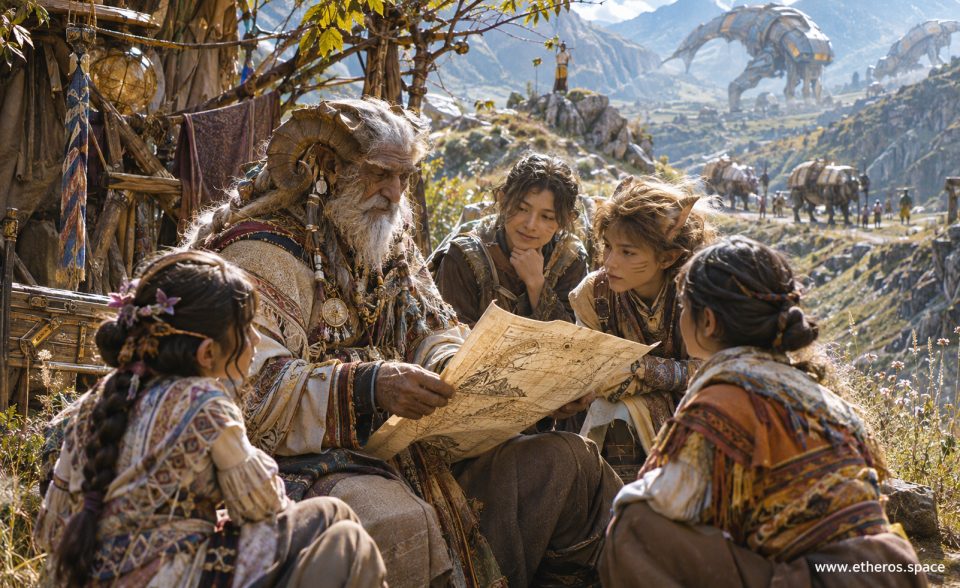
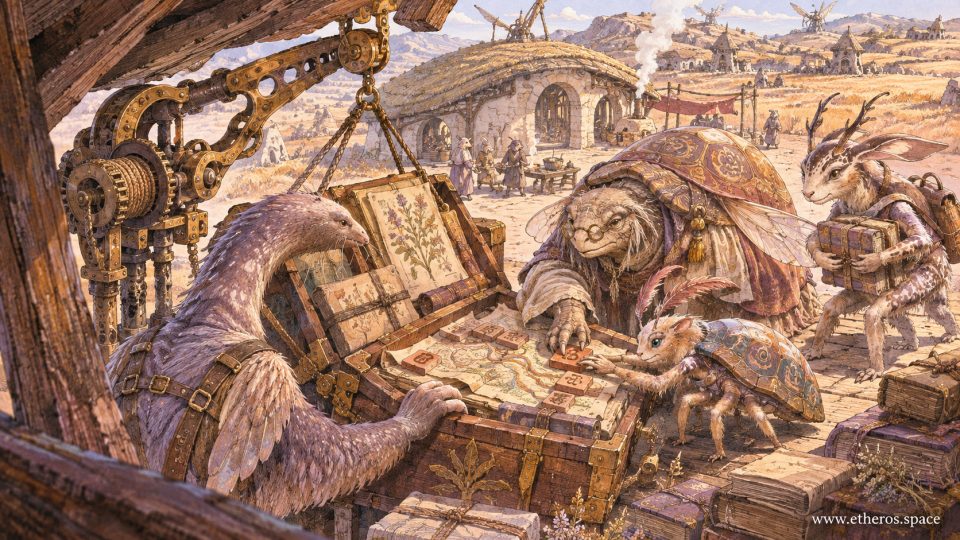
The young horned apprentice sat among the sample bowls with a slate balanced against a stone. She had already drawn the whole curve twice, one copy as the eye saw it and one with every uncertain boundary marked in dots. She had learned that second practice years before from Orshel, the traveling teacher whose lesson-chest crossed the dry uplands. Orshel used to say that a gap left honestly blank could teach more than an invented road.
“We can call it something that lived, perhaps,” Issen said. “We cannot call it something we remember.”
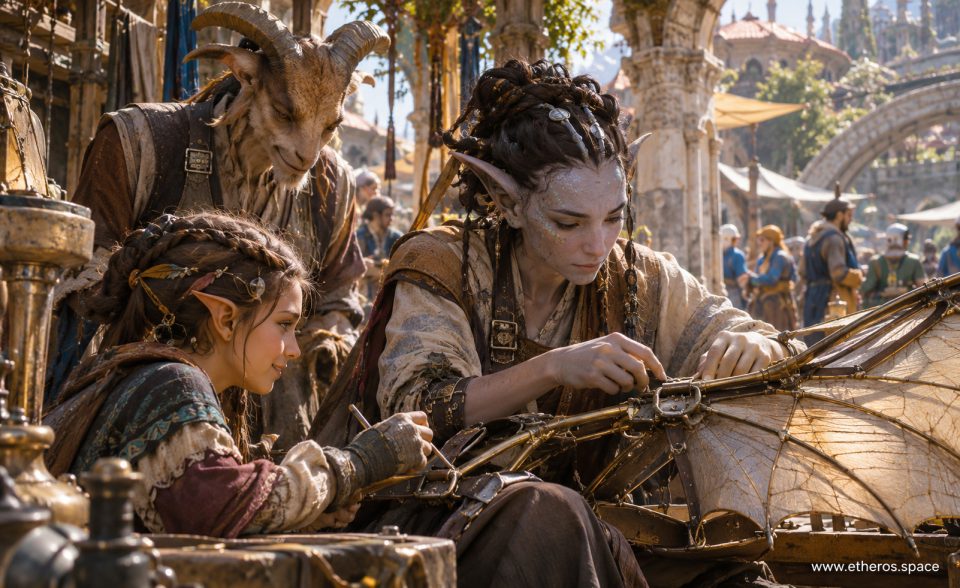
Above them Gorrun tightened a bronze screw, slowly enough for the tripod feet to settle on three firm patches of bedrock. Gorrun's layered carapace glinted at every movement. The frame did not lift the fossil or hold up the entire cliff. It kept a loose outer slab from rolling down while Issen worked, and the brace would have to be checked again after the rock cooled overnight. Across the distant ledge Pev waited beside a cart loaded with ordinary quarry stone; the draft harness was loose because there would be no more cutting here today.
The foreperson had sent word before sunset. If the spiral belonged to the quarry's mineral lease, the crew could remove it and sell its polished chambers to collectors. If it belonged to the public memory of Mareth, the workers might lose their best vein of building stone. The elders who lived below the cut could not afford a winter without new roof blocks. The naturalists who had climbed from three settlements could not bear the thought of a discovery cut into ornaments. Neither worry was foolish; both had hands attached to it.
Tirra pointed her stylus toward two small curling marks on the darker boulder. They looked, from this angle, almost like the greater spiral. No one knew whether they were old survey cuts, tools dragged through soft stone, or marks much older than either. She wrote the possibilities separately. Issen approved of that more than of the polished sketch.
In one shallow dish lay translucent shards of crystal; in another, rust-colored fragments removed from a fallen flake, not taken from the great central coil. Issen wrapped each with a strip of cloth and recorded its exact place. Nothing here could prove that the mineral still carried a voice, a memory, or anything living. There was no need to promise an impossible revelation to make the discovery precious.
At last Gorrun came down from the jack and asked the question no one at the cut had wanted to ask plainly: “Who pays for the hands that stay?”
They settled nothing grand before dark. They chose a smaller beginning. The workers would keep the safe lower quarry open, and the exposed wall would be sheltered but left in place. The council would pay the brace crew for two watches, not ask for their labor as a gift. The conservators would make a measured clay relief for the school travelers, and every mark on that relief would show whether it came from observation or conjecture. The larger question of custody would return when the town could hear all the people whose livelihoods touched the cut.
Pev turned the cart toward the last light. Gorrun tested the tripod a final time. Tirra put down her slate, feeling the rough stone dust settle across her claws. Issen stayed beneath the overhang for one more quiet moment. The spiral did not answer. It did not need to. The country around it had already begun learning how to ask better questions.