The Fourth Corner — An Evening at Rellan Hearth
Story
THE FOURTH CORNER — AN EVENING AT RELLAN HEARTH
Primordial Etheros, the highland homes of Rellan Cut; a cold violet dusk in the dry season
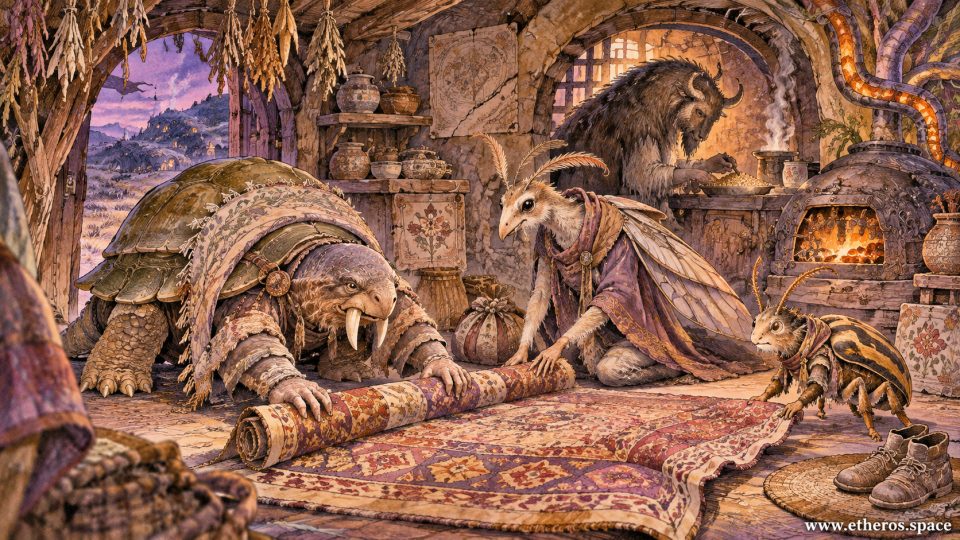
The rug was too long for the room, or so Roveth had insisted for twenty-seven seasons. Its fourth corner reached the cooking doorway. Tonight it seemed scarcely large enough.
Roveth bent his broad plated body beneath the hanging herbs and set his heavy foreclaws against the roll. His pale tusks were useless for straightening fabric. He pressed the curl until it relaxed. Faded red flowers and stitched gold squares opened across the floor. On the opposite edge, little Kessa caught the fringe between the tiny gripping tips of her forward legs. She pulled too hard and the edge sprang back.
"That is not how a floor is persuaded," Roveth said, without looking up.
Kessa, whose striped shell was barely as wide as the cloth's red border, tried again more gently. A feathered visitor beside her steadied the middle with a narrow hand. Irieth's long ears and trailing feelers stirred at the warmth of the room. Her folded wings carried the dull violet of dust and miles, and she kept them carefully away from the fire. The banked oven's copper-veined conduits carried its remaining heat into the sleeping nook. Someone still had to gather fuel and clean the flue.
From the rear alcove Havren stirred a pot. His great curved horns were dark against the orange light. He had added another handful of dry root to the broth, more helpful than a speech.
Beyond the arch, lit houses dotted the lavender hillside. Irieth had been delayed by ordinary troubles: a change of work, a missed grain carrier and an inn demanding advance payment. Towns could spare her a chair, but seldom a night. Her single bundle rested by the doorway; she had kept her boots near it, ready to leave.
There was another guest bed in the village, in the public loft above the storage house. Its warming conduit had cracked. The council closed the valve rather than risk fire; it could not agree whether to purchase a new fitting. Some neighbors offered spare floors until repairs; others said generosity did not absolve the village from maintaining a public shelter. Both had a point.
Irieth watched Roveth struggle with the last turn of the rug. "I have enough credit for supper," she said. "I should pay for the rest."
"You can help hold the edge," Roveth replied.
"That is not a price."
"I know. It is an edge."
Kessa giggled, then grew serious. She had been taught that a home needed a roof, a fire and a door. She asked whether making a place for someone meant they must always stay.
"No," said Irieth. "Sometimes it means they can leave when they are ready, rather than when they are afraid."
Roveth remembered staying with cousins when the winter shelf roads broke. He remembered kindness, and borrowed bowls, and his own wish to become invisible. He shifted the rug to leave a path wide enough for Irieth's folded wings. He did not demand her history.
Havren brought a bowl within Irieth's reach. Tomorrow they would visit the council store. Perhaps the cracked fitting could be remade from its bronze collar. Irieth knew flexible fabric joints and could ask why a rigid sleeve had been placed where the warm conduit expanded. Her experience might help; it was not payment demanded for tonight's meal.
"Then let me mend that seam," she said, touching a place where two faded flowers had come apart.
Roveth considered the question. The rug was an heirloom. Repair would alter its old stitches; neglect would too. He nodded toward Kessa and the needle pouch below the pottery shelf.
The little one drew the rug's outer corner straight. The visitor spread her wing just enough to shelter the loose thread from the draft. Roveth pressed the last curl flat. Their different claws left the corners imperfectly square.
But the space by the hearth was warm. The doorway was clear. Beyond the arch, Rellan's lights appeared one household at a time. No great behemoth was needed; only a humble channel carried heat between two rooms.
In the morning they would still dispute the common shelter. Tonight they had made room for a visitor, without pretending that kindness settled the public debt.