The Chair Kept for Listening
20261105T213353039909Z_066percent.png
Story
The Chair Kept for Listening
At the edge of Ravenn's dry country stood a small stone shelter whose door opened toward a plain too broad for any single family to own. From the porch, the travelers' lights appeared after dark as a faint string of amber points. Beyond them, something enormous crossed the distant skyline, though at this distance no one could say whether it was a carrying beast, a servant of the living planet, or simply a shape in the haze.
Inside the shelter, no one had sat in the carved chair since Orven's last winter.
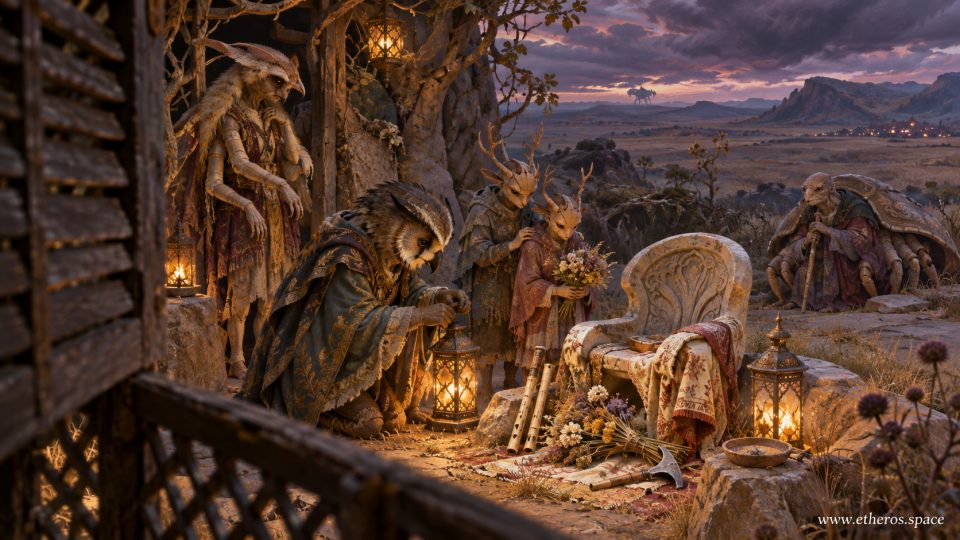
The chair was not an altar. It had once stood beside an ordinary hearth, where Orven repaired reed flutes for travelers who could pay and for children who could not. The old musician had died in her own bed, and the house had been empty for a season before the family brought the chair out under the thorn lantern to remember her. Now cloth was folded over the arm, two pale pipes lay against its base, and a shallow bowl held the dust-colored seed she used to scatter for passing ground birds.
Nessa knelt to trim the nearest lamp. Her tawny, owl-like face was bent close to the brass grille; the flame threw gold across her dark green mantle and made the engraved stone look deeper than it was. She had promised to keep the lights steady until the youngest guests had finished speaking. She had not promised to make the speaking easy.
Behind her, Hadril rested four slender hands against the folds of a red-gold robe. The old moth-kin had been Orven's neighbor for forty turns of the ridge's changing winds. Hadril remembered a thousand stories, but had recently begun confusing the first telling of each one with the last.
The two antlered siblings approached together. Ishel placed one hand on Vehi's shoulder. Vehi held a handful of pale hillside flowers so tightly that the small stems bent. They had made the climb from the lower terraces before the storm clouds gathered; neither child had ever known the shelter when Orven's voice still filled it.
"Which flute was hers?" Vehi asked.
Nessa looked at the two pipes on the cloth. One was smooth and pale; the other bore three dark rings near its mouth. She remembered Orven playing both, but could not remember which had belonged to her mother and which to a visitor who never returned.
"We know she repaired them," Nessa answered. "I don't know who made them."
Hadril's antennae moved in the little draft from the doorway. "Her grandfather made the ringed one," the elder said, and then, more softly, "Or perhaps he gave it to her. I used to be certain."
Torv, who had climbed up separately with the help of a cane, settled on a low rock outside. The heavy curve of the shell on Torv's back caught the last violet light. Orven had once helped Torv mark the distances between ridge wells with a tune that could be remembered when the painted guideposts vanished beneath dust. The melody had traveled farther than its maker. Torv still hummed it while walking, although the third phrase sometimes changed.
"If we cannot agree," Ishel asked, "should we leave the flutes here?"
"Yes," said Nessa. "And we can write what each of us remembers. Not all our recollections must become one story."
The child frowned. "Would that make us disloyal?"
"I think it is the opposite."
At first the gathering was silent. Wind touched the dry flowers in Vehi's hands and rattled the thorn branches above them. A few distant dwellings shone on the far edge of the plain. Nothing answered from the empty chair.
Then Torv spoke about a day Orven had carried an injured migration bird to the shelter. Hadril remembered the same day differently: not a bird but a broken harness, and Orven refusing payment until the traveler's children were fed. They disagreed about the incident, but both recalled the gentle impatience with which she worked. Nessa remembered her laugh, a low rasp that arrived a moment before the joke. Ishel remembered a cloth with an uneven blue seam. Vehi remembered nothing firsthand and said so.
"You can remember tonight," Nessa told the child.
Vehi placed the flowers beneath the chair, not on its cushion. Ishel straightened the folded cloth. Torv rested both hands on the cane. Hadril raised the lantern slightly, and Nessa moved the other flame closer to the threshold, where arrivals could see the broken step.
None of these gestures proved a genealogy, or fixed the disputed origin of the pipes. The chair would outlast many tellings, and even its carved patterns might one day be mistaken for a formal symbol rather than a carpenter's pleasure. What the family could preserve was smaller and more honest: the details each person had witnessed, the uncertainties they could name, and the kindness the old musician had made ordinary.
When the first rainless gust struck the shutters, Vehi finally loosened the grip on the flower stems. Somewhere beyond the ridge a great shape moved slowly against the sunset, tending to a task no one on the porch could see clearly. It passed without ceremony.
The lamps remained lit. The chair remained empty. And for the first time since Orven's death, that emptiness no longer felt like a question the family had failed to answer.