The Floor That Kept the Song — An Evening at Varrum Vault
20261106T203822229519Z_033percent.png
Story
The Floor That Kept the Song — An Evening at Varrum Vault
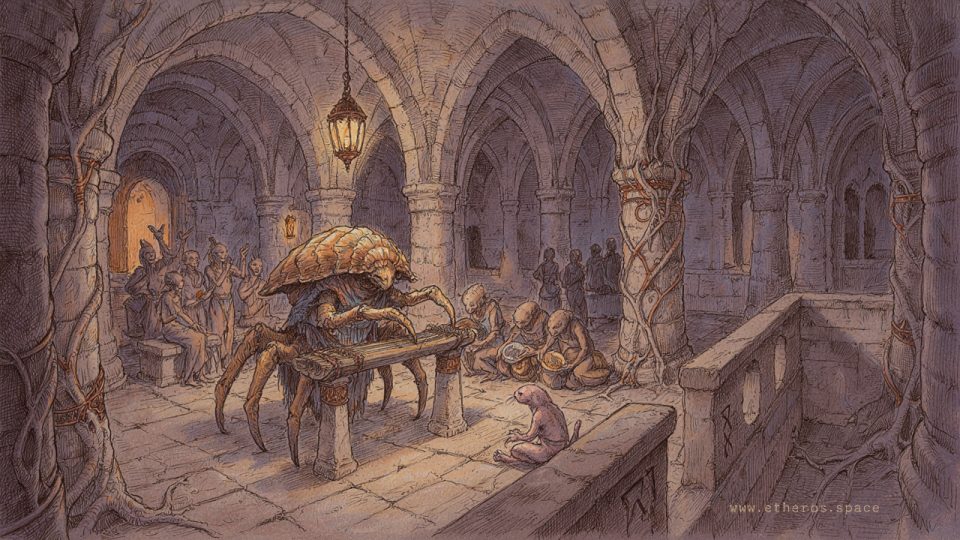
There was no stage in Varrum Vault, only a set of worn steps descending toward a chamber whose stones had outlived the families who laid them. A lantern swayed between two pointed arches. Bronze-root braces gripped the columns, and the ceiling returned every footfall as a softer, later answer. The first guests arrived early because nobody had ever agreed on precisely when a song should begin.
Sareth came last through the warm archway. Their back was a broad carapace plated in the colors of dried honey and old slate. Six sturdy legs had learned to carry its weight without hurrying; the forward limbs were slender, deft and sometimes unsteady. They stopped beside a long string-drum resting on two stone pillars, tested its tension, then bowed their head until the whiskerlike feelers beneath the shell brushed the strings. It had belonged to Sareth's teacher, who had once played it for miners coming off the night shift. Nobody knew the maker's name. Sareth had never tried to supply one.
On the left-hand benches, Kelik and several neighbors settled shoulder to shoulder. Kelik belonged to the highland earfolk, who kept time by tapping the long bones of their palms against wood. On the floor beyond the instrument, Ilen, Tavor and Oss cradled small resonating bowls. Each had come from a different quarter, each learned rhythm from a different kind of work: sweeping dust from limestone seams, counting loads at the granary, pacing a forge's cooling cycle. Their beats did not agree at first, and no one pretended they did.
Little Mivra took a place on the low parapet in front of them. Her hearing was narrow in the upper tones, but her feet could distinguish the three slow pulses passing through the stone. She sat with both hands beside her knees, as though keeping the stair from running away. The musicians thought she was waiting for permission to join; Mivra thought the musicians were waiting for someone to show where the pulse had gone.
The council had nearly canceled the evening. The rear gallery had begun to crack, and the new maintenance tariff would make the vault too expensive for families who came only to listen. Some residents wanted to close the upper chamber until the masons could assess it. Others argued that closing the only common listening place would leave the smaller species outside the neighborhood's music entirely. Both had reason. A sound could be shared for nothing, but a roof could not be held up by goodwill alone.
Sareth began with the oldest passage: two quiet strokes and an empty measure. The strings spoke through the carved instrument, through its stone supports and into the floor. The bowls answered too quickly. The audience smiled at the mistake. Kelik tapped an entirely different rhythm and caused an elder near the door to laugh aloud. Nobody corrected anyone. That, for a few minutes, was the point.
Then Mivra placed one hand flat on the parapet and looked toward the farthest bowl. Tavor understood first. The young listener was marking a fourth beat, a hollow space between the third pulse and its reflection from the rear wall. When the three players tried again, their separate tempos did not become identical. They made room for each other. The sound grew larger without anyone playing louder.
Afterward the listeners did not vote on the tariff. Instead they went upstairs in pairs to inspect the gallery in daylight, and asked the masons to draw a repair plan with safe capacity limits. Kelik proposed a sliding contribution according to household means; Ilen offered to help move stone in exchange for lessons; Oss insisted that working hands should still be paid. Sareth agreed, adding that free entrance should not mean invisible labor. None of it was settled by the final lantern, but everyone knew which question to ask next.
When the gathering thinned, Mivra remained by the stair, palms resting on the ancient rock. She was not attempting to remember a melody. She was learning the place where someone else's rhythm had left her room enough to answer. Across the chamber Sareth loosened a string so it would not split in the dry night air. The arches held. The little lamp trembled. The stone returned one final, very small note.
On Etheros, people often said the planet cared for its living inhabitants. Varrum's musicians understood the other half: care was work, passed between unlike bodies, and sometimes it sounded most clearly in the silence one life left for another.