The Half-Moon Helm — An Afternoon at Sundial Arcade
ETHEROS_20261106T113054150132Z_033percent.png
Story
The Half-Moon Helm — An Afternoon at Sundial Arcade
The small gold line had stopped just short of the ear.
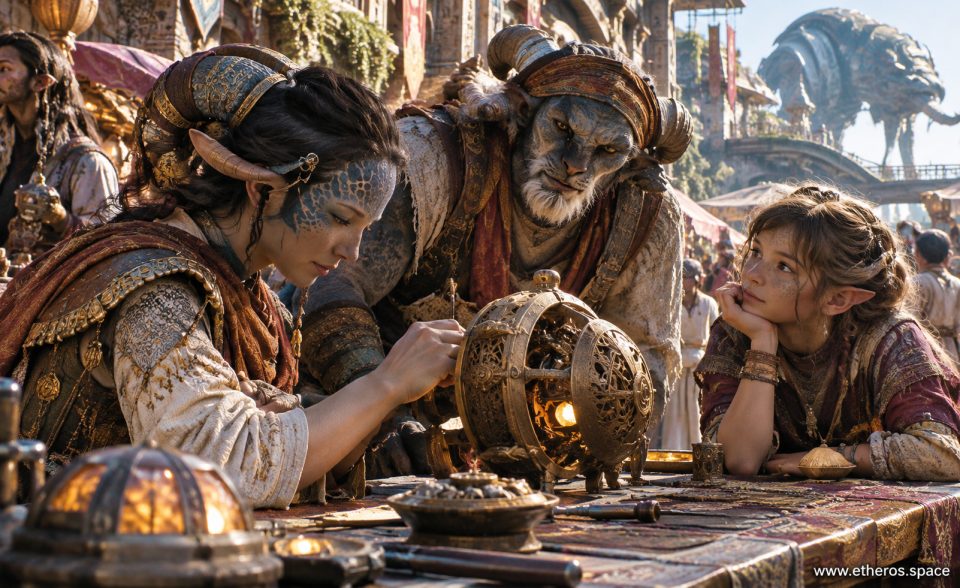
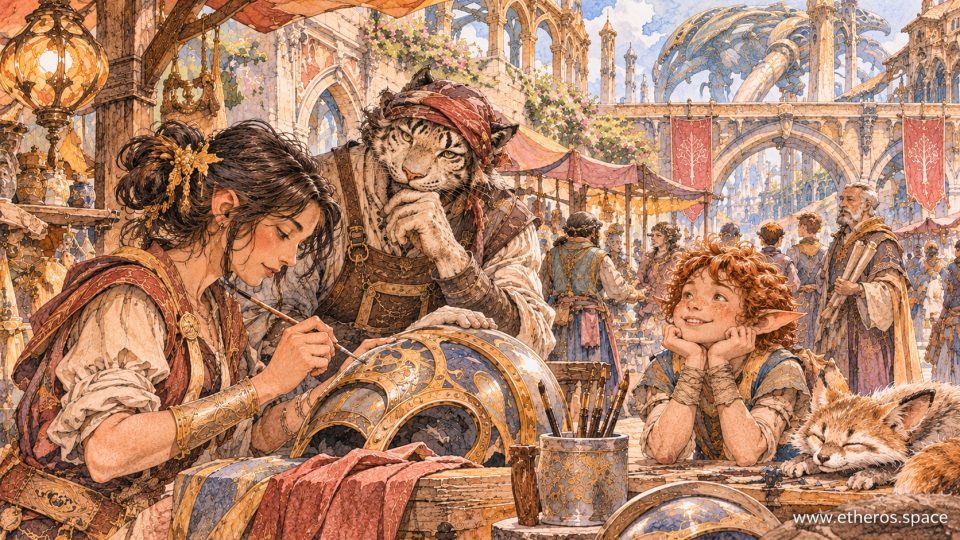
At the public metalwork stall of Sundial Arcade, that was reason enough for Ada Vey to put down her brush. Beneath the overhanging lantern and among the untidy bolts of colored cloth, a blue-and-gold half-shell lay on a padded block. The piece was not a crown, although its sweeping ribs invited the comparison. It was the protective cowl of a courier's folding headpiece: old, bent, carefully repaired, and still required for work on the steep streets above the market.
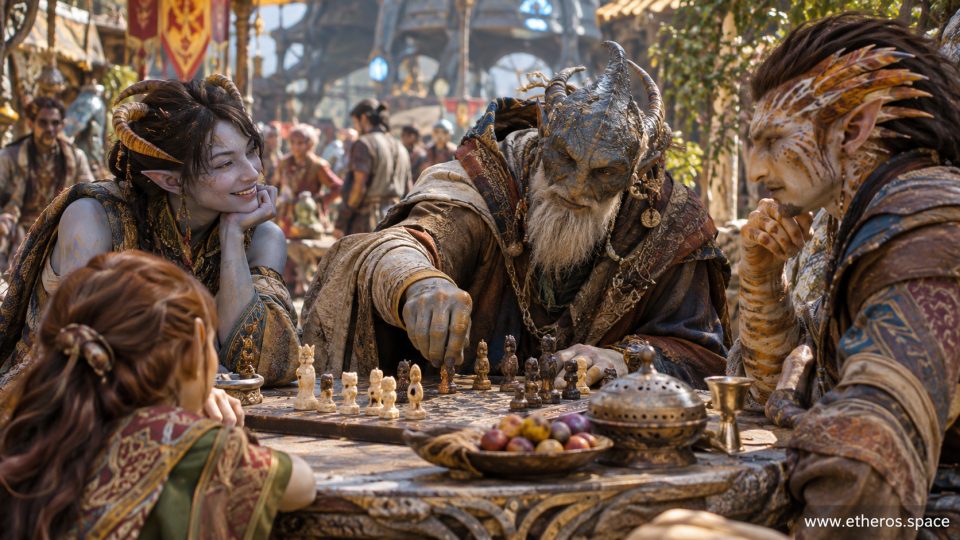
Ada's hand rested at the edge of a painted groove. Across the worktable, Kesh, a broad-faced, striped feline craftsman with a red headscarf and old spectacles strapped above his brow, watched the thin seam without touching it. He had been the one to straighten the outer rib. He also knew that the golden paint was not what made the headpiece safe.
"Does it have to be beautiful?" asked Perri.
The young, pointed-eared apprentice sat opposite them, elbows on the board and chin cradled between both palms. A little foxlike sleeper had curled beside the brushes and had apparently decided the dispute could proceed without them.
"It has to be honest," Kesh replied.
He turned the cowl a fraction. Inside, pale reinforcement strips followed the shell's curves toward its lower rim. One old fastening had cracked where a stiff rivet forced repeated impacts into a single point. Ada had already bound the split with a narrow flexible strap. Her unfinished line marked where the new connection would be inspected, so a future repairer would know precisely what had changed.
Perri frowned. In the school notebooks, every device looked immaculate. Here the work had seams, different metals, and little places where the light caught the history of mistakes. The child's parents had promised to replace the cowl at the next fair, but the next fair had come and gone. Tools were expensive, and young messengers were paid only for completed routes. Nobody counted the days spent maintaining the things that kept them alive.
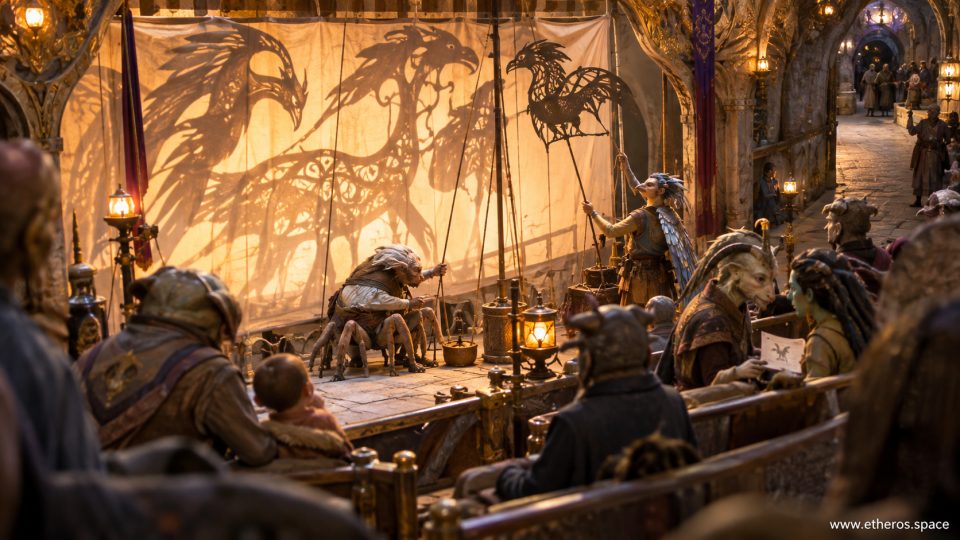
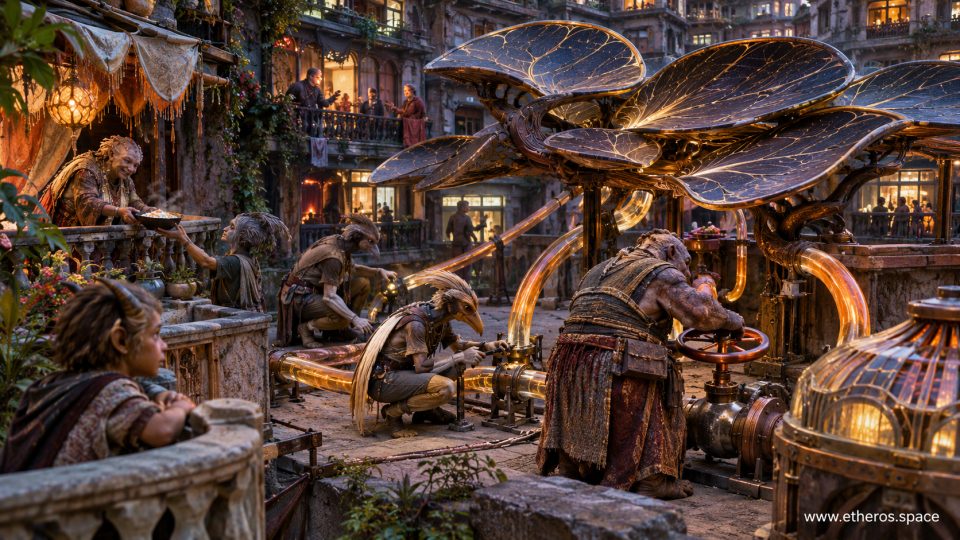
Behind the stall, afternoon traffic passed beneath the pointed arches. Traders moved between cloth awnings. High above them, a vast ribbed form could be glimpsed beyond the buildings, but neither its exact structure nor its purpose was clear from this narrow view. At the workbench, a few centimeters of bronze demanded more attention than the distant spectacle.
The original owner of the cowl, a courier named Orel, had left a note asking for the repair to be concealed. He worried that clients would refuse him work if the patched shell looked old. Kesh had understood. Ada had disagreed.
"If we hide a repair, the next person can't check it," she said. "And if a customer confuses painted gold with sound metal, we have sold reassurance instead of safety."
Kesh traced the rim with one blunt finger. He had spent much of his working life rebuilding discarded things that prosperous merchants expected to replace. He had also seen skilled repair used as an excuse to postpone necessary retirement. The problem, he told Perri, was not whether an object looked new. The problem was knowing what it could still do.
They chose a trial. A counterweighted testing arm on the side of the bench would apply a modest repeatable load to the rim, below the danger threshold of the assembled cowl. Kesh checked its contact pads; Ada loosened the decorative cover so the underlying fastener remained visible. Perri recorded each change with a charcoal mark on scrap parchment. Once the load was removed, they examined the seam for movement and any fresh cracks. Nothing shifted, but that single test did not prove the entire headpiece safe for every impact.
"Then we do another?" Perri asked.
"We do enough to discover whether our confidence is earned," Kesh said. "And we tell Orel what remains uncertain."
The child considered that while the fox slept and ordinary conversations swelled through the arcade. For the first time, Perri understood that skilled labor was not only the clever movement of hands. It was also a promise to report what those hands had and had not accomplished.
Before closing, Ada completed the gold mark. She left the repair trace visibly distinguishable from the older decoration, a slim crescent rather than a disguised scar. Kesh added the date of the workshop's own calendar to a hidden inspection tab. Perri wrote the first words of the accompanying note, then stopped and asked whether a courier who could not afford a replacement would have any real choice after reading their warnings.
Neither artisan answered immediately.
Finally, Ada proposed that the guild offer a loaner cowl while Orel's was examined more thoroughly. Kesh agreed to bring the matter before the shared repair council; the arrangement would cost materials and somebody's labor, so the council would also need to agree how to pay for it. That was an unfinished question, not a victory they could award themselves.
Perri watched the last light move across the half-moon shell. Out in the street, the old arcade continued its business, and the little sleeping creature did not stir. The line of gold was nearly invisible from a distance. Up close, it told anyone willing to look that something had once failed, that somebody had cared enough to mend it, and that caring meant leaving a truthful record for the person who came next.