The Third Pool of Orrinel — A Measure of Living Water
20261102T213305317883-0800_057percent.png

Story
At the Orrinel Conservatory, the oldest occupation in the city was not tending the fish. It was listening to the water before the fish had reason to complain.
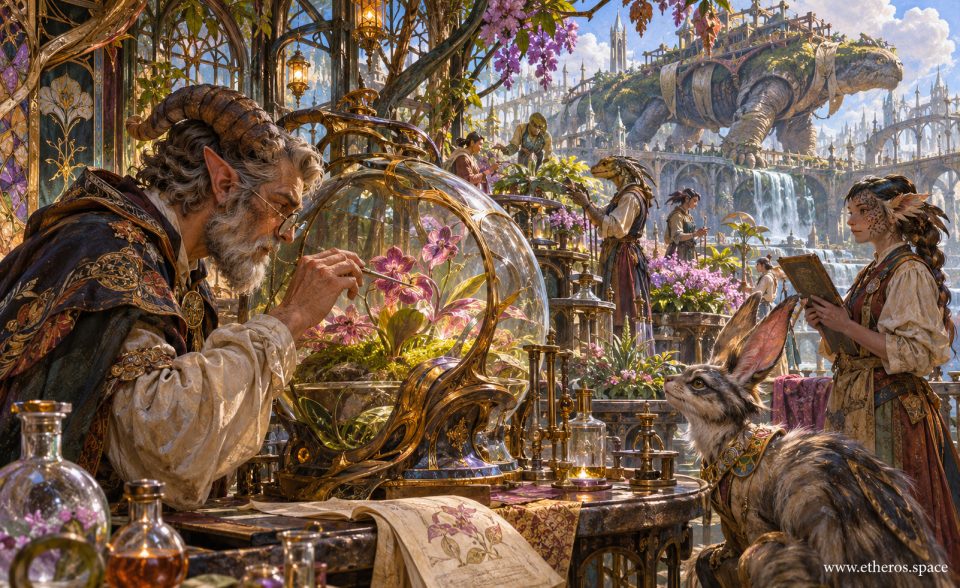
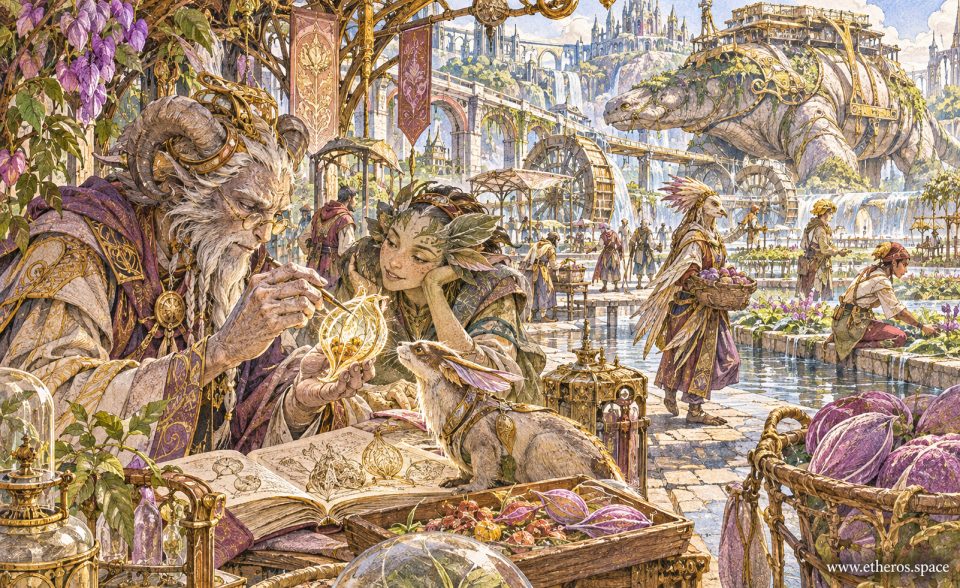
Mael had worked the third pool for forty-seven wet seasons. Age had put silver in the fur beneath his long, translucent ear-fins, but it had made his fingers more certain. He crouched beside the nursery water in a brocaded working mantle, his little circular spectacles catching the light. A brass tablet rested against his knee, engraved with the branching routes of the conservatory's intake veins. He dipped his spotted hand through the surface and held it perfectly still. The small ripples around his wrist told him that the current was turning against the usual flow.
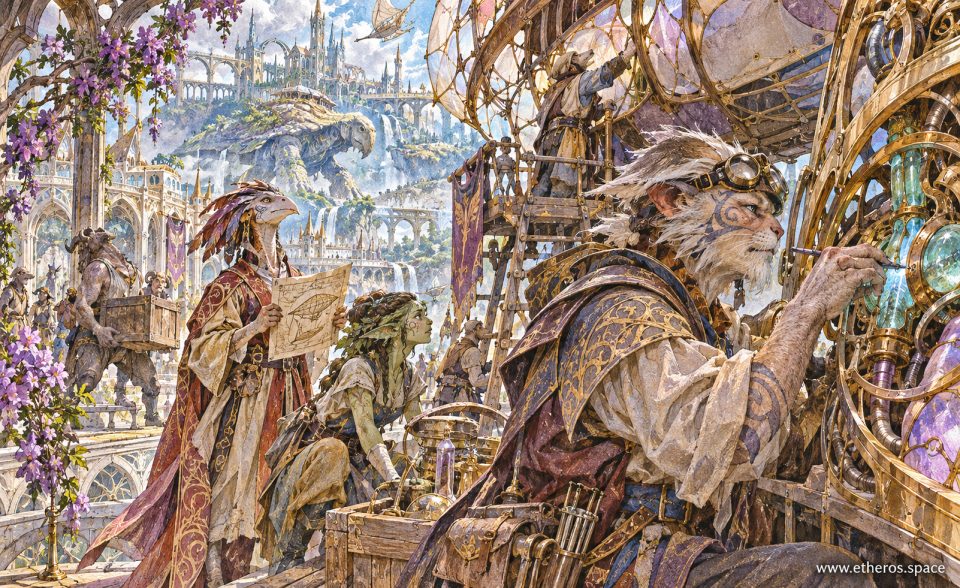
Above him, sunlight poured through glass ribs taller than houses. Ornamental ironwork supported the terraces, but the beauty was never only beauty: every arch carried a service walk, every planter clamped a filtration root to its own load-bearing shelf. Violet blossoms grew where the warm return pipes passed, and the upper galleries threaded through foliage so densely that a traveler could mistake the whole place for a forest that had learned engineering.
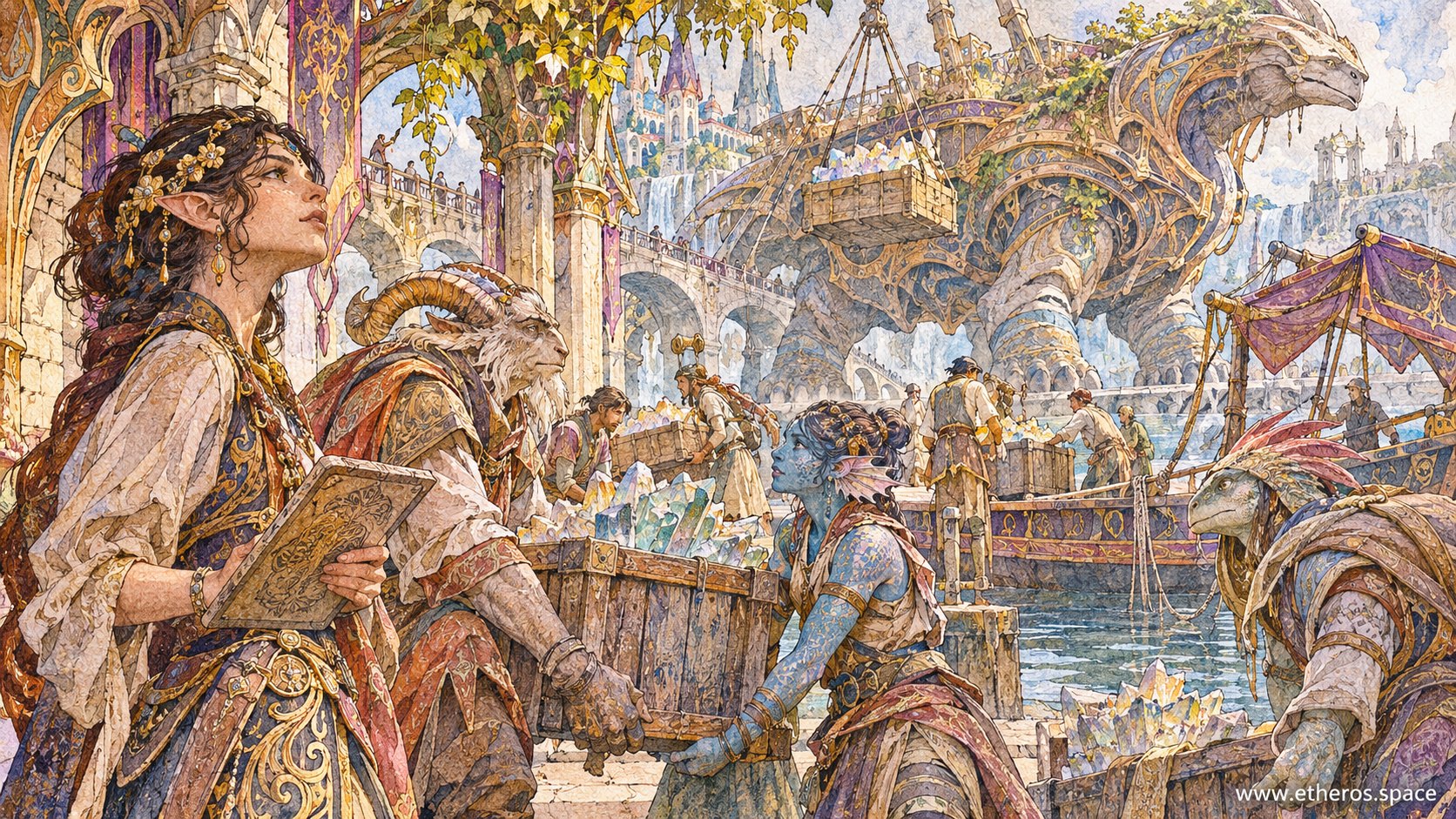
At the heart of the terraces stood Velu, a continent-old water-carrier descended from the planet's own repair organisms. Moss occupied the gaps between its armored plates. Its great neck bent over the central cascade; beneath its gilded jaw, a sheet of water broke into silver strands, tumbled over living stone, and entered the nursery channels. The creature did not conjure water. It lifted it through muscular cisterns from the deep recovery sump, drawing usable energy from stored sugars and mineral-fed symbionts along its flanks. Gravity performed the long descent; roots, microbial beds, and settle-pockets cleaned the water before it returned underground. Orrinel measured every bucket it borrowed from that cycle.
That morning the third pool had warmed by a fraction of a degree. Such a difference would not trouble anyone crossing the bridge, but the migrating mirrorfin were preparing to leave the nursery and enter the wider rivers. Their bright blue scales flared with copper and orange when they turned. A warm patch in the wrong place could leave an entire shoal short of oxygen at the narrowest gate.
Across the water, Tir, a blue-crested field keeper in a fitted work harness, lowered his hand net into the lilies. He was not fishing for dinner. He was clearing the weed that had caught against a submerged intake screen, one basket at a time so the young fish would not be startled into the stone. Farther back, Bera, whose horned silhouette stood above a woven service rail, inspected a row of planting trays while another worker watched the return channel. Nobody shouted. They knew that the water carried noise as faithfully as it carried silt.
Mael looked from the gilt lines of his tablet to the trembling membrane between two lily leaves. A shoal of mirrorfin drifted beneath his outstretched hand, and one small fish, its flank a patchwork of orange and river-blue, held its place in the gentle eddy. He remembered teaching Tir to read this particular pool when the boy's fingers had been too eager to remain still. His apprentice was grown now, and would inherit the work without being asked to inherit the worry.
He lifted two fingers. Tir saw the signal, set his basket against the low rail, and opened the bypass a little. Velu responded in the distant, patient way of a creature that felt a city's demands through pressure rather than words. Somewhere behind the glass and gold, a living valve changed its shape. More water began to fall from the broad mouth above. It struck the channel in a fine, aerating curtain instead of a heavy sheet, sending a fresh wash of bubbles beneath the roots.
The current against Mael's wrist reversed. The first cool thread arrived at his fingertips, carrying the faint metallic taste of the upper stone. He held his hand there until the little mirrorfin abandoned its eddy and moved with the shoal. Only then did he close the brass tablet, its measurements complete for another hour.
Visitors on the high bridges would remember the flowers, the sunlight, the impossible creature holding a garden together. They might never notice the elder kneeling at the water's edge, or the net rising on the far bank, or the careful movement of a valve too deep to see. That was the kind of success Orrinel had learned to value: the pipes remained whole, the migrating fish passed safely, the great organism ate and worked without exhaustion, and a thousand ordinary households received clean water without having to think about who had listened for its smallest change.