Where the Glasswings Rest
Story
WHERE THE GLASSWINGS REST
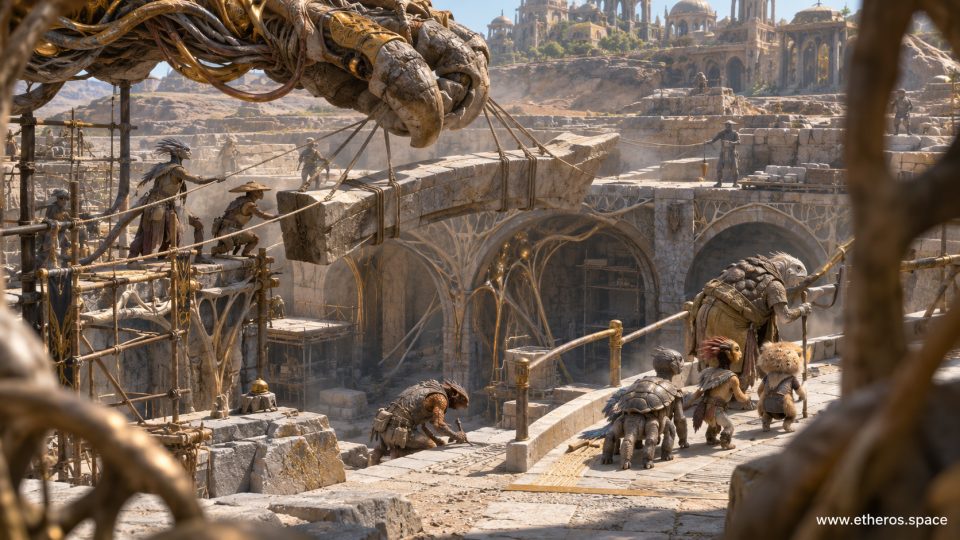
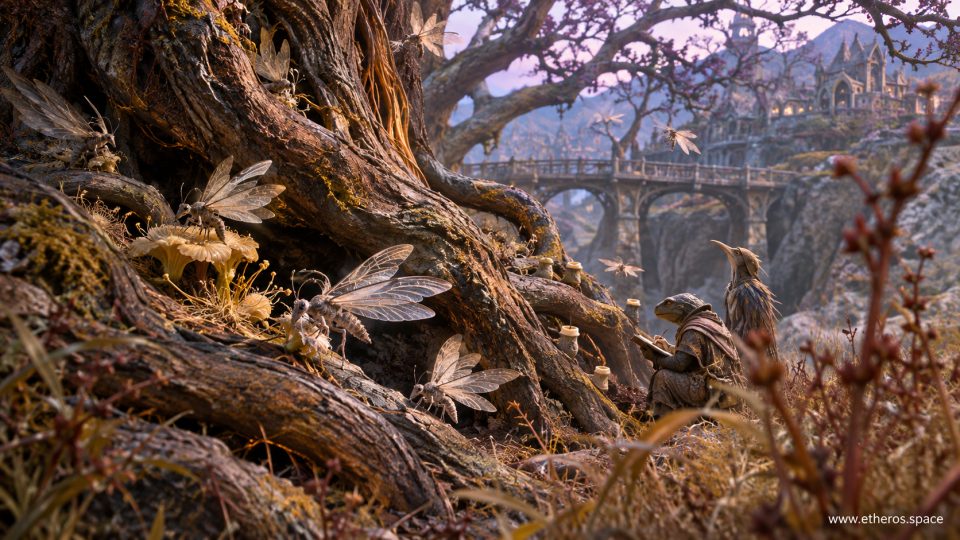
At the eastern edge of Verune, where the inhabited bridge crossed the dry ravine, the oldest tree in the thornwood held its flowers close to the ground.
They were pale, almost white, and opened only when the air turned cool. Travelers passing above saw little more than a twisted trunk and a sweep of golden roots. The glasswings saw something else. They gathered on the soft cups of the flowers in twos and threes, their transparent membranes trembling as they fed, then rested beneath the cracked bark until the next wind rose.
By the time the first light reached the gorge, Lethri had counted eleven.
The small slate-scaled recorder crouched beside the exposed roots with a tablet balanced against one knee. Lethri was careful not to lean on the flowers. A glasswing that had settled upon a low bloom remained still even as the recorder's stylus moved. Another beat its wings briefly and climbed into the shallow, illuminated hollow above.
Ithren stood farther back, the tall feathered watcher keeping an eye on the footbridge and the city beyond. The bridge was already busy with messengers crossing between the two halves of Verune. Its arch divided the ravine without touching the tree, but the lanterns recently added to its upper parapet burned well past midnight.
"Eleven is not a route," Ithren said.
"No," Lethri answered. "It is eleven visitors here, at this hour. Yesterday we saw six. Before that, none."
The city wanted a map. The westward flower beds had thinned after three dry seasons, and the gardeners had found unfamiliar seeds scattered near the bridge foundations. Some believed the glasswings were returning along an old path. Others thought the insects had simply been displaced from a patch of scrub beyond the hills.
There was reason to care about either possibility. The small creatures carried powder from bloom to bloom, and their resting places often preceded the appearance of new rootgrowth. But no one had yet learned whether the rootgrowth followed the insects, or whether both had responded to the same change in weather.
Ithren looked up at a glasswing drifting across the open ravine. It did not travel straight. For a moment the insect hovered near a bare branch, then turned toward the bright flowers under the trunk.
"We could ask the bridge keepers to take down the lamps," the watcher said.
Lethri paused above the tablet. Last month a late courier had caught a foot against a broken paving joint. The additional light had been installed after the accident, and the people who needed to cross in darkness remembered the injury more clearly than they remembered any insect.
"We cannot know the lights caused this," Lethri replied. "Nor can we pretend the bridge needs no light."
The little measuring cups wedged among the roots had been placed there by the grove keepers. They held dust and fallen pollen, not captured insects. Lethri examined one, moved it back beneath a sheltered branch, and wrote down the position. The glasswings continued to feed on the pale flowers. No net was lifted, no wing was marked, and nothing in the grove was announced as proof.
Ithren had once helped repair the parapet. The watcher knew there was room beneath its handrail for a row of downward-facing shutters. They might keep the path visible while sparing the valley the full wash of lantern light. But it would cost timber, skilled hands and several evenings of work, and the city had other repairs waiting.
"Then we ask for a trial," Ithren said. "One span, not the whole bridge."
"And we count the crossings as well as the wings," Lethri said. "We cannot protect one kind of traveler by forgetting another."
The watcher bent to look at the tablet. Lethri had left a wide empty column between the marks for each morning. No invented distances, no confident arrows. Just the weather, the number of visitors, the order in which flowers opened and the hour when the bridge lamps went dark.
Beyond the gorge, the roofs of Verune warmed in the rising light. The city's stone arches had stood for generations, yet every year its inhabitants changed something: a stair for a different stride, a passage for a wider shell, a garden where a wall had once blocked the wind. Some changes were mistaken. Others became part of the city so quietly that no one remembered the argument that had brought them about.
A glasswing rose from the lowest flower and passed between Lethri and Ithren. Its wings caught the daylight for an instant, a fine lattice of veins more intricate than any diagram on the recorder's slate. Then it joined the others above the twisted roots.
Lethri counted again. Twelve.
"Tomorrow, before the lamps go out?" Ithren asked.
"Before the lamps," said Lethri. "And after. We will see what actually changes."
They remained by the tree until the bridge filled with the ordinary sound of morning. Neither had discovered where the glasswings began their journey, and neither knew where they would rest the following night. The city still needed its crossing; the grove still needed its blooms.
For one morning, at least, both were being watched with care.