The Address Between Two Steps

Story
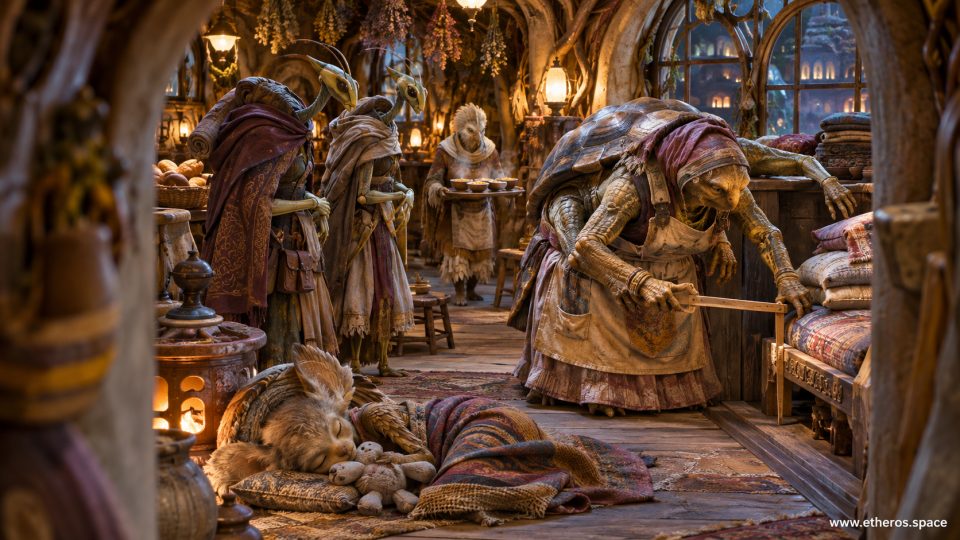
The address office in Eshaal had no sign above its door. Everyone who needed it knew the carved arch and the warm lamp that burned above the registrar's desk.
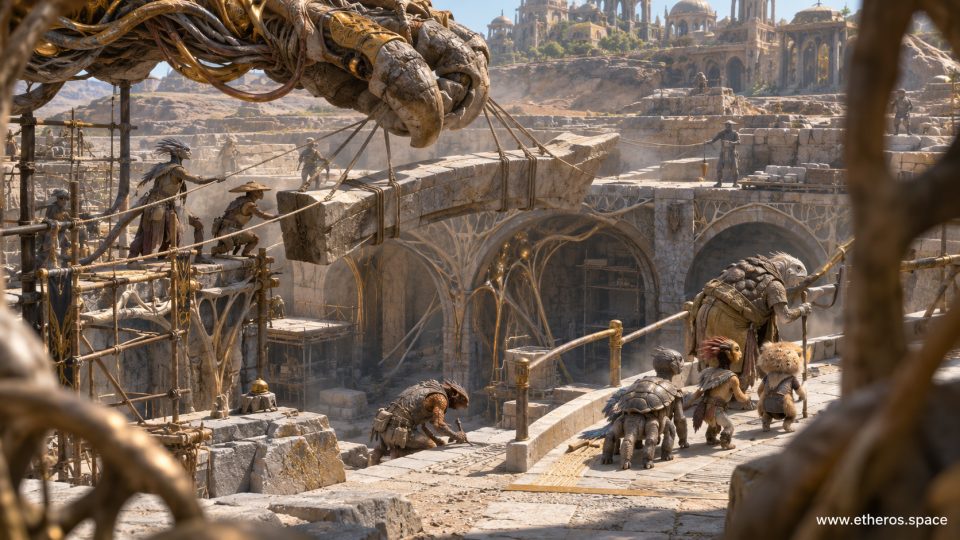
Beyond the outer window lay the pale escarpment and the stacked dwellings of the cliff city. Inside, shelves held hundreds of little packets, map leaves and grooved tablets. Every household had a mark: an arrangement of lines showing where a message could be delivered, where a repair crew could find a broken support, and which flight of stairs a visitor should climb.
That was the theory.
Eliat stood before the desk with a folded map in one hand and a worn token in the other. Her narrow feathered crest shifted each time she looked toward the door. Beside her sat Brennel, an older horned mason who had brought three rolls of evidence and very little confidence that any of it would be accepted.
Across the desk, Orrum bent over a reddish clay plate. The registrar's broad patterned carapace made his shoulders look like part of the furniture, though his hands were fine enough to cut a line thinner than a thread. He kept his stylus on the plate while he listened.
"We live on the twenty-third landing," Eliat said.
"There is no twenty-third landing on this register."
"There is one beneath the western stair."
Orrum looked up. "A resting ledge."
"It is a home now."
At the wall, Thesa, the long-necked archivist, stopped sorting the packets for an instant. The problem was familiar. Families arrived with a door key but no deed, a roof but no numbered stair, or a room that had been cut out of a workshop and occupied long enough to become ordinary. The official map, made years before, remembered the buildings. It did not always remember the lives inside them.
Brennel unrolled the first document. It showed where the ledge joined the supporting rock, the places he had reinforced and the short path by which a visitor could approach. Two neighbors had made their witness marks at the bottom.
Orrum examined it without touching the blank receiving tablet.
"If I assign a permanent household mark," he said, "couriers will take this route. The relief porters will add it to their rounds. The public repair ledger will treat the ledge as an approved dwelling. Has its outer stair been inspected?"
"Not fully," Brennel admitted. "The western handrail is sound. The last three treads still need replacing."
"Then a permanent address could send someone into danger."
Eliat lowered the map. She had heard that argument before, often from people who had never carried provisions up the western cliff.
"Without an address," she said, "how can the inspectors send us their decision?"
The silence that followed was not an admission of bad faith. Orrum had spent forty seasons trying to make a small public office answer for consequences it could barely control. Brennel knew how quickly a neglected stair could fail. Eliat knew what happened when a name was absent from every list.
Somewhere among the undelivered packets was a letter from her brother, who had left for work on the eastern plains. The packet keepers had twice sent her back to ask for the proper receiving mark. It might have been the wrong letter. That was another uncertainty. She wanted only the opportunity to find out.
Thesa brought down an older volume. Between its pages lay a small set of temporary markers used after the great northern stair had been rebuilt. These were not grants of ownership or declarations that a structure was safe. They simply named a reachable meeting point where a resident could collect correspondence while a permanent route was investigated.
Orrum turned one of the markers over.
"We stopped using these because no one was assigned to renew them," he said.
"We could renew one," Thesa replied.
"And who will record the inspections?"
Brennel studied the map. "I can put my name against the three damaged treads. I cannot pay to replace them today, but I can mark them, measure them and submit the load test before the next dry season."
Orrum considered that. The office had no power to declare a stair safe because a mason made a promise. Nor could it justly pretend the ledge was uninhabited while the council deliberated.
He placed the blank clay tablet between them. It held room for a route, a witness and an expiration mark. He drew the first spiral with the stylus, then paused for Eliat to show him exactly where the sheltered landing met the public stairs.
The temporary address would lead not to her door, but to the guarded public alcove below it. The courier would leave packets there. The mark would last one season, after which a safety inspection and a new council decision would be required.
It was not a title to a home. It was not a repaired handrail. It was not even a guarantee that the letter she hoped for existed.
Eliat traced the route with one fingertip.
"Someone will know where to find us?"
"At this point," Orrum said. "And they will know who is responsible for checking whether the path can go farther."
Thesa turned back to the shelves to make room for a new packet. Brennel gathered his rolled papers, leaving the signed measurements on the table. Outside, a late sun shone on the crowded stone dwellings that had never waited for a clerk's permission to be lived in.
Orrum pressed the last mark into the clay.
For the first time, the office could receive Eliat's name without mistaking the act of recording her for the much harder work of making her home secure.