The Minute No One Owned — The Unstruck Bell of Canticle Aerie
ETHEROS_20261103T181915399475Z_033percent.png
Story
At Canticle Aerie, there was a minute between the third cargo bell and the release of the great passenger gantry that nobody was paid to watch.
It was not a secret minute. There were hundreds of eyes at the upper harbor, where copper-ribbed vessels rested against their moorings and clerks, porters, messenger birds, and families in traveling clothes flowed beneath the vaulted arches. But everyone belonged to a timetable. The people in the loading baskets listened for the third bell. The winch crews listened for the fourth. Those who swept the iron decking after each departure listened for a silence between them, and tried to finish before the ropes tightened.
That morning, Master Oruven found the silence growing shorter.
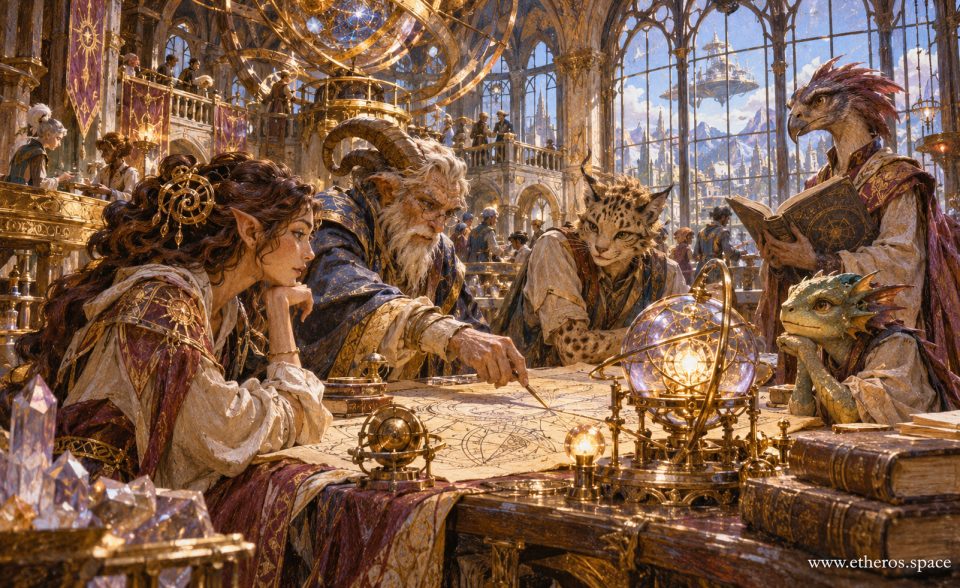
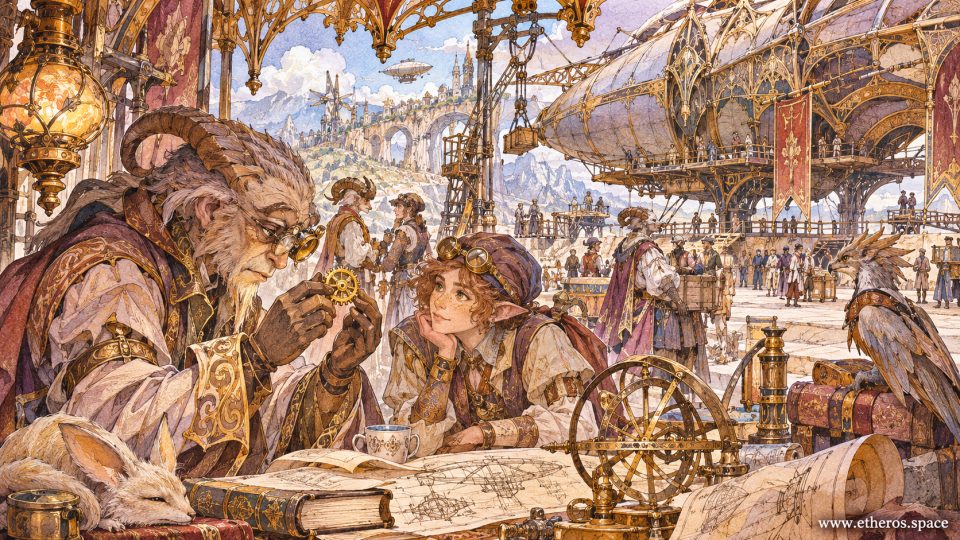
He sat at a crowded workbench with a small brass index wheel balanced between his broad, dark fingertips. A horned, silver-maned member of the highland ramfolk, Oruven had spent forty-two years tending the harbor's warning instruments. His spectacles could magnify the teeth of a wheel; his aching hands still knew by touch when a pin was badly seated. Beside him, his apprentice, Tali, leaned her chin upon her hand and followed the cog as it turned in the lamplight. The diagrams spread under their elbows were not maps of distant kingdoms. They were records of the machinery immediately beyond the railing: pulleys, timing shafts, compensators, and the audible bells on which a city's ordinary working lives depended.
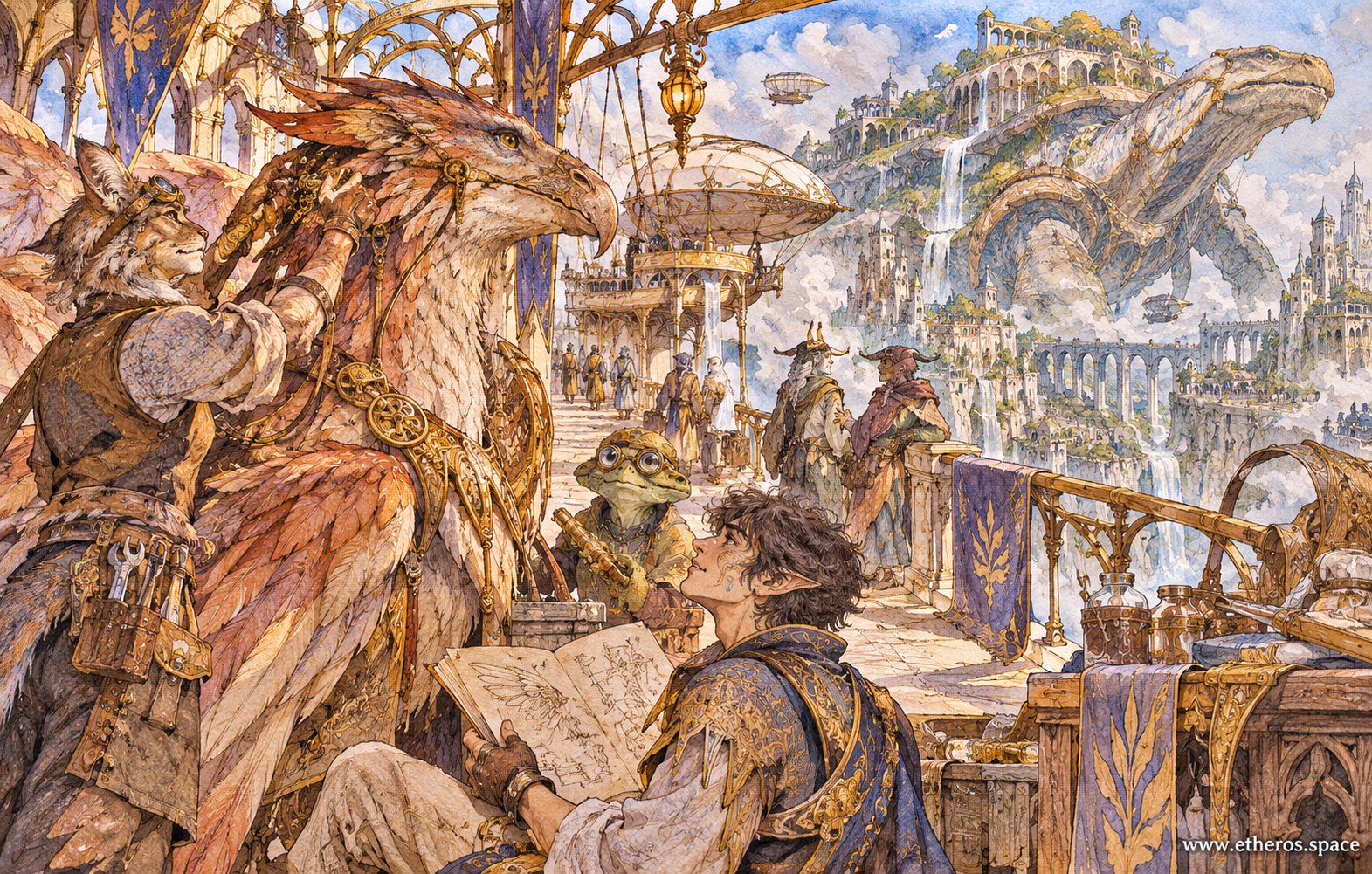
A long-eared fennec had fallen asleep on the notebooks, undisturbed by the traffic. Across the table, a feather-crested courier waited by the parcel rollers. Beyond them, an enormous fabric-sided sky-vessel filled the opening in the arcade while people moved like stitches along the loading galleries. The ship's lift came from buoyant chambers and carefully tended propulsion membranes. Its cargo was held by braided suspension members. The little wheel in Oruven's hand lifted nothing; it merely said when the living workers could safely let go.
'It loses the same interval every cycle,' Tali said.
Oruven turned the wheel toward her. One tooth had worn not outward but sideways. Under load, the regulator slipped a fraction of a revolution before the catch engaged. The bell still sounded loudly and on the right number, as far as anyone in the counting room could tell. Only the silent interval following it was being eaten away.
Tali opened the ledger to the last inspection. It had been marked acceptable by a mechanic who had retired two winters earlier. Oruven had taught that mechanic. For a moment his gaze left the cog and passed beyond the pier, where the sun caught the pale towers and a tiny distant airship moved slowly over the hills.
'We measured the sound,' he said. 'We did not measure the people who must move between the sounds.'
Below the overhanging vessel, two laborers were shifting cargo beside a rail. A passenger queue gathered behind them. On the next cycle, the third bell would come. Then, before the sweepers finished crossing the platform, the fourth would call for tension on the gantry's hoist line. No explosion, no heroic catastrophe was necessary to make the fault dangerous. A worker merely had to have a boot caught where a rail met a moving deck.
The courier offered to run ahead and order the ship held. Oruven shook his head only long enough to tell him what the message must say: *Hold the release line; sound one hand bell; check the entire emptying of the deck before resetting the clock.* The courier departed through the people, taking the warning toward the flight marshal. The crane operators would still have to secure the suspended loads. Nothing was being commanded to float without support.
Tali took a sheet of clean paper and sketched a new indexing profile. The tooth would be replaced by a wider sacrificial insert, easy for the smallest mechanic's hands to remove, while the stop would be set to fail into an audible warning instead of a silent slip. It was a modest change, not something worth inscribing on a monumental foundation stone. But it would restore the missing minute and make the next failure conspicuous.
'And who will sign the new schedule?' she asked.
'Whoever cleans the deck,' Oruven answered. 'They know how long it takes.'
They waited until the runner returned with the signatures of three sweepers and the marshal's blue seal. Tali had never seen a maintenance form written that way. She made space in the margin for four names where the old document had permitted only one.
The vessel left in the afternoon. Its ropes rose in a measured order, the rail cleared, and the bells rang with a new brief pause between them. The passengers heard nothing unusual. The porters returned to their loads. The fennec slept on, one ear twitching when the fourth bell finally spoke.
Oruven did not tell anyone that the repair had saved a life; no life could be counted that way. He polished the old worn wheel, marked it with the date, and placed it on the shelf where the apprentices could find it. Tali wrote beneath its label: *The mechanism did not need to carry the weight of the ship. It needed to remember the weight of the smallest person underneath it.*
By dusk, the harbor's clocks were agreed again. For the first time in years, the minute between the bells belonged to the people who needed it.