The Uncounted Weight — Late Morning at Bellglass Registry
ETHEROS_20261104T101011236184Z_033percent.png
Story
THE UNCOUNTED WEIGHT — LATE MORNING AT BELLGLASS REGISTRY
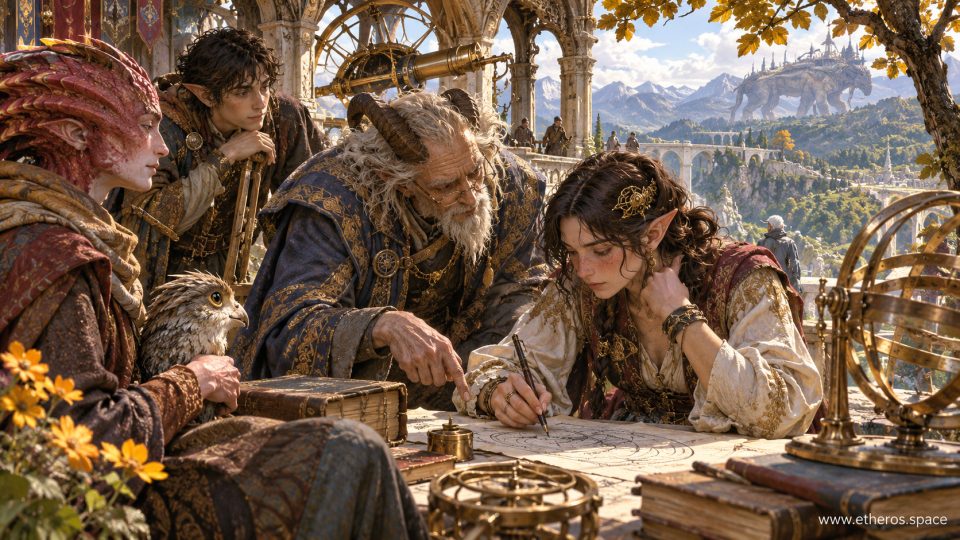
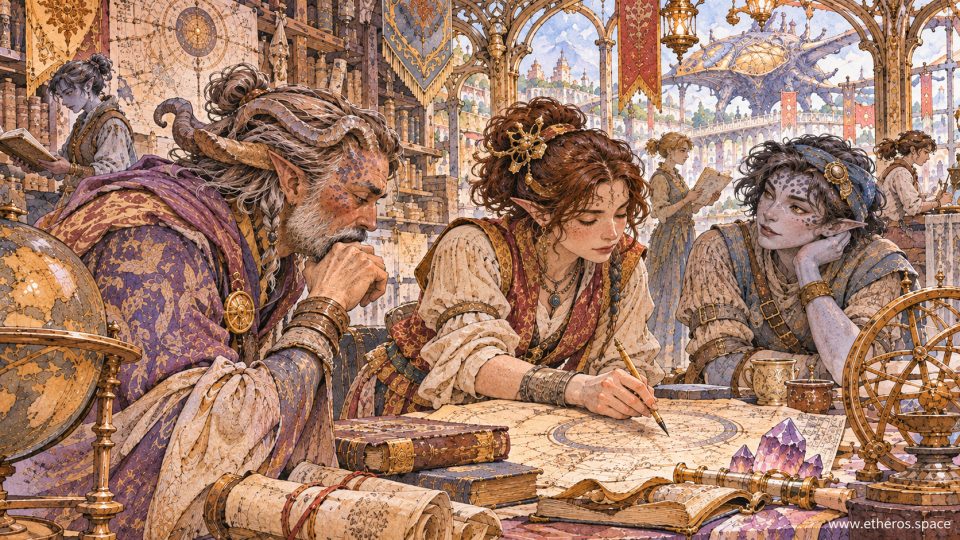
At Bellglass Registry the morning light arrived through an arcade crowded with banners. It slid along carved ribs in the ceiling, found the gold rims of the instruments, and fell across the table where nobody had yet agreed what the map meant.
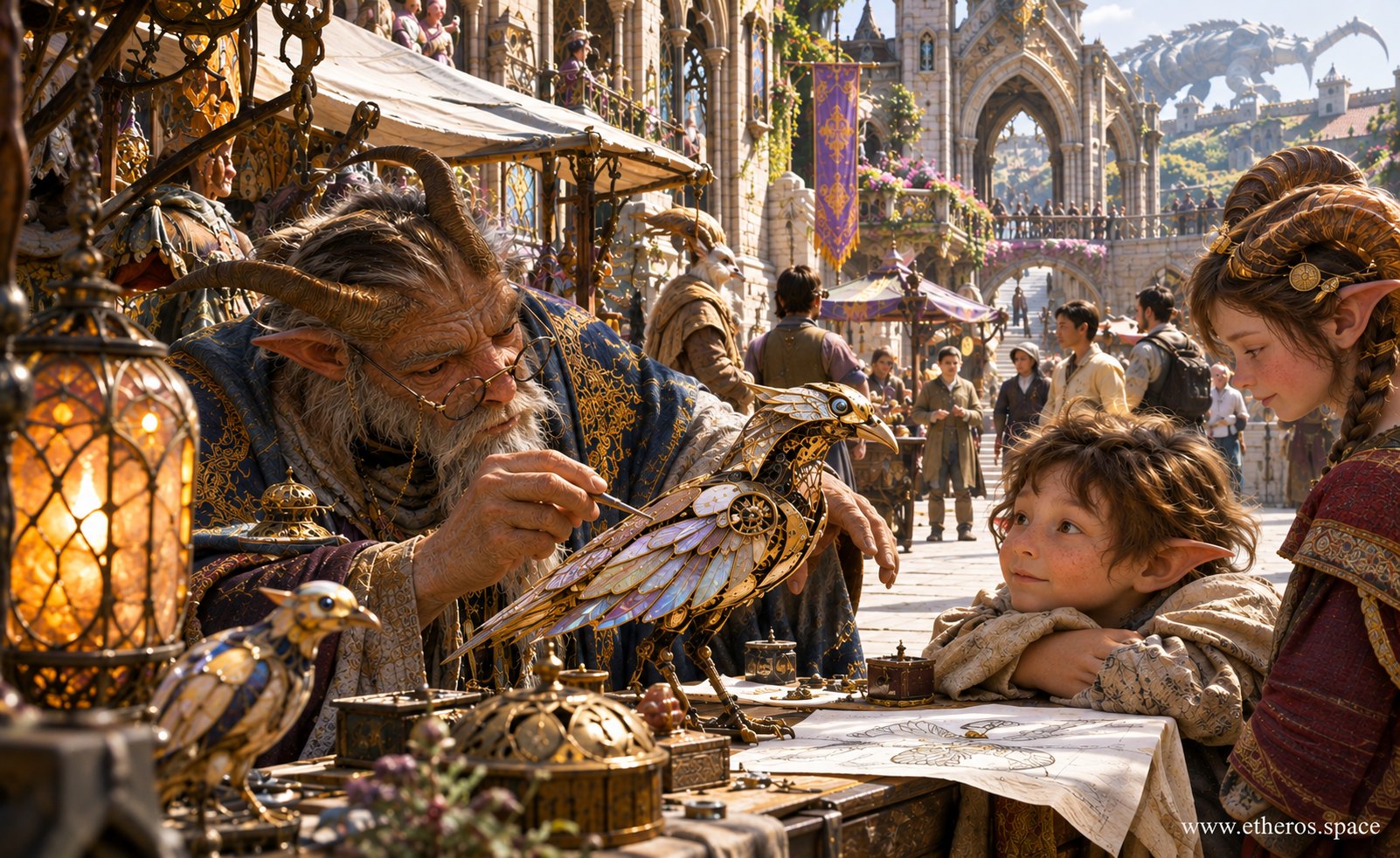
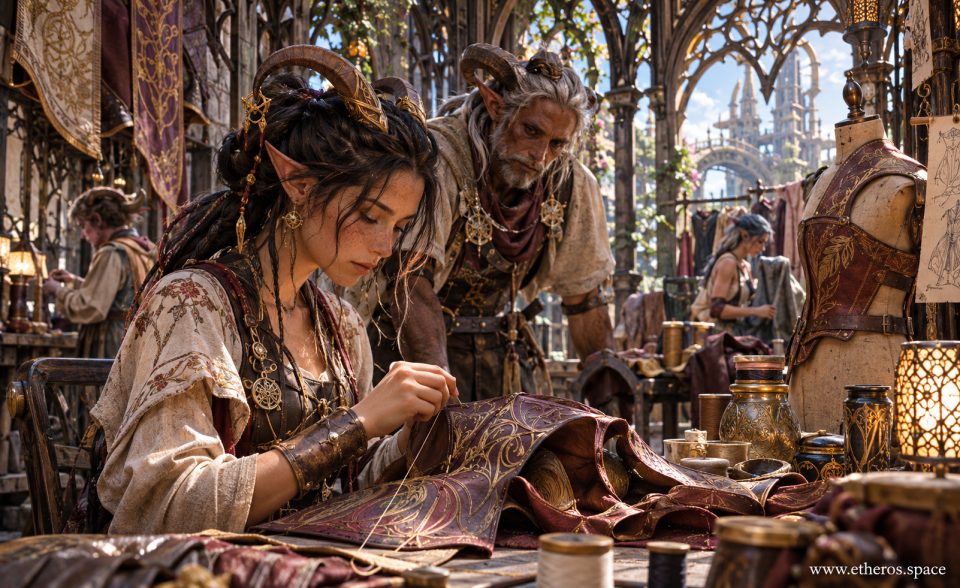
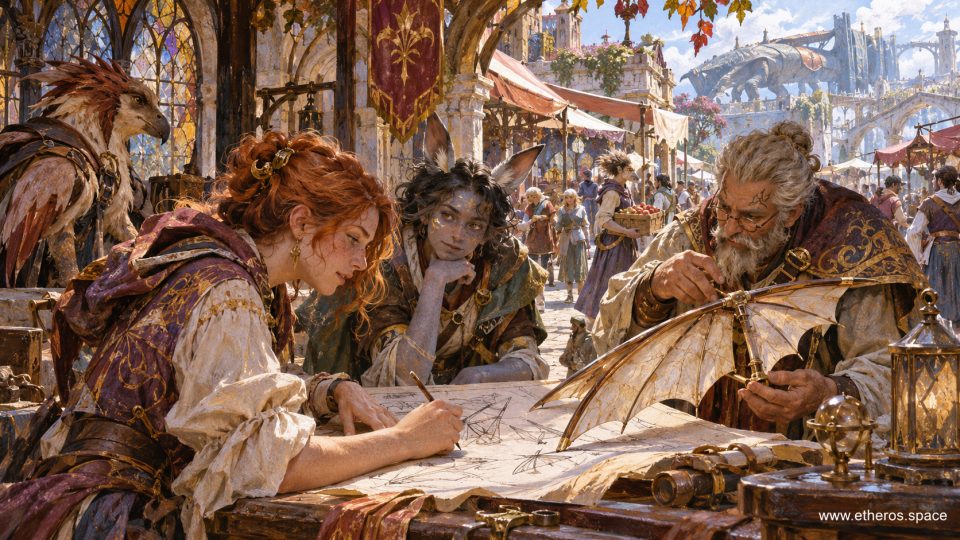
Aurell Sol held her pen over a circle of fine blue lines. Her dark hair was fastened with a small gold ornament, and the cuffs of her cream sleeves had become grey from shifting dusty ledgers. To her left, the old registrar Vorran leaned forward, his curled horns emerging from silver-brown hair. He wore a purple brocade coat whose repairs had been hidden inside the embroidery. His hand stayed near his chin while he listened. Across the chart, a young blue-violet courier named Iven rested a cheek upon one hand, looking at the tip of Aurell's pen rather than at the elder.
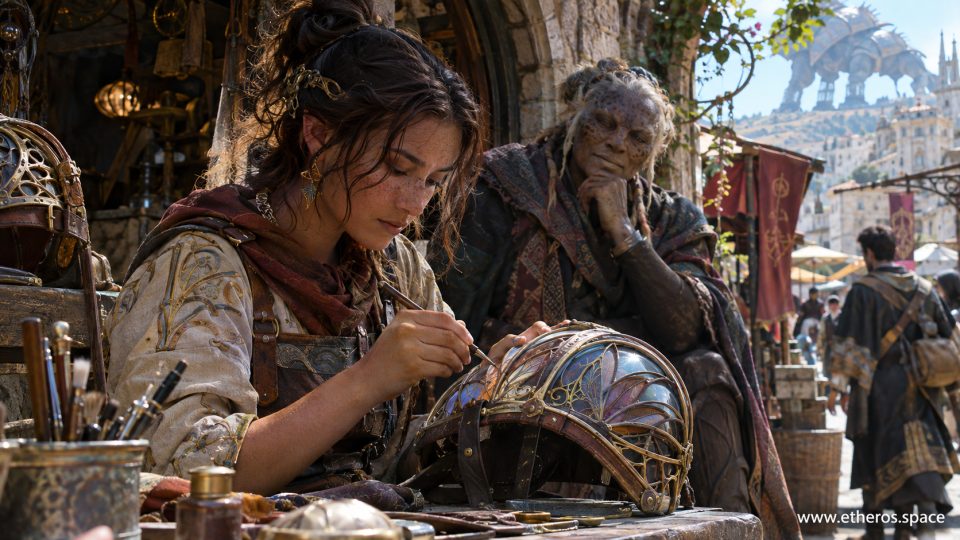
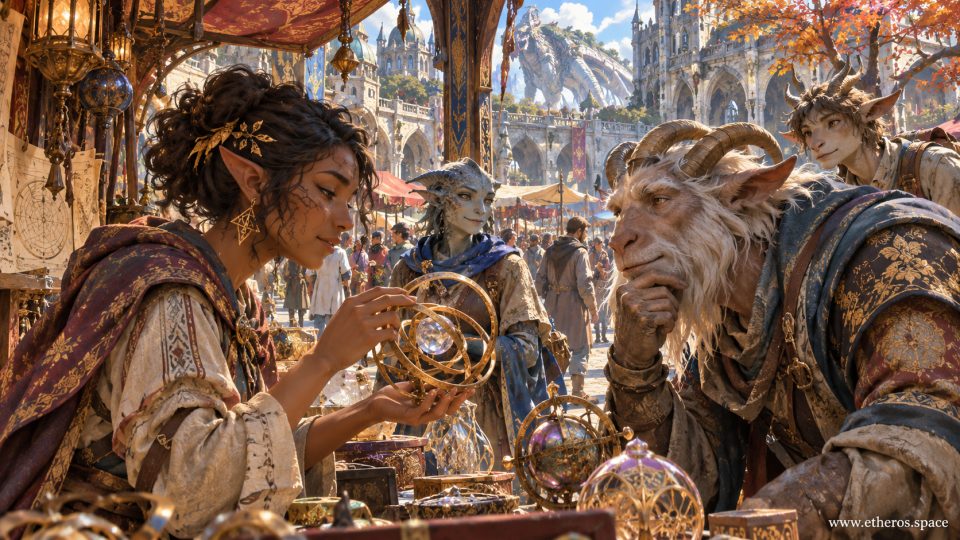
Behind them other readers moved between shelves. A worker copied a page beside the open arch. Beyond it, an immense organic-mechanical shape was partly visible beyond the bridges, too distant and obscured for anyone in the registry to say what it was carrying. The city went about its errands anyway. Cups cooled on desks. A little set of violet crystals caught the light beside the brass armillary. Paper kept accumulating.
The trouble had arrived folded into a freight notice, not as a catastrophe. On the eastern Antherine road, a survey had discovered that a trusted measuring ring had been catching once every revolution. The copied notice bore the name Ila Venn, a hill observatory's chart keeper. It did not say the road had collapsed; it said the old line had overstated its certainty, and that a smaller, real shift in the road remained. The distinction made the bell at Bellglass ring for an extraordinary session that nearly everyone considered inconvenient.
By noon the freight guild wanted its load permits signed. Two bakery districts expected their grain deliveries. The night couriers expected their wages. A ridge clinic awaited jars of mineral salts. Neither ignoring the warning nor cancelling every journey would leave the city unharmed.
Vorran had already drawn a clean black stroke around the unsafe weight band. 'Do not authorize anything above this line,' he said.
Iven looked at the mark. 'If you simply close the heavy route, all those deliveries will be put onto the lower stairs. The stairs are narrow, and they have no place for the beasts to rest. We've sent them there before.'
'And the high route?' Vorran asked.
'It will hold lighter traffic, if the bridge wardens agree. Not everything must travel together.'
Aurell laid a narrow straightedge across the circular chart. The instrument at the right-hand edge of the table tracked the changing angle of the morning light, but she was using it only to place the existing public route periods on a common scale. The small crystals were weights for keeping curled vellum flat. Nothing on the table could make the mountain stronger. It could only help them describe the decisions accurately.
She separated the single thick freight line into three smaller passages. Food loads could use the upper road in pairs with long intervals between. Heavy material would wait for the wardens' physical inspection. The clinic parcels could be carried on the eastern stair by short-footed couriers without borrowing a freight animal already near exhaustion.
Then she stopped drawing. Three passages meant more trips, and more trips meant more labor. She had written in the roads and the weights, but not the time that living carriers would need to recover between them.
'Your chart has made another kind of mistake,' Iven said softly.
Aurell looked at her. For a moment she felt the heat rise under her freckles; she had been trained to make the diagram beautiful, and its rings now closed so neatly they seemed complete.
Vorran unfolded the copied hill notice again. In the margin, below the measured angles, the observatory had left a plain instruction: distinguish what the instrument reports from what the ground will bear. Aurell read it twice. Then she drew open spaces between the freight marks and wrote rest intervals inside them.
'Who approves the extra hours?' she asked.
Vorran did not answer at once. This was not a problem that an armillary could solve. The guild would object to wages paid while nothing moved. The riders would object to another route declared safe by people who had not walked it. And the bakery districts would object to receiving food late, even if it arrived with everyone alive.
'I will sign the provisional map,' he said at last, 'if the council also signs the additional pay. And Iven will take it to the bridge wardens before we stamp a single load pass.'
'Ask them where the resting places actually are,' Iven said. 'Not where we have drawn them.'
Outside, somebody called for another ledger. A student at a back shelf laughed at an unrelated joke. The great plated silhouette slipped behind the nearer arch, its purpose still unknowable from this room. Aurell left the final ring unfinished, not through uncertainty about the pen, but because the people who used the road had yet to answer.
For the first time all morning, Vorran seemed pleased by an incomplete chart.
The map would not open the mountain. It would not carry grain or mend stone. It would tell people precisely where knowledge ended, and give them room to do the necessary work beyond that boundary.
Aurell wrote in the margin: 'Provisional — ground inspection and fair labor terms required.' Then she put down her pen and gave Iven the first copy, without waiting for the pretty gilt seal.