The Last Manifest Before the Glass Keel
20261102T223224217783-0800_074percent.png
Story
The Last Manifest Before the Glass Keel
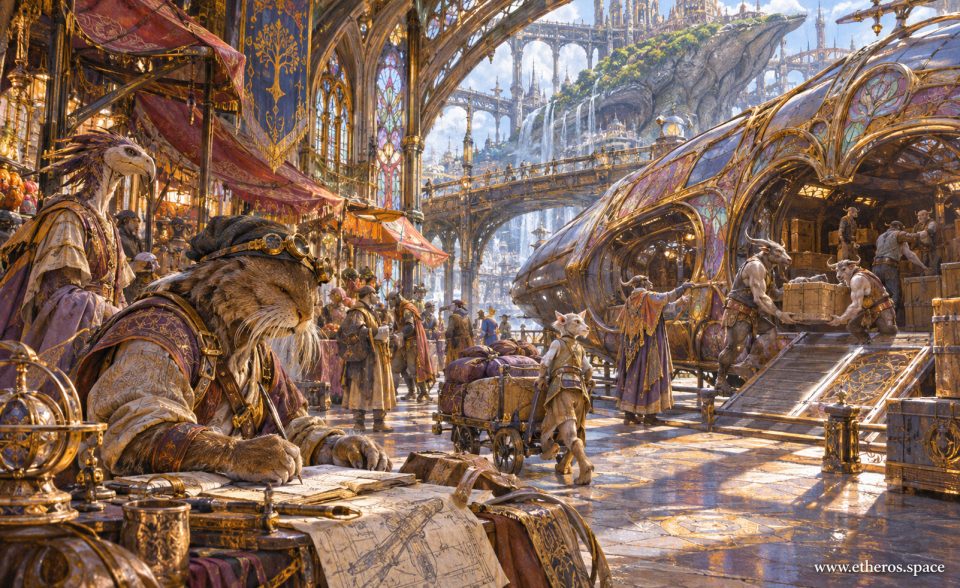
By the time the first pale light reached the arches of Vardel Exchange, the freight hall had already been awake for six hours. Sunlight, broken by stained glass, fell across the damp gold floor in long, uneven panels. Beyond the terminal's open edge, bridges crossed a canyon threaded with waterfalls. Inside, the great glass-backed carrier waited with its loading ramp lowered, its bronze ribs contracting almost too slowly for the eye to follow.
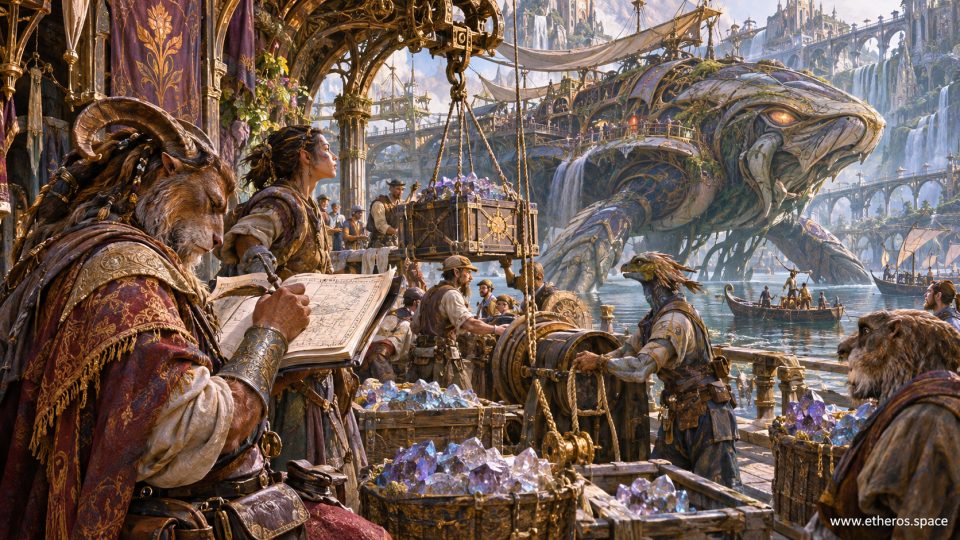
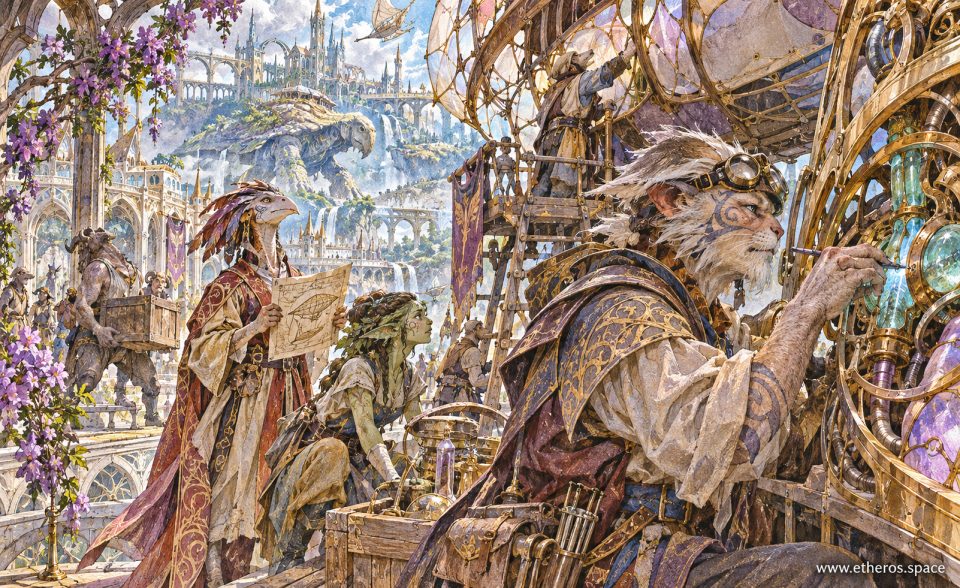
At the ledger table, Odrin Vale bent his heavy whiskered muzzle over a page covered in tiny measurements. The old canal-kin wore a traveler's faded coat, an engraved shoulder harness, and a pair of brass lenses pushed into his fur. In his youth he had been strong enough to shift a mooring beam alone. These days his work was quieter: counting what left the city, and what might never come back. Every crate meant something to someone at the end of the route. A number written carelessly here could become an empty cupboard three valleys away.
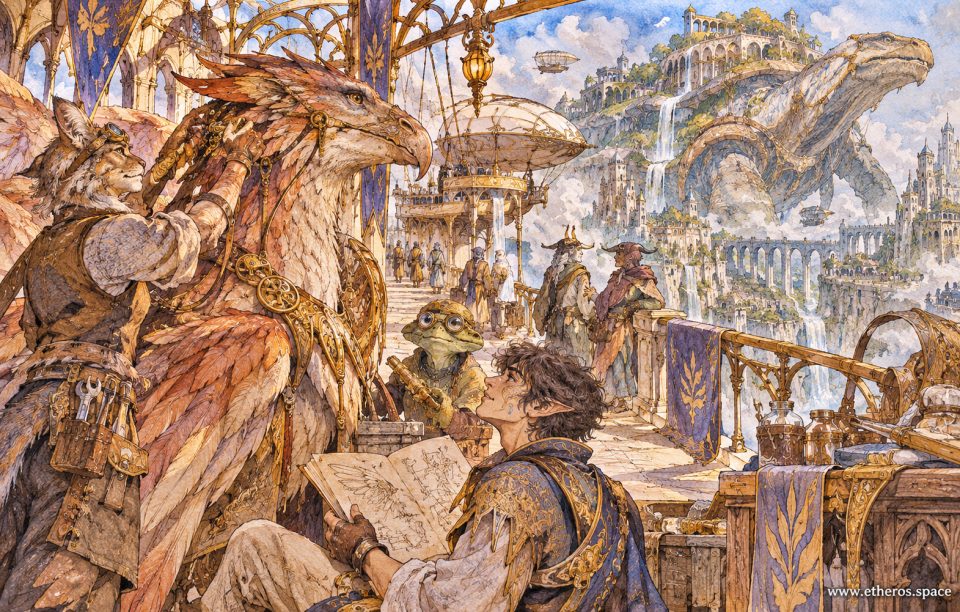
Above his left shoulder, the long-necked avian courier Nareth watched the bustle without interrupting. Nareth could read the faint changes of pressure along the living keel of the carrier. The glass-and-metal shell was not simply a hull; beneath its ornamental panels ran responsive tendons, hydraulic sacs, and a vascular mesh that carried coolant from the canal beneath the platform. A throat of soft cartilage flexed along the upper gantry when the cargo doors opened. The ship would not depart until its balance membranes agreed with the load recorded in Odrin's ledger.
A line of horned dockworkers passed square wooden cases hand to hand at the foot of the ramp. The two at the top took a box together, placing their feet against the incline before lifting. Behind them, a smaller tawny-furred porter leaned into a wheeled trolley bound with violet cloth. Around the terminal, traders hurried beneath canopies, guards made way for the carts, and passengers peered through the arched windows at the day beyond the cliffs. Everyone moved as if the building itself breathed in rhythm with them.
Odrin had noticed an imbalance just before sunrise. The ship's right buoyancy chamber had warmed faster than the left, yet the cargo list showed identical weights. A courier had blamed the sun. The shipwright had blamed a sleepy sensor. Odrin blamed a missing line on the manifest, because the wooden cases marked for the western cistern had been counted as ordinary building stone when they held heat-retaining ceramic hearts. The distinction mattered. In a living vessel, mass was only half the question: heat could change pressure, pressure could change muscle tension, and tension could pull a whole traveling district a handspan off balance.
He dragged his thumb along the record, then marked the line again. Not a dramatic correction, not the sort of deed sung about in the taverns under the high bridge—merely a patient old clerk refusing to let an error travel farther than his desk. Nareth tilted his narrow head. The carrier's ribs gave a short, almost audible click as the balancing valves recalculated. Farther down the platform, the workers paused with a crate between their hands. Nobody shouted. They simply waited for the long bronze ramp to stop trembling.
Outside, water poured over the terraced stone. The ancient load-bearing ridge above the city was veined with living greenery and reinforced with biomechanical arcs; it distributed runoff to the lower streets and took the strain of the elevated crossings. Children on the upper walkways would later look down and see only a beautiful morning. They would not know how many routine adjustments had kept that morning beautiful: a closed coolant valve, a properly lashed bundle, a signal answered before the next axle passed, an accurate line of ink.
When the right and left pressure columns finally agreed, Nareth touched two taloned fingers to the desk in the old courier sign for safe passage. Odrin did not smile at once. He finished his last numeral, checked the subtotal, and sanded the ink until it would not run in the damp air. Only then did he nod toward the ramp. The porter pushed the violet bundles onward. The horned workers resumed their careful chain. The ornate living hull held steady, its windows bright with river light.
Somewhere beyond the visible bridges, families were waiting for the ceramic hearts and the repair timber, unaware of the small hesitation at Vardel Exchange. Their ovens would be lit before nightfall. Their water pumps would rise and fall in time again. Nothing in the destination would bear Odrin's name. He knew that; it was part of why he kept the ledger so faithfully. On Etheros, much of the work of keeping life possible passed without witnesses. The world's great bodies lifted cities, nourished watersheds, and bore impossible weights. Its smaller hands made sure those wonders arrived where they were needed.
Nareth stepped away to call the departure signal. Odrin looked once at the crowded platform—the glass keel, the scarred boots on the ramp, the patient little trolley, the terraces beyond the light—and turned the page. There was another column to check before the next vessel came in.