Where the Small Footsteps Turned
20261103T184133862622Z_069percent.png
Story
Where the Small Footsteps Turned
The night survey began with seven missing heartbeats.
Across the red country of the Kareth Plain, the night-runner herds made their yearly passage between the thorn groves and the basalt shelters. Three lantern-antlered sentinels were visible upon the distant ridge. Their small lights marked the herd's customary route, and the crescent moon gave just enough silver to distinguish the grass from the cracked earth. But the smallest animals, whose footprints usually ran between the sentinels' larger tracks, had vanished from the census.
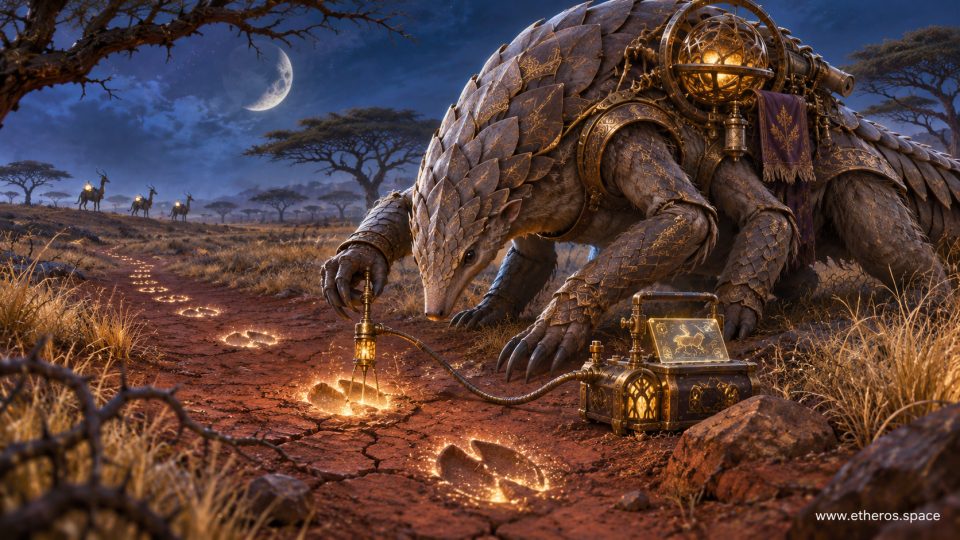
Iruven, keeper of the South Trace, lowered his plated snout toward the ground. He belonged to a burrowing, many-limbed lineage whose heavy claws could open stone-crusted soil without crushing the life beneath it. Most visitors took his articulated bronze frame for a ceremonial saddle. It was nothing of the sort. The frame distributed the weight of a sensing lantern across his shoulder plates, keeping its warm metabolic core off the tender scales along his spine. He had inherited it from a fieldworker who had died before teaching him everything it could do.
The lamp glowed in a ring of engraved brass. From a sealed charge vessel near the creature's back, a braided insulated conduit ran to a small reader resting on the earth. When Iruven settled the reader into the first clear print, the instrument measured minute compressions and the faint mineral reaction left by a hoof. Amber light rose from its aperture. On the path behind him, disturbed grains already carried a weaker natural afterglow, so that the route appeared as a scattered constellation laid into the dust.
He counted the broad marks first. Then the smaller ones. Four, five, six, and a seventh hardly longer than one of his claws.
At the fork beneath the acacia, they turned away from the herd.
Iruven kept his head down while the sentinels waited on the skyline. There was no sign of struggle. No drag mark, no sudden spray of gravel, no pressure hollow where a frightened animal had fallen. Instead, every small print had been placed carefully, and each rested within the shallow channel of a much older passage. The youngsters had not fled. They had followed something that the adults had forgotten.
The old route led toward the westward salt crust, a place where the red soil became thin and brittle. The elders had closed it two generations ago after a mining conveyor collapsed and left fractured plates under the grass. Most maps labeled the ground unsafe. Iruven remembered the closure because he had been a juvenile when the warning bells were first set. He also remembered that a certain pale burrowing insect used to hatch there just before the seasonal migration.
His instrument flickered. The compact display drew a small outline of a hoof, then a broken circle around its heel: an unusually light tread. Young animals. All seven.
The light ahead was not calling to them. It was recording where they had gone. That distinction mattered. The lantern could reveal an imprint, but it could not tell him why the bearer had made it.
He turned the instrument toward an older mark and compared the pressure ridges. The same soft heel, the same narrow toe. Beneath it, the soil's conductive dust had shifted in a band no wider than a grass stem. The westward ground had settled since the mine was abandoned. Something below had opened a passage through the broken crust.
For a moment, Iruven felt the old anger return. The quarry had paid the village for its stone and left the animals to learn the consequences. The safety posts still stood, but no one had returned to see what the injured ground was becoming. The plain was healing without permission from its surveyors.
The three distant sentinels raised their lanterns in the slow rhythm that meant they would hold position. Iruven did not need to shout across the field. Their lights told him the adults were safe, and his little reader was sending back enough information to sketch a temporary route. He marked the western fork as a living corridor, not as a reopened mine road. A corridor could be watched, sheltered, and restored. A road, once named, too easily became an invitation to take.
He would follow the seven small footprints before moonset. At dawn he would bring the elders to examine the ground themselves. They might discover that the pale insects had returned. They might find only a sheltered place to sleep. Either way, the vanished heartbeats belonged to living creatures, not to the blanks on a census ledger.
The lamp's glow settled into a steady pulse. Iruven drew his sensor out of the track and folded its tiny legs so its weight would not mar the next print. Beside him the older hoofmarks continued across the cracked earth, each brief luminous edge fading as the mineral charge cooled.
Somewhere in the darkness ahead were seven young travelers, a damaged place quietly mending, and a piece of the planet's memory that had never been entered into the records.
Iruven lifted one great claw, placing it carefully between the tracks, and followed.