The Shape of What We Leave — Evening at the Keshar Salt Steps
ETHEROS_20261104T152356867754Z_066percent.png
Story
THE SHAPE OF WHAT WE LEAVE — EVENING AT THE KESHAR SALT STEPS
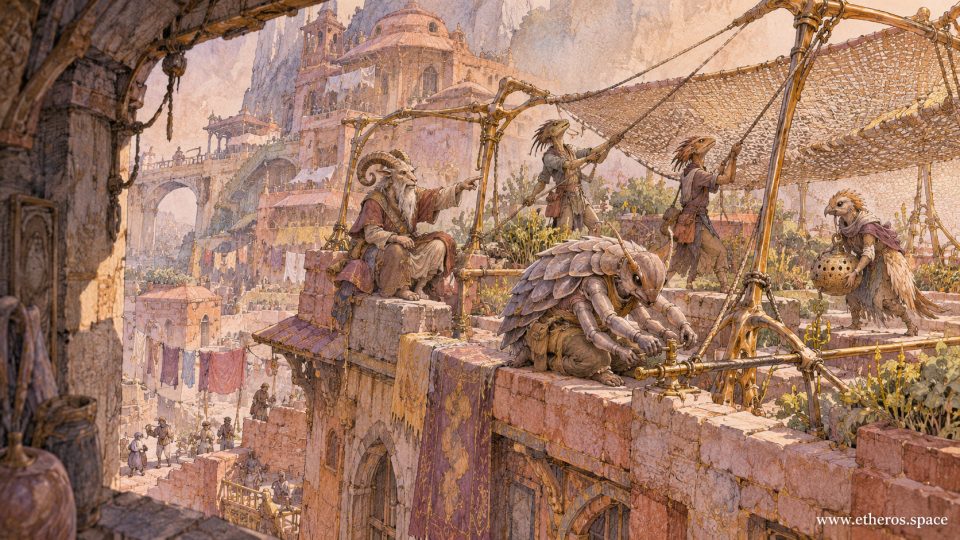
The last freight sled crossed the white flats with its runners grumbling over the crust. Two haulers bent into the straps, followed by their shadows, longer now than the road itself. Above them the town of Keshar clung to the red cliffs: galleries with woven roofs, a stair under a carved arch, and rooms dug into the living rock. The salt quarry had built most of those rooms. It had also made the flats a place where every hour of daylight belonged to somebody.
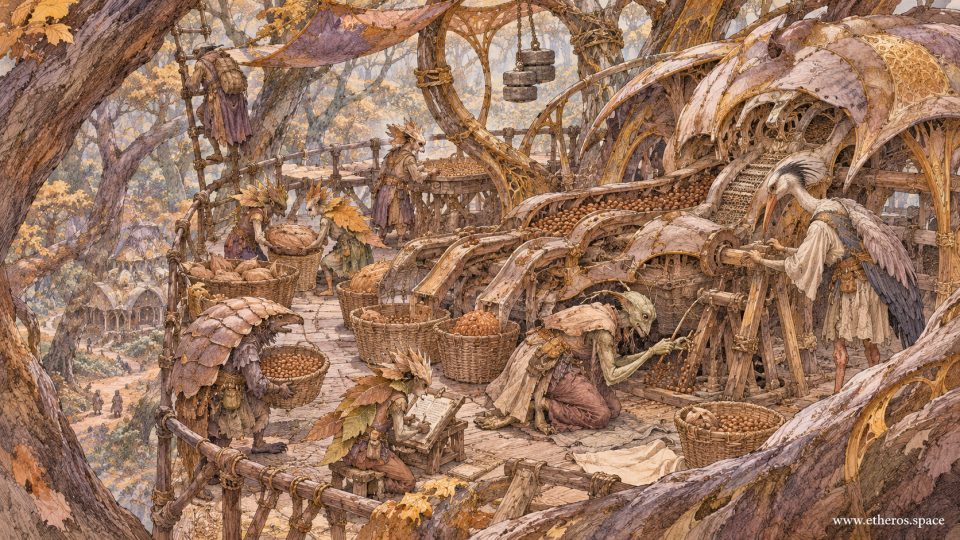
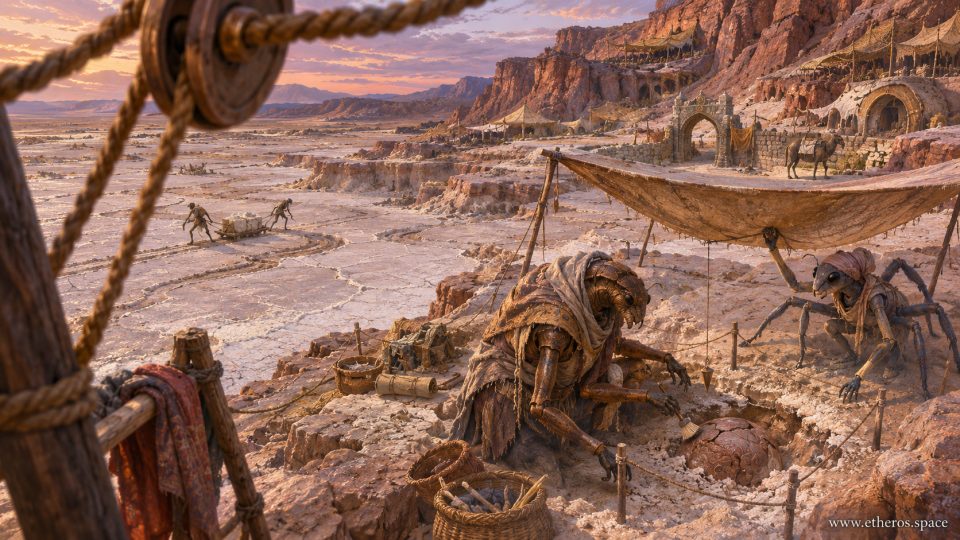
From the upper scaffold, one could see a wooden hauling wheel and a thick rope descending across the view. Below it, a little patch of ground had ceased to be a quarry. Four pegs marked the corners of a shallow cut. A shade cloth hung low over the workers, not because of rain—there was none—but to stop the dying sun from hardening the newly uncovered earth too quickly.
Rhel Vaska had gone to collect the final day's salt tally when the tool struck something hollow. He was a broad, copper-shelled digger with a worn cloth around his neck and fingers that could sort sharp salt flakes without breaking the skin beneath. He could have lifted the thing out in a minute. It would probably have brought three weeks' wages from the traders camped on the ridge. Instead he put down his pick, called for a soft brush, and stayed on his knees.
Now the reddish, ornamented shoulder of an old vessel showed through a collar of chalky soil. One side was cracked. Nothing moved inside it. It might have held dried seeds, household ashes, or merely a family's drinking cups. The patterns on its surface were not legible enough to tell. Rhel eased loose grit away with the brush while Nemi, a slender, many-limbed traveler with a dusky head scarf, held the canvas taut above him. Her other hand steadied a stake when the ridge wind caught the cloth.
"The quarry master wants this section cleared by first bell," Nemi said. She had been hired to sort the hauling ropes, not to defend dead pottery. "The road crew needs the salt before the cold changes the crust."
"I know." Rhel worked the brush along the rim. "They still need the salt if I break this. They will never need this exact earth again."
The argument was not simple. The haulers had children who slept in Keshar's cliff rooms and bought their suppers with the weights they delivered. A day's delay could leave a family short of fuel. But the vessel was resting beside a line of darker stones and a narrow stripe of ash. Remove it without recording that order, and even a perfect pot would lose half its story. Nemi was the one who noticed that the ash stripe continued beyond the marked corner of the cut.
She knelt on her rear limbs and asked Rhel for the thread from his field kit. With one narrow hand she held the knot; with another she tightened it between pegs. The line made a little square of the dig, no larger than a supper table. In that measured square the vessel's broken shoulder suddenly belonged to the ground around it. A buried place was becoming something they could speak about honestly.
Above them a pack animal waited beneath the arch, patient with its heavy load. Someone on the long terrace called that the descending team should move before darkness. Rhel waved without standing. The rope wheel creaked once and went still. It was the sound that frightened him most: not collapse, not a mystery, just other people's work pausing because of his decision.
Then Nemi made a proposal. The east runner was firm and the west runner had already been cut. If the haulers took the west path for one evening, they could keep their loads moving while the marked square remained untouched. The longer way would cost each team a little time; the cut could be mapped before morning. Rhel studied the steep ground and said they must ask the haulers rather than announce it. A path suitable for a surveyor's boots was not necessarily suitable for someone dragging a full sled.
The first hauler came down, tested the west runner with his heel and objected to its loose stones. The second, who had the lighter cart, offered to lead and clear them. Nobody called the plan noble. They counted its cost in breath, daylight, and the number of journeys remaining. Finally the first agreed on the condition that next day's work begin from the safer lower ramp. Nemi wrote the agreement onto a strip of scrap linen, and Rhel added his mark. They would show the same terms to the quarry master, who might still be angry.
Rhel remembered a mountain tale told to young diggers: that the living rock allowed people to borrow its bones so long as they learned what they were taking. He did not know how old the tale was. His own grandfather had never claimed to know. It made no sense as a measure of salt, and yet there it was in the way he held a brush instead of a blade.
By the time the first star appeared, only the top of the vessel was clear. They left the rest in the ground, covered the cut with a breathing cloth, tied the corners to the stakes and wrote its measurements where the night's wind could not take them. They had not discovered a kingdom, explained a vanished people, or found a cure for the troubles of their own town. They had saved a small arrangement of evidence from being turned into a pretty object without a history.
As the haulers took the longer track, their voices traveled across the flats in an uneven rhythm. Rhel stayed to check the ropes. Nemi watched the fading outline of the vessel until the last copper light withdrew from its cracked rim. Whatever had been placed there, whoever had carried it, the old clay would now have another night in its own earth. Tomorrow, perhaps, it would have a story that could be shared rather than sold.