The Hour That Belonged to Everyone — Afternoon at Veilbridge Court
20261106T181410080517Z_033percent.png
Story
THE HOUR THAT BELONGED TO EVERYONE — AFTERNOON AT VEILBRIDGE COURT
Primordial Etheros, the upper courtyards of Velisar; late afternoon
At Veilbridge, the sunlight had always come between the stone arches in a narrow wedge. The oldest residents could tell the hour by which flower it touched. No bell was required. It lit the copper-leaved bed, crossed the little square of paving, and vanished under the suspended footbridge before the day was properly cool.
Then the bridge acquired a canopy.
The lower houses needed its shade. Delivery carriers and elders used the high walkway when the sun stood fierce above the ridge; there were days when even the stone became too hot for soft feet. The new woven awning, rolled on a brass spindle above the arch, promised a gentler passage. But its first full extension would have darkened the courtyard below. Oruv's small collection of sun-fed herbs grew in that strip of light, and several neighbors depended on the cuttings to keep their winter rooms fragrant and alive.
So nobody had simply raised the screen and declared the work finished.
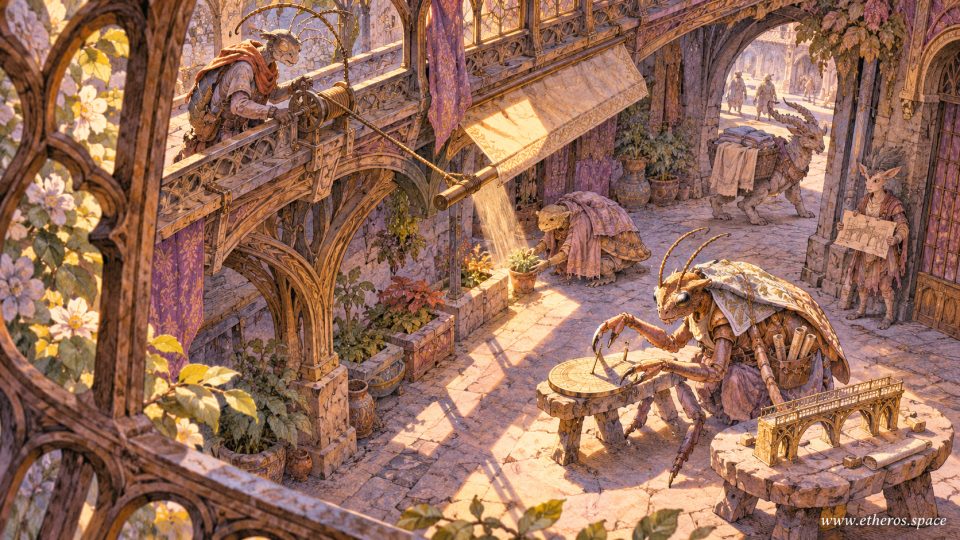
Nareth had brought a portable sun table into the courtyard: a low metal dial on three steady legs, its needle fixed where the afternoon ray could find it. The broad-shelled surveyor crouched over its markings, setting a slender pointer against one engraved division and then another. Beside the dial stood a miniature of the actual bridge, made not as an ornament but to test the fall of shadow against the geometry of the old arches.
Above, Teren waited at the winding drum. His shellcloth hood fluttered as he eased a lever by half a tooth. A taut rope led from the spindle across the carved parapet to the canopy's long support. The cloth shifted only a finger's breadth, but on the stones below a bright patch slid toward Oruv's herb pots. Nareth moved the pointer and scratched the position onto a waxed card. The same experiment would have to be repeated when the sun stood lower.
Oruv, old enough to remember the bridge before its upper rail was gilded, knelt beside a plant and turned its earthen pot. It had survived two transfers of soil and one season of bitter wind. This was not a demand that the bridge remain unchanged. Oruv had walked that burning upper path too. The question was whether relief for one set of feet must be purchased with darkness for the lives below.
From the doorway, the young plan-bearer Lessa unfolded a drawing so large that its corner almost touched the ground. On it she had traced the bridge's load-bearing ribs, the cloth's sweep and the small right-of-way used by carts passing the court. Her first version had been wrong. She had measured the shadow at noon, when the herbs were resting, and forgotten the late hour when they took their last warmth. Now she stood where she could compare paper with stone, refusing the easier defense of an elegant mistake.
Beyond the arch, Hurren, a horned courier with bundled cloth across his pack, watched the work for a moment before continuing through the street. He knew why the shade mattered. Long journeys taught the body a precise account of heat. But he also knew the cost of a badly planned shortcut: a street convenient for its first users could become impossible for everyone else.
Nareth proposed no miracle. The upper screen would be shortened where the westward light entered, and Teren would mark three positions on the winding mechanism rather than one. A keeper would open it at the hot hours and draw it back when the herbs needed the sinking sun. On days of unusual heat, the residents would decide together which burden was greater. The mechanism could be locked safely; its cables would be checked each season, and the keeper would be paid rather than presumed generous forever.
Lessa added a narrow line to the plan and, beneath it, an empty space for the names of those who would maintain the pulley. Oruv did not smile at once. Neither did Teren. The adjustment was more work; the window of light was smaller than before. Yet a usable compromise could be measured and revised. That was something a promise alone could never offer.
When the spindle clicked into its new notch, the courtyard brightened just enough to reach the smallest pot. Oruv leaned close to examine a leaf. Above, Teren held the handle until the rope settled. At the sun table, Nareth recorded the angle without ceremony. The bridge remained a bridge. The herbs remained fragile. For one afternoon, the inhabitants had made a little room for both.
In the late light, no one called it victory. They called it an hour worth keeping.