The Seeds Outside the Measure
20261104T162753003809Z_024percent.png
Story
THE SEEDS OUTSIDE THE MEASURE
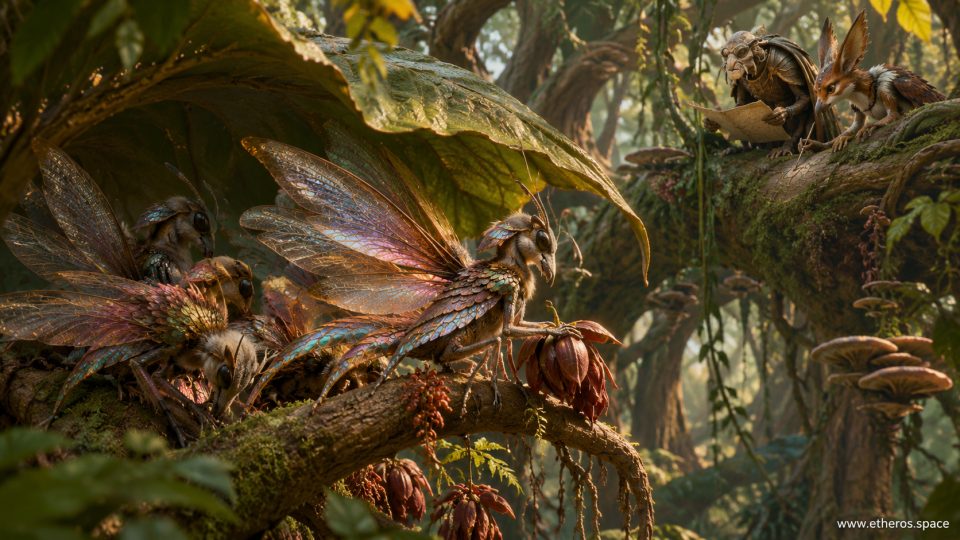
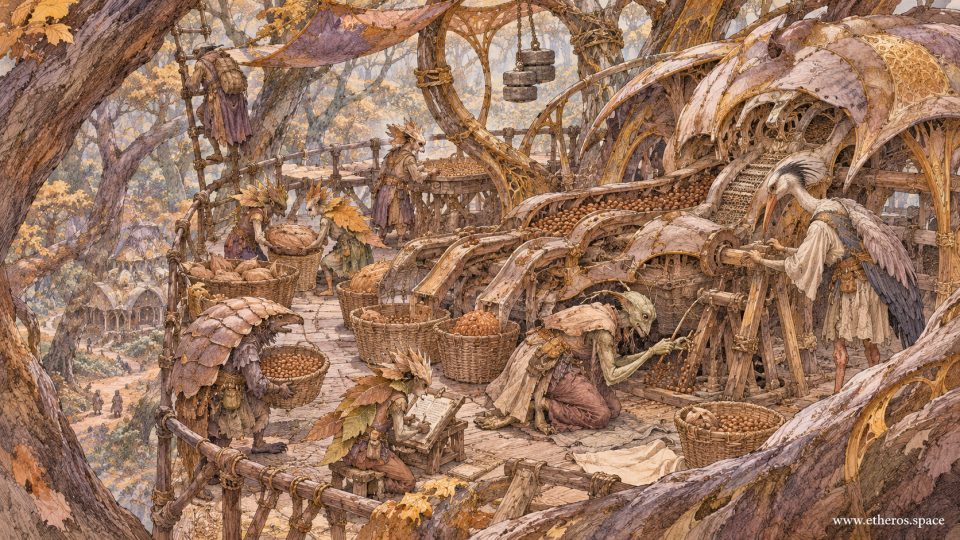
Above the lower forests of Leafthresh, the day's work began with a peculiar sound: not the crash of a new invention, but a thousand little dry seeds rolling through the ribs of something that had learned to count. The sorter was built into a broad branch platform with ropes, counterweights, latticed throats and wooden gates whose carved edges followed the grain of living timber. Its cream-colored hood curved over a sloping bed of brown seedpods. Below, baskets gathered the harvest in heaps too modest to feed a city and too important to misplace.
There was no one standing before it for a portrait. Each worker had somewhere to look and something to hold. Neris, a pale long-beaked, wing-backed operator in a blue-gray work mantle, kept one hand near the lever that controlled the bed's descent. Ruvo, green-faced and narrow-shouldered, crouched beneath the forward lip with a small hooked implement and listened to the rattle of a troubled gate. Brakka, an older shell-armored porter, rested a full basket against the rail rather than set it upon the suspended plank. At a low desk Ilven, whose leaflike crest spread across one shoulder, recorded the day's counts. Above them, Sella shook another shallow tray into a receiving funnel. Two smaller carriers were occupied with baskets near the upper rail. Farther down the slope the round roofs of other dwellings showed between trunks.
The old hand-sorting tables had once filled the entire walkway. Families earned their share by learning to distinguish seed from husk by weight, sound and the soft resistance of the shell beneath a thumb. Since the new machine had been fitted beneath the painted canopy, one crew could separate in an hour what six crews had once handled before dusk. On paper that meant fewer bruised fingers and more time to tend the forest. On the wage board it also meant fewer paid places. The council had never decided who should receive the saved hours.
Ruvo had helped install the sorter. The thought that troubled Ruvo was not whether it worked; it worked almost beautifully. In the slanted light, every counterweight and tensioned line had a reason. Seeds passed downward under their own mass. A lever changed the slope, a fine mesh caught the smallest fragments, and the woven baskets stood beneath the chutes. Nothing floated. No unseen giant held the machinery in place. The branch below was thick, but its old bark had been reinforced where the load pulled hardest. The only mysterious thing was how an invention could be so correct about force and so uncertain about fairness.
A little before the afternoon bell, a basket arrived from the far platform bearing an irregular selection of seeds. They had passed the new sieve as sound, but when Brakka turned them under the light, several showed a hairline darkening at the seam. It was a defect the machine's screen could not feel. Neris stopped the intake, and the rolling sound faded. Ruvo reached beneath the hood, withdrew a handful, and rubbed the hulls against a rough palm. They were not all spoiled. The uncertainty was worse: the next field planted from such a mixed lot would fail unpredictably.
Ilven turned a page of the ledger. The board had columns for volume, weight and loss. There was no column for 'perhaps.' At Vesperhollow, another grain keeper had recently faced a similar question about a precious reserve. A copied inquiry attributed to Sesh, a tally clerk there, had reached Leafthresh by ordinary carrier: could the seed lots be assessed separately from food stocks before anyone promised how much would remain for spring? The note gave no answer, and it did not prove that Sesh had ever visited these trees. It merely asked the sort of question that travels farther than its sender.
Neris had an answer of a kind. The finest seeds could be passed through the machine twice, with a slower slope and a tighter opening. That would reduce waste, but some cracks might still slip through. Brakka suggested returning a paid hand-inspection station to the platform, not as a relic or punishment, but as the last step in a process the machine could begin and could not finish. Ruvo stared at the lever: a worker who fixed gears knew perfectly well how quickly a guild could call a task unnecessary. Ilven asked who would pay for the extra examination. No one could answer before dusk.
So they did the small possible thing. Neris opened a lower gate; the doubtful seeds were diverted into a separate basket. Ruvo loosened the jammed linkage without removing the counterweight. Ilven added a temporary mark in the margin, a symbol everyone present agreed to interpret as 'unresolved.' Brakka left the heavy basket within easy reach of the morning crew, where nobody could pretend it had vanished into the total. The upper workers resumed their slow passage from tray to tray, their movements uneven and unceremonious, and the sorter began to speak again.
By evening the roofed machine had not taken anyone's livelihood back, and neither had the workers solved what the council owed them. What they had done was refuse a falsely clean number. The sound of seeds falling through the ribs rose into the branches, where the village seemed for a moment to be listening. Ilven wrote one more line beneath the tally: 'The instrument measures what we built it to measure.' Tomorrow, before the next basket was filled, someone would have to decide what else was worth counting.