The Fourth Crate at Marrow Quay — A Morning Beneath the Living Sky
20261103T141323091260Z_033percent.png
Story
The Fourth Crate at Marrow Quay — A Morning Beneath the Living Sky
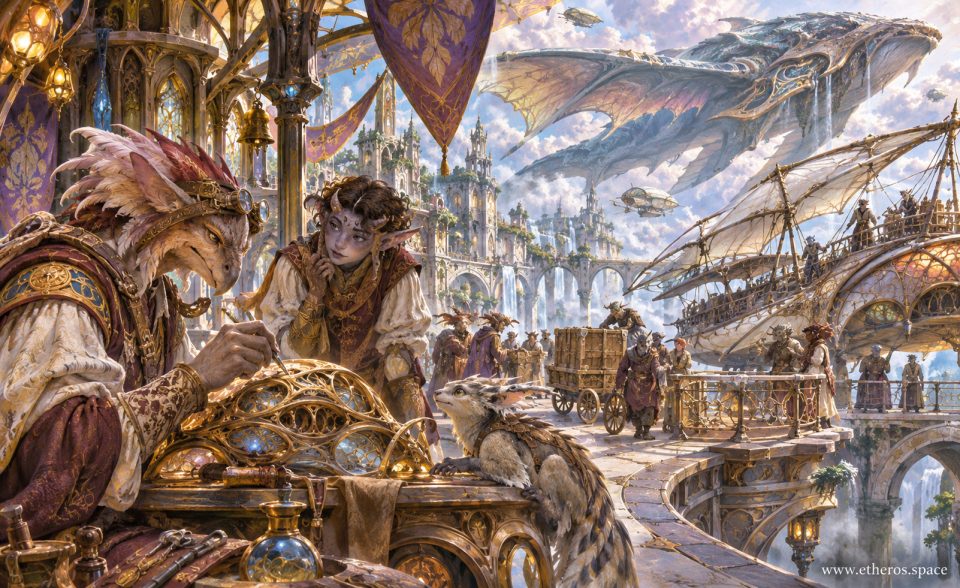
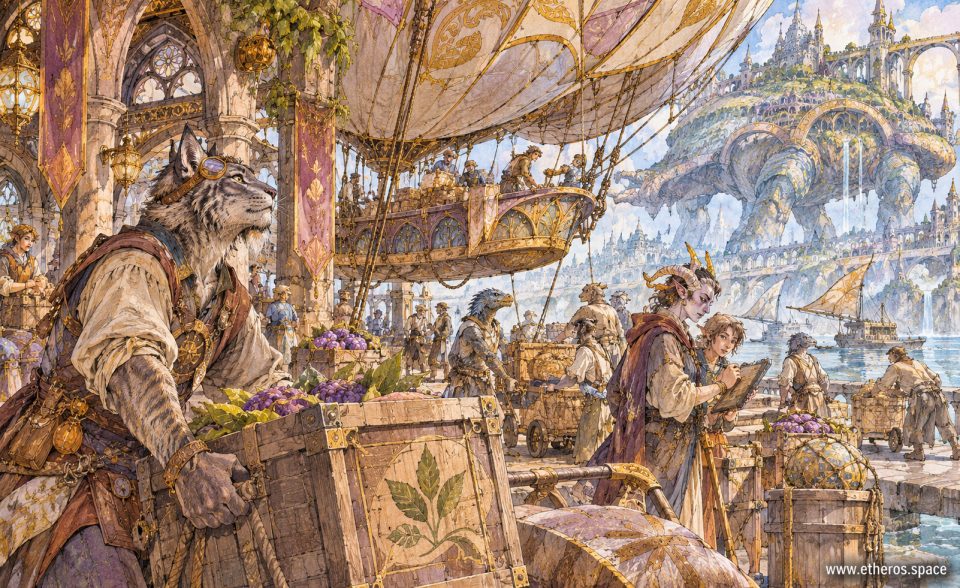
At Marrow Quay, the airships arrived before the tide had finished withdrawing from the lower moorings. Their hanging platforms groaned with wooden chests, kitchen baskets and rolls of reedcloth. Porters moved between Gothic pillars and flowered banners with the practiced impatience of people who knew that every delay in the harbor became somebody else's hunger by evening.
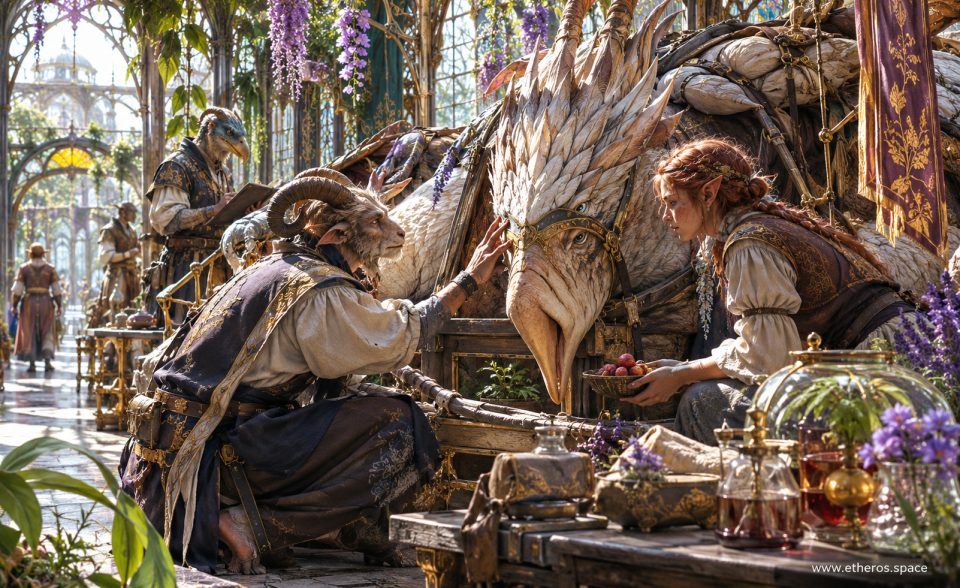
Jaro Fen, a lynx-folk cargo bearer with old brass goggles pushed above his eyes, steadied a wide crate of violet duskroot against a handcart. There was a green leaf painted on the near side. The mark was simple enough for an exhausted deckhand to recognize, but the plant itself was not simple: beneath each purple bulb were capillary filaments capable of keeping the roots alive through three days of dry wind. They were the kind of food that could survive the upper districts' long winters. They were also, if planted alive, the beginning of next year's harvest.
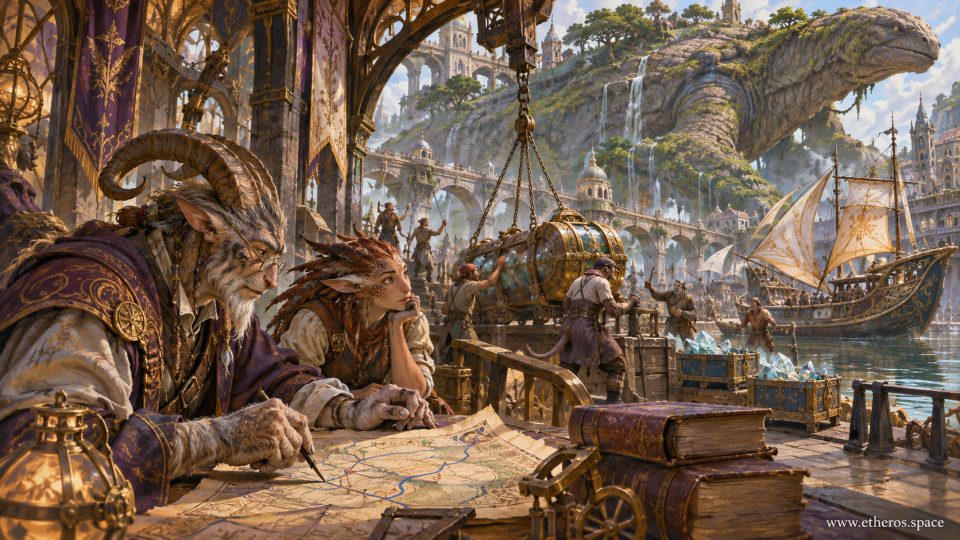
At the dock's other end, two municipal recorders leaned over a slate ledger. The elder, Vessa Oren, wore small curved horns and a weather-darkened burgundy coat. Beside her stood her young assistant, Meret, who had learned to count cargo weights before learning the names of every species that carried them. Their figures did not agree. The gondola above had brought eighteen crates of duskroot, the loading tally showed seventeen, and the school kitchens below the Falls had been promised exactly eighteen.
Jaro had found the missing crate. He had also found the reason for the error. Someone had attached a second label beneath its brass handle: NURSERY RESERVE — DO NOT ISSUE. Both inscriptions were official. Neither had been crossed out. He could have passed it onward and let the error reach the kitchens, where there would be bowls enough tonight and seedlings too few next season. Or he could have held it at the quay, leaving the kitchens with seventeen and a promise that paper alone could not fulfill.
He called Vessa over before the crate reached the counting gate. Meret ran a finger beneath the two labels, then stared up at the suspended ship. Its cargo balcony swayed gently as the loaders passed bundles down in measured sequence. Shifting one heavy case without updating the ballast sheet would make the descent platform lean. Shifting the wrong one could crush a smaller worker at the chains. In Marrow Quay, a number was also a distribution of weight.
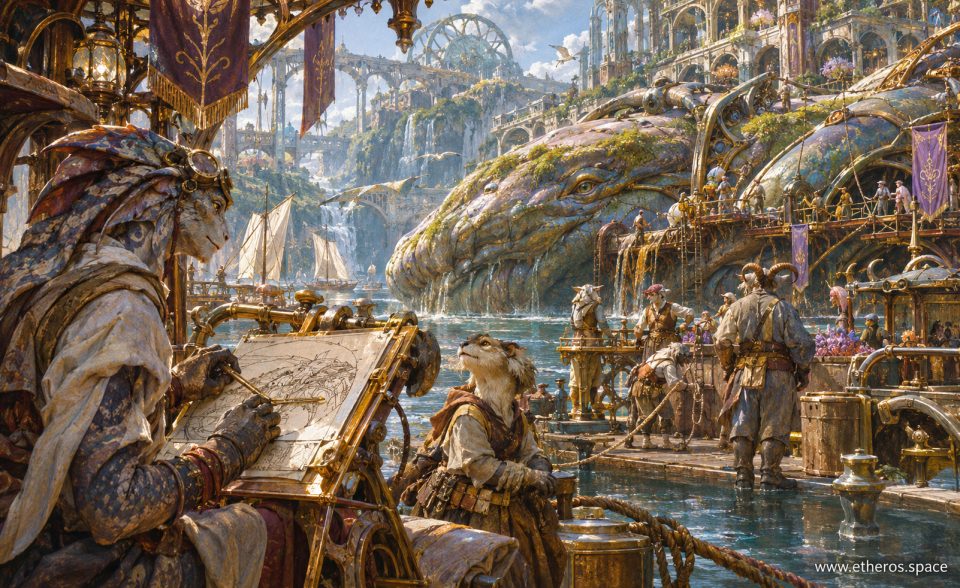
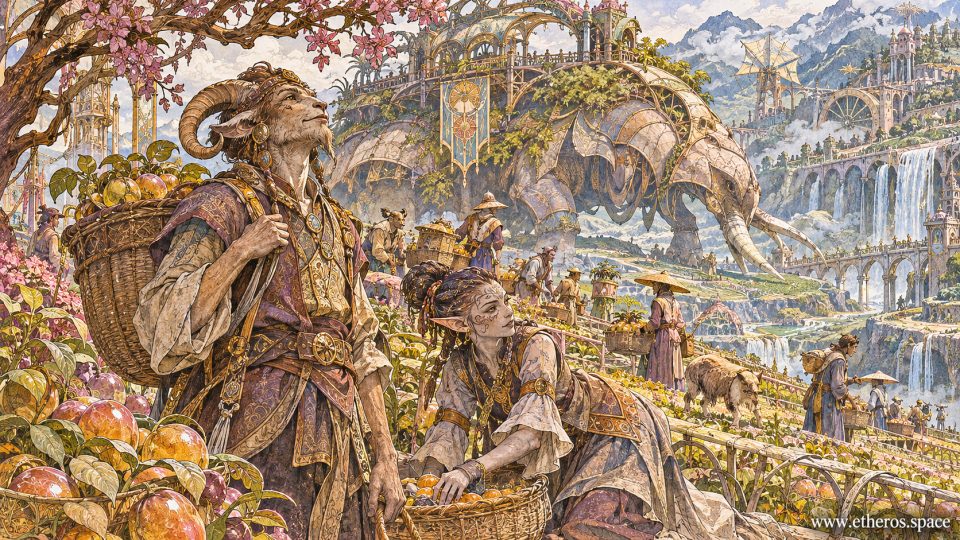
Across the water, the planet-born bearer they called Mother-of-Arches moved behind the terraces. Its tremendous stone-and-cartilage limbs supported inhabited galleries, fountains and water channels; its pace was so slow that its motion was evident mainly in the sliding pattern of shadows on the distant bridges. It was not carrying the morning's root crop. It was replenishing the hills above the eastern reservoir, delivering captured water down a spine of living conduits to the districts built upon its older pathways.
Vessa considered the leaf mark on Jaro's crate. She had been a kitchen steward before the records office discovered that her particular talent was remembering what happened to supplies after they left the harbor. 'If we send the reserve to dinner,' she said, 'the children eat one night. If we send it to planting, they may eat the year.'
Meret shook his head. 'But not all of them eat tonight.'
They argued at the counter while scaled dockhands rolled fresh barrels along the cobbles and a boat moved under the pale sails outside. Jaro listened, one paw braced on the crate. He did not offer an easy third answer. He offered a route. The outer market had received a separate shipment of dried sea beans that morning, but its owners were expecting payment in duskroot seed stock. If the market guild accepted next season's planting shares rather than today's bulbs, the school kitchens could receive beans by the low-water stairs before the evening meal.
The bargain was not charity. It required a recorded debt, signatures from the market boat, and an adjustment to the next three barges' load schedules. Vessa opened a fresh page. Meret made the calculations twice, subtracting the seed crate's weight from the departing wagon, adding the sea-bean sacks to the kitchen route, and checking both against the gondola's remaining counterweight. Above them a bell rang once for the upper landing and twice for the tide stairs. No one was permitted to move until the ledger and the hanging balance agreed.
By noon the fourth crate had been turned away from the kitchens and delivered to the nursery. The school received the beans. Not every child loved them, but every bowl was filled, and the nursery would have viable duskroot when the rains turned cold. Jaro washed his hands in the tide trough and watched Meret file the new route beneath the leaf emblem. The assistant's pencil hovered at the bottom of the page before he wrote one more line: DELAY AVOIDED, DEBT ACCEPTED, PLANTING STOCK PRESERVED.
The great bearer passed almost unnoticed beyond the harbor, bearing a city on its back and water in its bones. At Marrow Quay, no one called the morning heroic. A good port, they believed, was a place where a crate could be counted for everything it contained: its weight, its food, its future, and the hands that would carry it home.
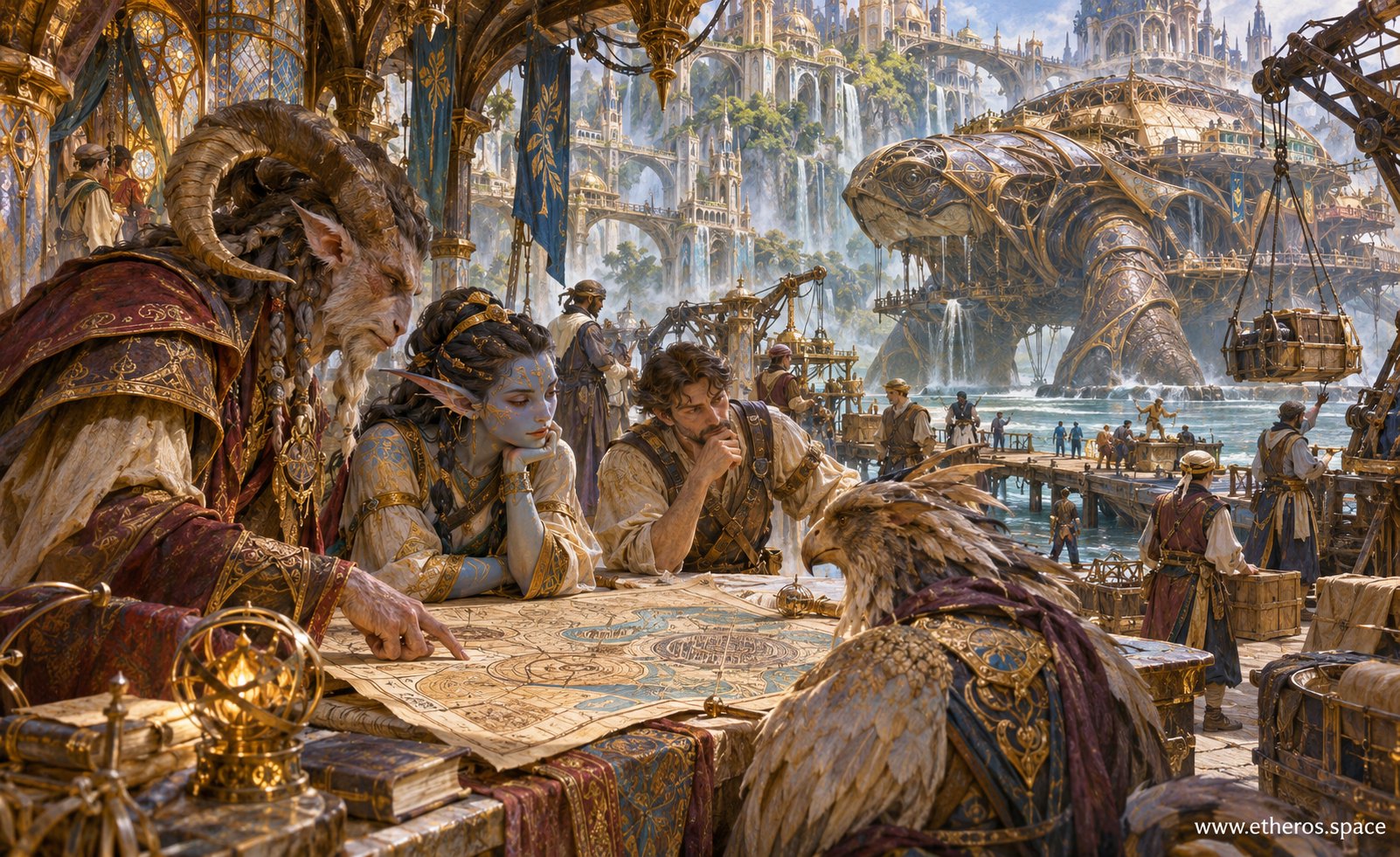
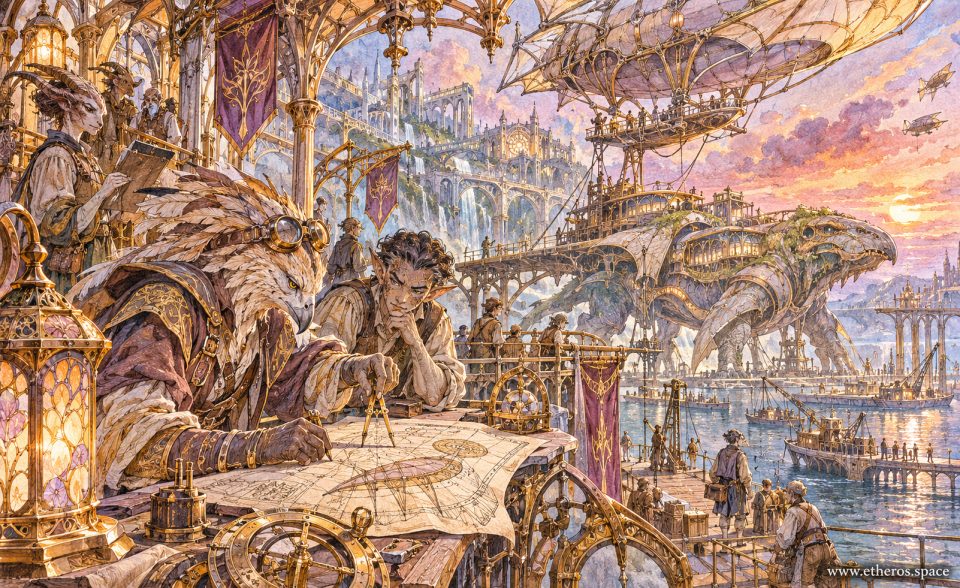
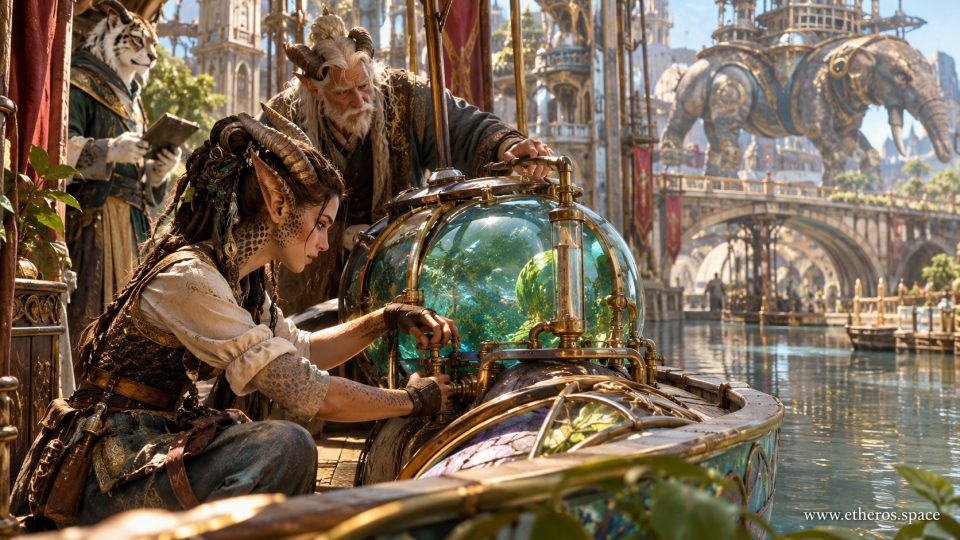
— An Etheros day-in-the-life fiction. The visible artwork contains the crowded waterfront, lynx-like porter and purple produce, two ledger readers, suspended cargo balcony, ships, bridges, waterfalls, and distant enormous biomechanical bearer. Personal names, the double-label dilemma, negotiated exchange and subsequent events are invented to tell a story consistent with that scene.