The Door That Was Almost Wide Enough
20261106T092933666781Z_066percent.png
Story
THE DOOR THAT WAS ALMOST WIDE ENOUGH
The Veyran Steps, in the long evenings of primordial Etheros
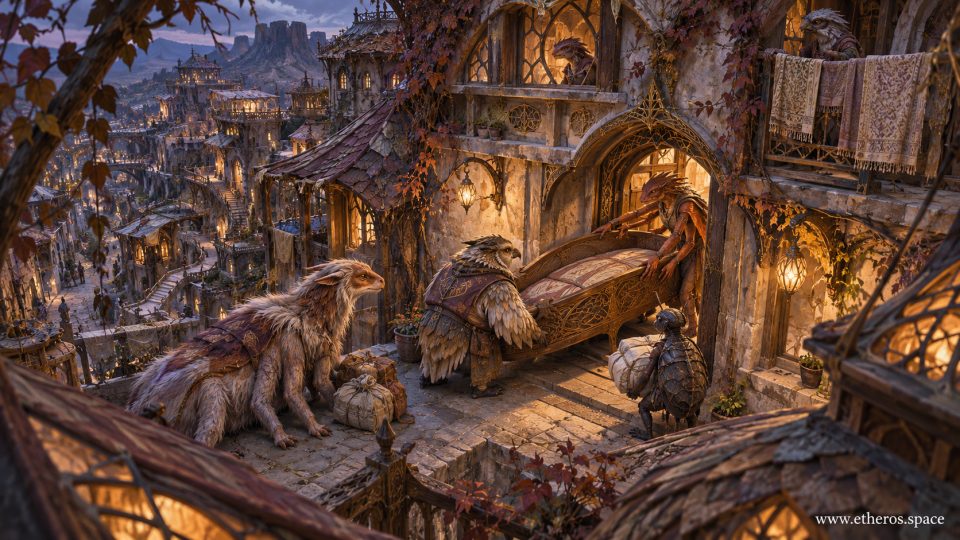
From the roofs above Veyra, the whole city appeared to be taking its supper. Lamps burned behind carved stone windows; narrow walkways clung to the escarpment; beneath the clustered dwellings the old public stairs made crooked journeys between the terraces. There was no great procession that night, no monument unveiled, no promise of a new age. One family had found a room.
The difficulty was getting the bed through its door.
Ruunn, a thin red-scaled resident of the upper steps, had both hands around the curved head of a sleeping cradle built for a much wider body than their own. At the foot, Thale braced a feathered shoulder beneath the frame and measured each turn with the soles of their boots. The carved gold lattice flexed only a little. The doorway was older than either of them. It had been designed for the narrow, upright people who once inhabited that house, not for anyone who slept with a shell or needed room to fold several limbs.
“Another finger-width,” Ruunn said.
“Of furniture or stone?” Thale asked.
Neither laughed until the bed stopped moving.
Below them, Morr sat patiently on the terrace stones, shaggy flanks rising with slow breaths, its travel harness resting amid tied bundles. It had carried the family's belongings up the last crooked stair, then refused another step. Beside the threshold, small shell-backed Kerrin hugged a roll of bedding to their chest and watched the two neighbors debate an arch that had never before seemed particularly important. At an upper window, a dark avian silhouette looked down. On a balcony a feathered tenant was pulling a patterned textile over the rail, careful not to drop it on those working beneath.
Kerrin had been given a tenancy token that morning. It bore the seal of the common housing circle and the shape of a living root, but nothing about it guaranteed the room would fit. The circle maintained a list of available homes, collected small rents for roof repair and assigned ground-level dwellings first to bodies unable to climb the steep streets. That rule had helped many residents. It had not made the old architecture equally welcoming.
They had tried the cradle sideways, upside down, and with its rolled mattress removed. The two widest corners still caught beneath the stone arch. Ruunn proposed taking off an ornamental rim. Thale objected: the rim held the weight of a sleeper's protective upper shell, keeping pressure away from a healing joint. The bed could not safely be narrowed. Kerrin said nothing, though their hands tightened around the bedding.
Across the steps, the windows glowed while other households carried on. Somewhere below, a kettle whistled, and the wind passed through a hundred hanging leaves of copper. Veyra was full of rooms. Finding one that did not make its occupants apologize for the shapes of their bodies was another matter.
The feathered tenant on the balcony called down to ask whether the hinge pins had been taken out. Ruunn looked at Thale. Neither had thought of the hinges. There was a pause, and then the tenant disappeared from the railing and returned with a small iron drift and a wrapped cloth. They did not offer to dismantle the whole wall. First they examined the lintel, then the door's older seams, then the way its frame distributed weight into the adjacent masonry. Only the narrow, replaceable inner trim could be loosened without disturbing the load-bearing arch.
“Who pays for what comes away?” Thale asked.
The tenant rested the tool on the sill. The housing circle's fund would cover repairs necessary for safe occupancy, but it was already committed to two cracked winter roofs. Ruunn was willing to help, yet knew better than to promise another person's money. Kerrin had scarcely enough left from the journey for food and bedding. No one wanted to turn the child away; no one wished to leave a neighbor with an expense they had not agreed to carry.
At last they decided on a measure small enough to test: remove the trim, protect the ancient stone, slide the cradle in with its bracing intact, and restore the frame with a reversible broader wooden insert. If the room remained safe after the first night, Ruunn would bring the plan before the housing circle at its next meeting. Their agreement was not a new law and did not solve the shortage of suitable rooms. It meant only that the family would not have to sleep on the landing while the meeting was arranged.
For the final push, Thale planted both feet, Ruunn lifted the upper rail, and Kerrin held the bedding clear of the threshold. The bed's wide belly passed beneath the arch with barely a breath to spare. It settled inside without a splintered lattice or cracked stone. Morr, who had endured the entire operation with the solemnity of a mountain, put its muzzle on the nearest bundle and went to sleep.
Kerrin crossed the sill slowly. Within the house there was little to see yet but bare floor, a warmer corner and a window toward the far mesas. From outside, the new room looked like all the others: one square of amber among many, neither grand nor remarkable. In that window's reflection, Kerrin could see three neighbors still speaking over the displaced strip of trim. They were arguing now about whose name to enter in the maintenance book.
For the first time since leaving their previous dwelling, Kerrin opened the roll of bedding instead of holding it ready to carry farther. Nothing on Etheros had changed in an instant. A house had not become a fair city; a careful rule had not become sufficient simply because its keepers meant well. But the little room had admitted its new occupants, the old arch still stood, and someone had agreed to write down what the doorway had taught them.
By the time the last bundle was brought inside, the lanterns of the upper steps were being lit one by one. The neighbors promised to return with a proper threshold wedge in the morning. The housing circle would decide the larger question later. That night, there was room to lie down.