The Music That Made Room for Sleep
ETHEROS_20261104T095150763267Z_100percent.png

Story
THE MUSIC THAT MADE ROOM FOR SLEEP
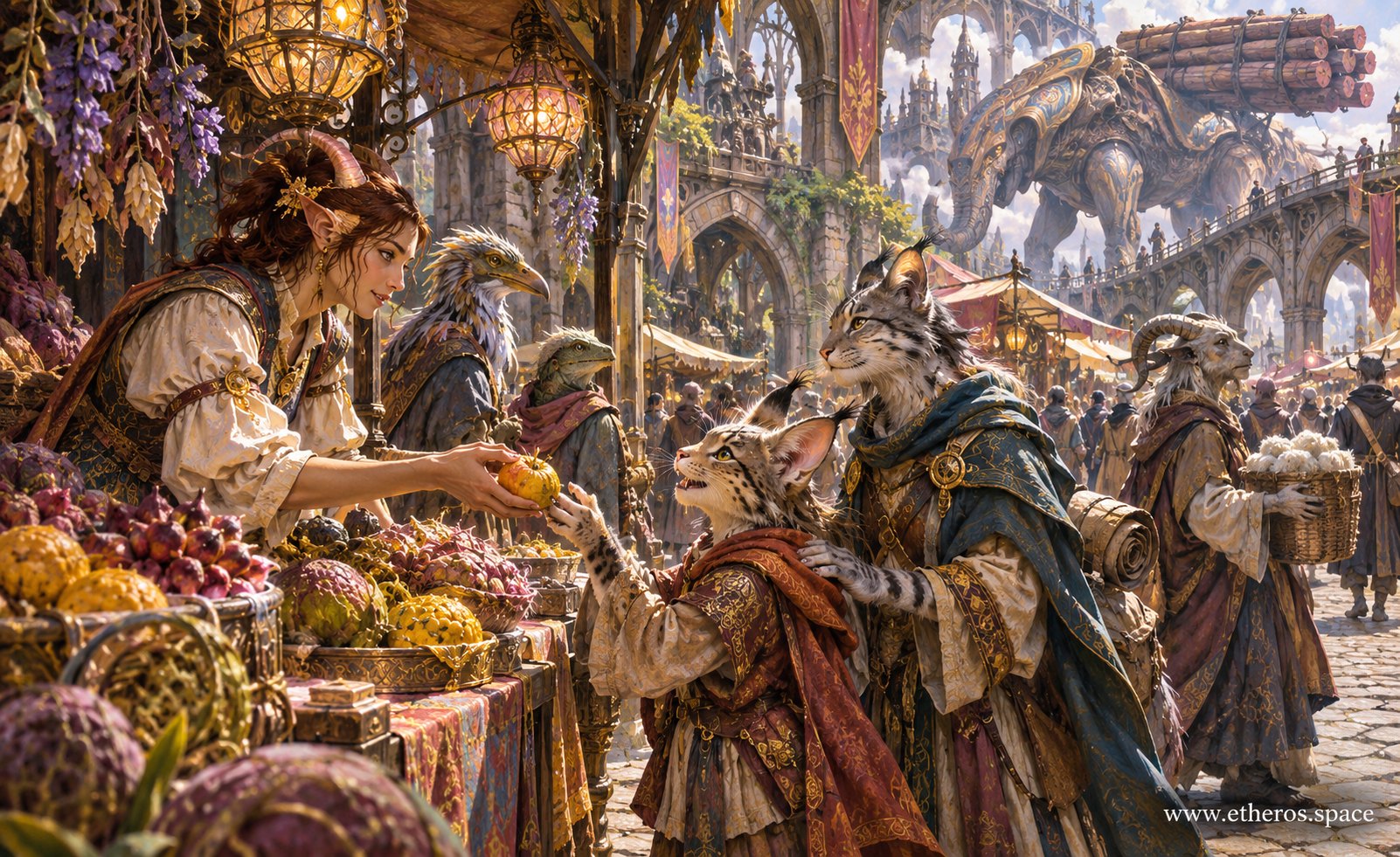
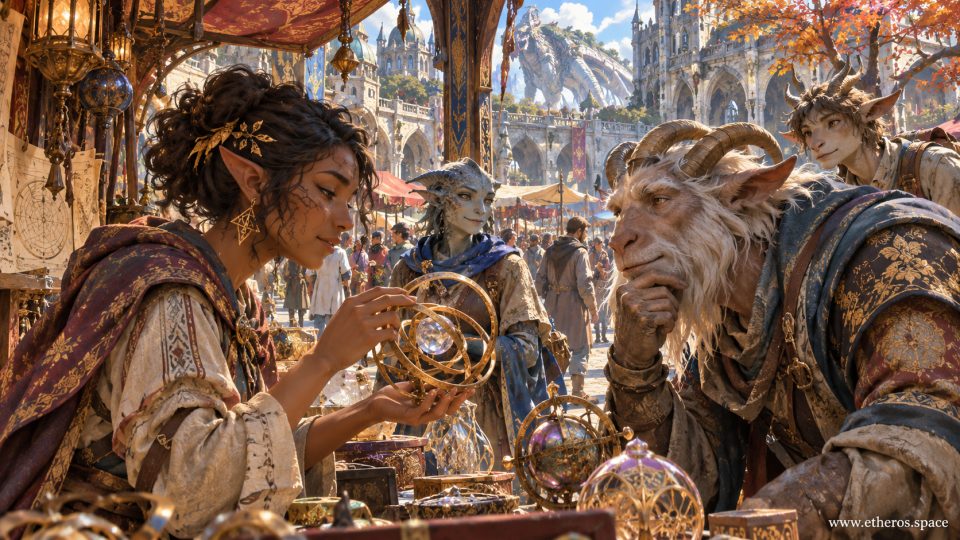
On the western stair of Rellian's flower arcade, the city kept the hour badly. Its bells arrived from seven directions and never quite agreed. Merchants called to porters, wagons passed beneath the stone arches, and the vines climbing the columns rattled whenever the dry hill wind reached the square. Above the far roofs, a vast blue-and-bronze biomechanical structure stood against the bright terraces; from here only portions of its body and supports could be read through the haze, and no one at street level could be certain what job it was doing.
In the shadow of one column, Nemi was playing softly enough that most people walked past without stopping.
Her harp was narrow and high, its gilded curved neck almost brushing her cheek. She sat with one shoulder turned to the street, eyes closed, dark braids spilling across her embroidered purple sleeves. The broad, spotted creature beside her had laid its head on her skirt and seemed unwilling to move. Its heavy collar and worn straps showed that it was accustomed to traveling among people, but it was resting with the complete trust of an animal that had finally decided the ground was safe.
Nemi had been trying to earn that trust since morning.
The creature was called Pell, a ridge-cat with fur the color of old snow and eyes like polished amber. At dawn a freight wagon had struck an uneven stone at the lower gate. Nothing had broken, but the sharp sound of its load shifting had sent Pell into a trembling panic. The cat had crossed three mountain passes with Nemi without complaining. Yet one sudden crash in a crowded square could make a familiar place strange.
She had first attempted to leave. Pell would not rise. Then she had offered food, checked the collar for a pinch and tested the animal's forelegs for injury. None appeared. Finally she had taken the harp from its case and begun the plain four-note cadence she used when the caravan camps were too noisy to sleep.
The cat exhaled. After a while its weight settled against her knee.
From the outer arcade came a child's laughter. A little horned girl in a pale dress chased a translucent bubble between two passing travelers, followed by an older man who was laughing too. The bubble lifted into sunlight and broke against nothing at all. Its brief rainbow shone in Pell's half-open eye. The animal's ears moved, then stilled again.
Nemi did not look up. She kept the cadence level, leaving a silence after the fourth note wide enough for the square to sound through it.
A reptilian courier paused near the opposite column, waiting for pedestrians to clear his route. A shopkeeper came out with folded cloth. Farther behind, a family negotiated a flight of steps with a bundle too wide to carry comfortably. None of them formed an audience. All of them passed through the music, and the music made no demand on their attention.
A few seasons earlier, Nemi had traveled through Thornweft during the Festival of Common Winds. There she had heard children shouting about a fourth string on a great hand-built kite: not the line that lifted it, but the line that let someone bring it safely down. She had never learned the makers' names. Perhaps the story had grown in the telling. Still, she remembered the idea better than the festival song itself.
She thought of that string now as the note that did not need to be played.
Her teacher had taught her to fill a room, to hold a market, to make coins ring against a wooden bowl. For years she had mistaken volume for generosity. Traveling with Pell had taught her another use for music: the measured space between sounds, when a frightened companion could hear that the world was continuing and nothing was coming to strike it again.
At the far end of the arcade, the child caught a second bubble on her fingertips. The old man lifted both hands in astonishment. For a moment the little street celebration made the square seem brighter than the sun.
Pell opened one eye, watching the color move. Nemi let the next phrase finish, then rested her fingers against the strings without pressing them. The cat kept its head on her lap. The market carried on around them. Somewhere high above the terraces, metal or living armor made a distant, unhurried sound, swallowed almost immediately by the city bells.
There was no miracle to announce. The noise would return. The freight roads would stay uneven; travelers would still shout; the mountain wind would keep finding its way between the arches. Nemi would have to leave before the evening bell if she wanted to reach the next caravan halt before dark.
But when she touched the first string again, Pell shifted onto its side and fell asleep.
She played a little longer than she needed to. In Rellian's crowded flower arcade, nobody minded that the song was quiet. The child kept chasing bubbles, the courier found his opening, and an entire city continued its work without knowing that, for one traveler and one weary animal, a safe place had briefly been made among its ordinary sounds.