The Evening the Rootbridge Gave Back — Kelmorr Hollow
20261106T033335933353Z_066percent.png
Story
THE EVENING THE ROOTBRIDGE GAVE BACK
Kelmorr Hollow, in the early Lanternfall season of primordial Etheros
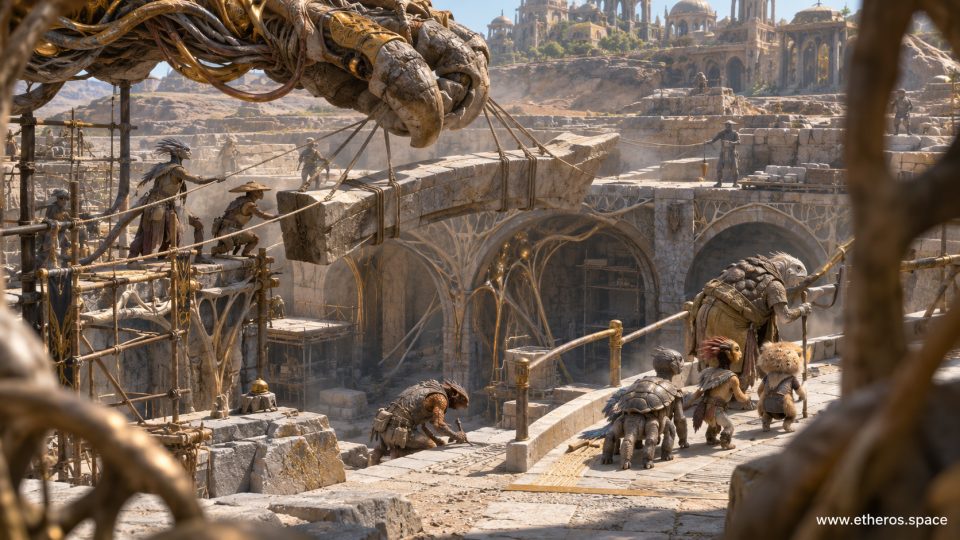
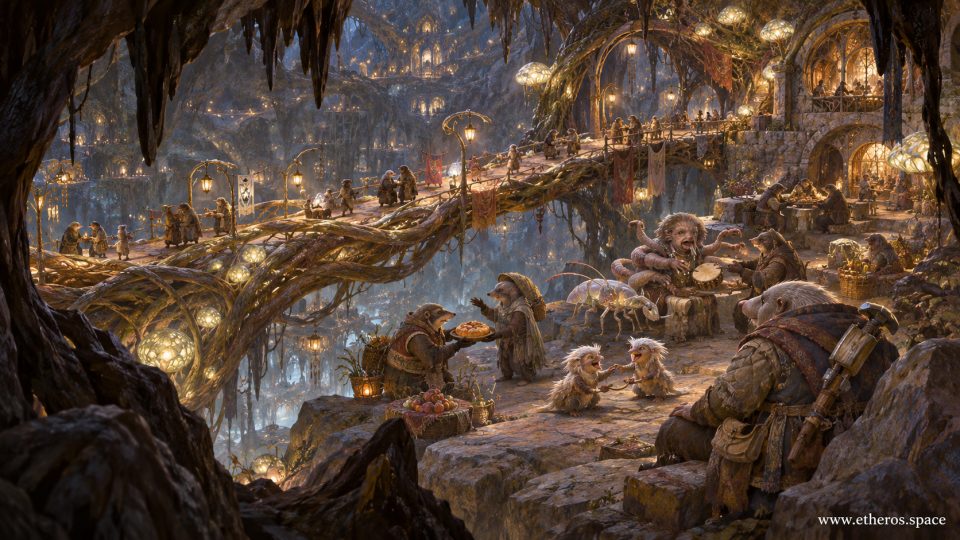
Kelmorr called the hour dusk out of courtesy. No sunset had ever crossed its cavern roof. The change of day arrived instead as a slow warming of the lantern fungi and a quieter movement of freight along the great living root that bridged the chasm. Through the dark mouth of a side grotto, the bridge seemed to rise out of nothing: a thick, branching span drawn diagonally above the blue depths, its suspended lamps bright as the fruits of an impossible tree. Beyond it the town climbed into the rock in irregular tiers of arches, windows, terraces, and tables.
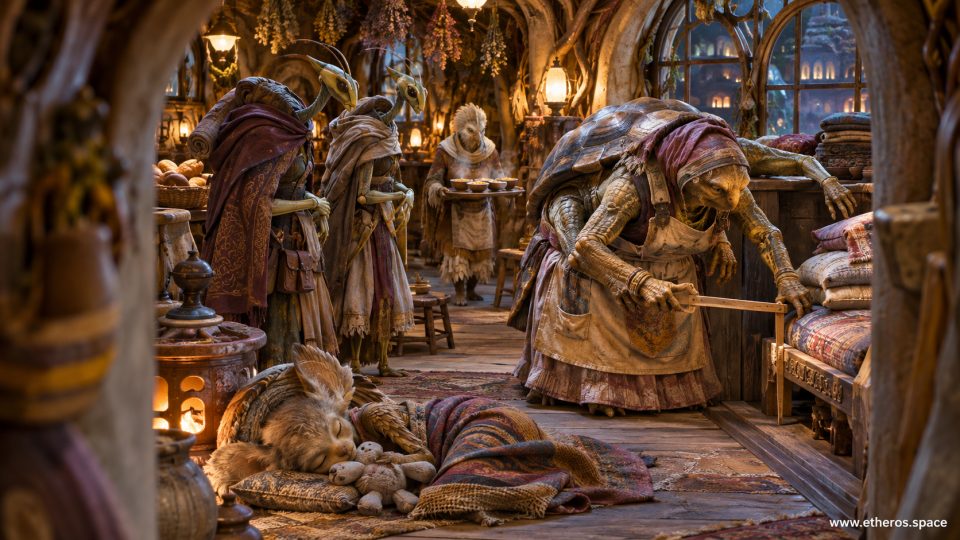
On one shelf near the watcher’s side of the gulf, two little shaggy children were conducting an earnest argument with their fingers. Ruu had found a seed husk that rattled. Pima insisted it was a drum, not a toy boat; there were no boats in this dry chamber anyway. They took turns tapping its rim while, farther up the ledge, Garru beat a skin drum with four lively forelimbs and a voice that rasped pleasantly through his whiskers. The rhythm reached the opposite balconies in soft increments, then returned as applause.
Under the bridge, pale segmented lantern-mites advanced in a loose cluster through a seam in the masonry. The grownups left them an opening. They fed on the fragile outer rind of the root without disturbing its load-bearing fibers, and the hollow’s stewards had learned not to sweep them away. Even the town’s most sophisticated living structures depended upon lives too small for most citizens to notice.
Odran sat at the edge of the gathering with his heavy back turned toward the music. His tool satchel still carried the curved cutters, wedges, and sounding pins of a root-inspector, though the kit had not been opened for three days. He had spent most of his adult life in harness beneath the bridge, listening for fatigue in its braided tendons. Then the bridge had begun knitting new outer strands faster than the inspection crews could clear the old ones. For the first time within living memory, the night shift had been shortened.
For many citizens that was good news. The freight could travel in daylight, exhausted workers could sleep, and a public gathering that once lasted only an hour could continue without robbing anyone of rest. Yet some of the wages disappeared with the work. Odran's contract was among the first to be reduced. The change was not a betrayal by the living planet; Etheros had merely grown. Decisions about how the resulting abundance would be shared belonged to those who benefited from it.
Sella, who had spent the afternoon carrying hot rounds of bread to the crowded terrace, stopped beside the traveler in the patched cloak. She offered a loaf to the newcomer and then turned to Odran. She did not call his lost wage a blessing. He had heard enough people congratulating him for having so much free time.
“I cannot pay rent in hours,” he said.
“No,” Sella replied, setting down the bread. “But an hour can make room for a conversation.”
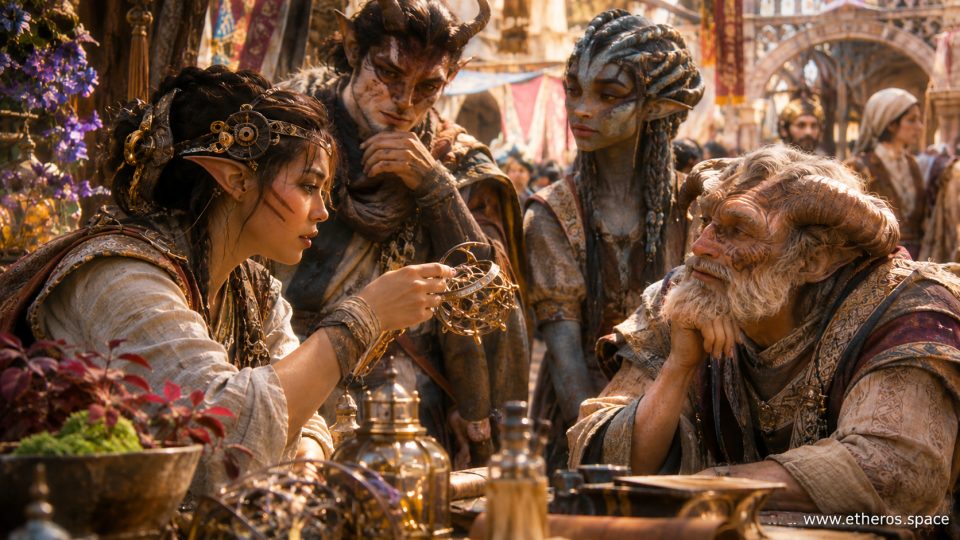
Across the rootbridge a dozen neighbors were lingering instead of hurrying home. Some had come straight from their workshops; others had crossed the hollow with baskets or children or nothing more urgent than a wish not to eat alone. Nobody was positioned to watch Garru perfectly. Half the people missed half the music. From one table came a rude laugh, from another a correction about the bridge’s latest growth, and from the far balcony the sound of someone trying a borrowed tune in the wrong key.
Sella had brought a proposal written on three scraps of bark. The merchant council wanted to retain the full savings from the shorter night shift, arguing that freight rates were already uncertain. The maintenance guild wanted every displaced hour paid as before. Both positions had a cost. If the guild received everything, households buying food across the chasm would still pay the same toll; if the merchants kept everything, skilled stewards would be left to find new work on their own. Sella proposed a trial: a portion for reduced crossing fees, a portion for a shared wage fund, and a new paid watch for the mites and living root that could be adjusted as evidence accumulated.
Odran studied the strips. “You make me a keeper of insects.”
“You already were,” she said, pointing below the branch where the translucent bodies moved. “You only never charged for noticing them.”
He considered the bridge for a long while. The woven span was holding, the lamps swayed only slightly, and the crowd’s combined weight remained well within the marked limits of the terrace. Nothing in the picture could tell him how long the new growth would last. An inspector's honest answer was sometimes that the span had not yet been watched long enough.
When the children ran past, Pima offered him the rattling husk. Odran declined, then accepted it, then failed entirely to keep time with Garru. Ruu laughed so hard she fell backward onto the warm stone. He passed the husk back without embarrassment. He was not saved by a song, and a wage dispute did not disappear because people had eaten together. But someone had finally asked him to help decide what his skills were worth in a changed town.
The gathering lasted until the rootbridge's lamps dimmed to their night color. On the opposite side, another family arrived carrying a basket; a stranger made space at a table. Odran put one sounding pin on Sella's bark proposal as a paperweight. In the morning they would measure, argue, and perhaps amend the plan. Tonight they had discovered a smaller thing they could afford to share without accounting for it: the hour itself.