The Step That Held the Morning — The Thistle Line, Verrical
ETHEROS_20261104T180725391266Z_033percent.png
Story
THE STEP THAT HELD THE MORNING — THE THISTLE LINE, VERRICAL
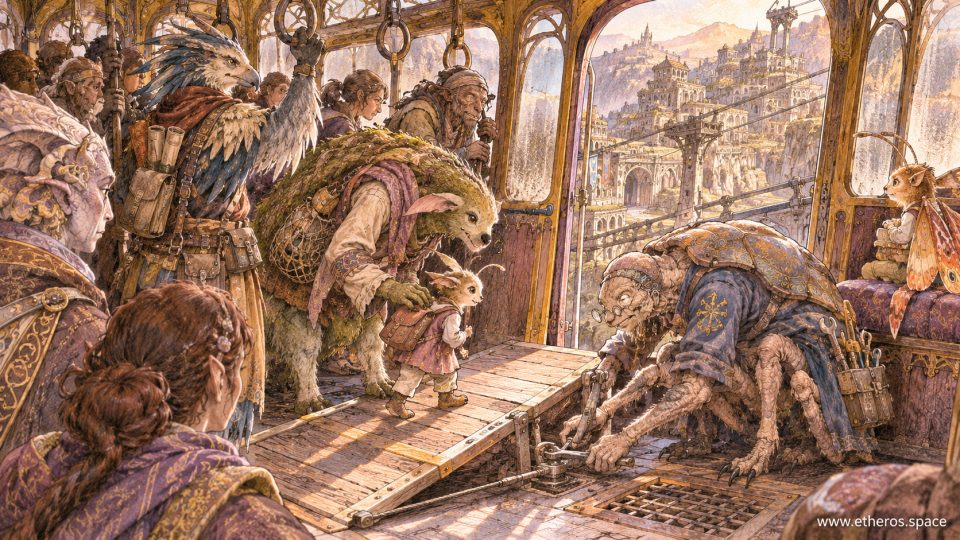
The cable carriage had stopped halfway through its morning circuit, with the city of Verrical shining beyond the arched windows like a thousand rooms built on the inside of a cliff. Far below, narrow stair streets led into markets; above them, viaducts and cable pylons shouldered the traffic of a growing hill town. At this hour the Thistle Line was supposed to be moving.
Instead, the passengers were gathered around a section of floor that refused to lie flat.
Tessan, the carriage's oldest maintenance fitter, had folded his many jointed limbs beneath his shell and lowered himself beside the ramp hinge. He was a patient worker whose leather pouch contained more mismatched tools than anyone thought a single person could carry. One hand steadied the locking bar. Another held the service wrench. The smallest pair worked around a cotter pin scarcely longer than a grain husk.
He had asked the driver to set the carriage brake and keep the traction cable still. An inclined floor panel was no place to make a hurried adjustment while a cabin traveled over an open drop.
Near him stood Mirae, a broad-shouldered, moss-backed traveler on four sturdy legs. A shawl lay across her shoulders, fitted around the crest of her neck instead of pinching it. Beneath her protective hand, little Lenn tested the boarding board with one boot. The child had long soft ears, a tiny travel satchel, and a school coat they had insisted on fastening without help.
"Does it move now?" Lenn asked.
"Not until it holds twice," Tessan replied, without looking up.
The ramp had been fitted three seasons before, when the upper districts finally admitted that a stair built for two-legged citizens was not a universal measure of convenience. The same passage needed to carry small children, workers with injured joints, broad-bodied quadrupeds, and visitors whose weight fell on more than four points of contact. A good carriage could not demand that everyone enter it in the same way.
But the hinge had an old flaw. Its metal catch could settle crookedly under repeated off-center loading. It still appeared secure to anyone looking from a distance. Only when a traveler shifted their weight toward the outer corner did the panel begin to lift against its stop.
A tall feather-crested passenger, Surr, kept one hand around an overhead ring and watched the work with the wary attention of someone who knew how expensive a late arrival could become. Behind Surr, an exhausted porter pressed near the window. Other riders turned their faces toward the open city. On the opposite bench, a small orange-winged child studied the repairs with evident curiosity.
"My delivery mark expires at the quarter bell," the porter said.
"And mine was due at the first," answered the conductor from somewhere behind the travelers. Neither spoke cruelly; one had a wage to protect and the other a route to keep. A delayed carriage put those obligations in conflict without making either imaginary.
Tessan eased the pin out. The worn part was almost smooth where the locking notch ought to have caught. He laid it on a square of cloth, marked the damage, and searched his pouch for a replacement with a longer shoulder and a wider bearing surface.
Mirae shifted backward to give him space. Lenn, trying to be useful, held the satchel against their chest so its buckle would not catch on the railing. Outside the door, a fine cloud of dust rose from the next station platform. The cable sang faintly through the support tower beyond the window, but the carriage remained still.
When the new pin seated, Tessan did not declare victory. He pressed down on the end of the board and listened. Surr moved closer to apply weight near the outer edge, following Tessan's directions rather than guessing at the safest position. The panel settled without lifting. They checked the catch again, then checked it with the load moved to the opposite corner.
Only after those tests did Tessan give Mirae a small nod.
Lenn crossed first, one careful step, then another, until both boots reached the level boards. The child glanced back at the hinge, not with triumph but with an engineer's unexpected interest.
"Will you change all the other ones?" Lenn asked.
Tessan looked at the damaged pin in his palm. "I'll ask. And I'll put its shape in the maintenance book, so someone who has never met me can recognize the problem."
Surr took the little piece of cloth from him and folded it around the worn part. The porter looked at the clock, then at Lenn, and said nothing more about the mark. The conductor wrote the delay into the route ledger instead of asking the passengers to pretend it had not happened.
Far outside, Verrical continued its noisy ordinary life. Workers disappeared into archways. Cargo wagons crossed stone bridges. Children took paths their grandparents would have regarded as impossibly steep. The Thistle Line's cabin, for all its ornament, was only one small piece of the city's promise that movement could belong to everyone.
When the brake was released, Lenn climbed onto the seat beneath the window and watched the cliff houses begin to move past. The orange-winged child opposite raised a hand in greeting. Lenn returned it shyly.
The carriage had lost several minutes. It had also kept a promise that could not be measured by a timetable.