The Vein That Sang Back
ETHEROS_20261103T170503937805Z_100percent.png
Story
On the ochre terraces of Sahri, where the mountains had been opened layer by layer across nine generations, there was a rule older than the quarry itself: every stone belonged to the planet until its purpose had been understood.
Most workers had forgotten who first said it.
Dorran had not.
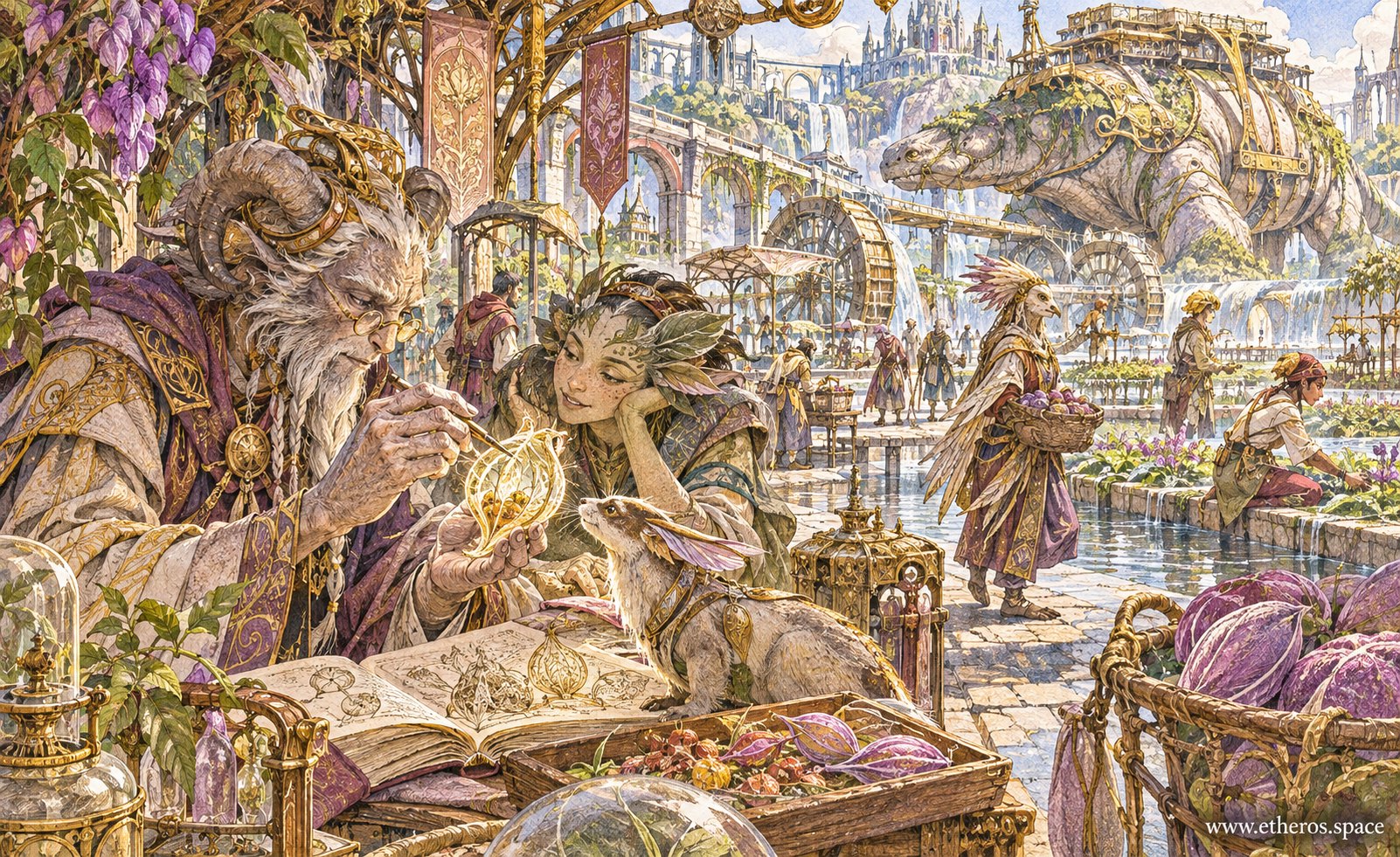
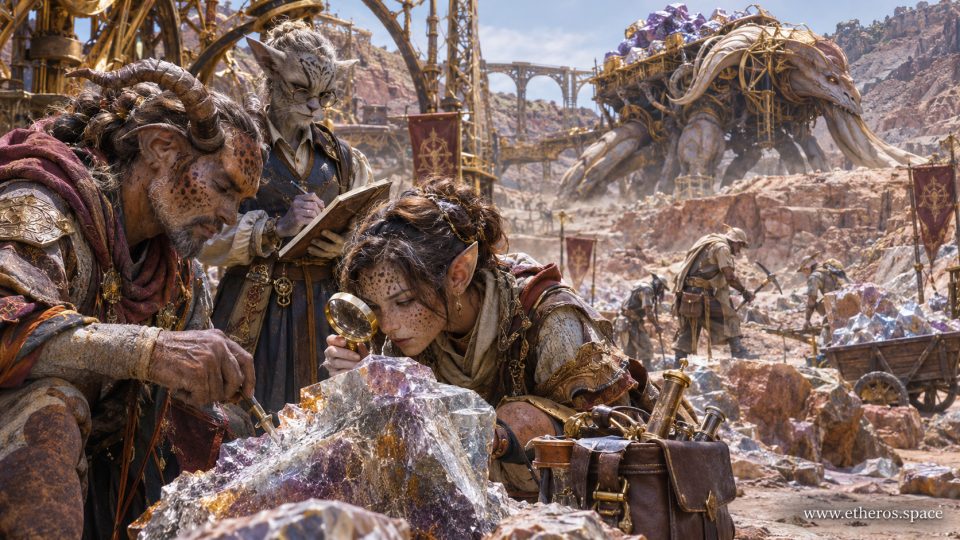
His horns were worn smooth near their tips. Mineral dust had settled permanently into the markings of his face, and the gold thread of his work coat had been repaired more times than he could count. He knelt beside a newly uncovered crystal formation, holding his cutting instrument against its translucent surface without making the final incision.
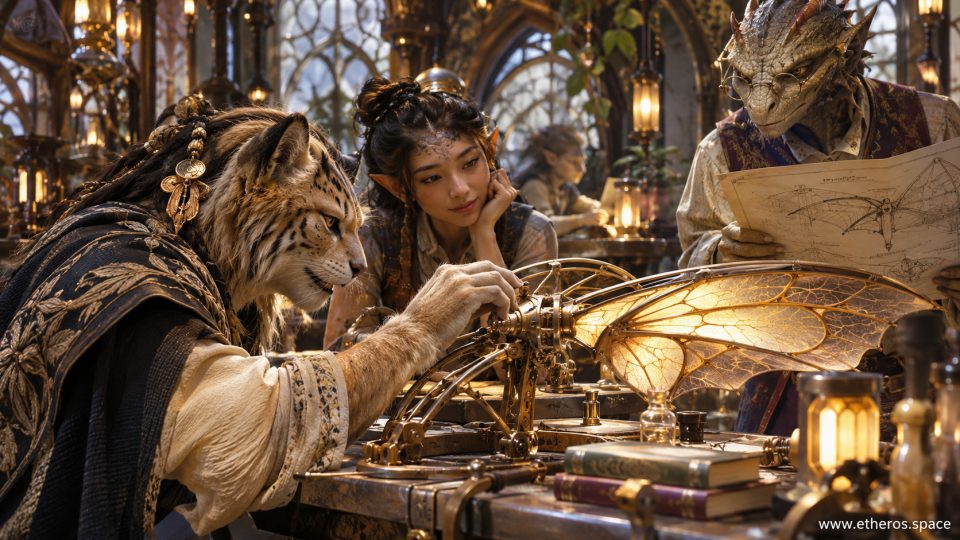
Across from him, Niva bent close with a magnifying lens. She was young enough to regard most things as mysteries worth solving and experienced enough to know that some mysteries could kill.
Behind them stood Erq, the pale-furred registrar, recording the examination in his leather-bound field ledger.
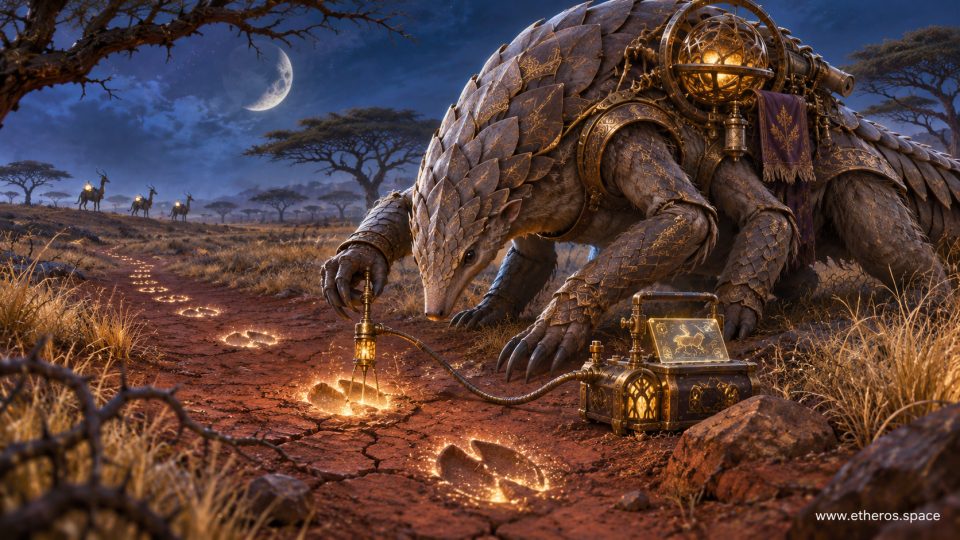
Beyond the quarry floor, the great carrier Varr-Set moved among scaffolds and stone bridges. His immense biomechanical body bore an elevated load of violet crystals. Living tendons beneath articulated armor distributed the weight through six powerful limbs, while a lattice of gold-braced suspension members prevented the cargo from shifting during a climb.
Every step was calculated. Every load had a destination.
Today, the crystals were intended for the southern furnace district, where their stored structural energy would help support the heating systems of several thousand homes.
But the formation beneath Niva's lens was different.
Its fractures did not radiate outward from pressure points. They curved around small, repeating chambers, each chamber separated from the next by a membrane too fine to see without magnification.
"Those aren't cracks," she said.
Dorran did not answer.
"They're growth boundaries."
Erq stopped writing.
The old cutter slowly lifted his instrument from the stone. Years earlier, he had discovered a similar formation beneath the eastern escarpment. That vein had been extracted before anyone understood its structure. For three seasons afterward, nearby mineral groves had produced no new crystalline growth.
The supervisors had blamed the weather.
Dorran had never believed them.
Niva adjusted her lens again. Within the amber and violet layers she saw tiny inclusions arranged in regular intervals. Their geometry suggested development rather than random deposition.
She placed her gloved fingertips against the crystal.
There was a faint vibration.
Not a mechanical fault. Not a tremor from Varr-Set's footsteps.
A pulse, followed by a pause, followed by another pulse.
Erq came closer.
"What do I write?" he asked.
Dorran looked toward the carts waiting to be loaded. Workers with families depended on the day's wages. The furnaces needed the mineral. The municipality had already assigned Varr-Set to carry the shipment before dusk.
He could hear the picks striking farther up the slope, and beyond them the slow rhythm of the colossal carrier's feet.
"Write that the vein is living," he said.
Erq hesitated. "That will suspend the extraction."
"I know."
"The northern seam will cost twice the labor."
"I know that too."
Niva looked up from the crystal. Her expression held neither triumph nor fear, only the sudden responsibility of having learned something that could not be unlearned.
Dorran reached for the instrument once more.
For an instant, Erq thought the old cutter had changed his mind.
Instead, Dorran withdrew the blade entirely and laid it on the stone beside him.
The nearest workers stopped when he raised his hand. A signal traveled across the quarry, from one terrace to the next, until the mechanical winches fell silent and the sound of striking metal faded into the dry afternoon.
Varr-Set halted above them, his tremendous load resting motionless beneath the golden suspension frame.
The mountain seemed to grow quieter.
Erq opened a fresh page.
The first entry named the site. The second recorded the apparent developmental chambers. The third recommended protecting the exposed formation and redirecting extraction toward an exhausted seam where geological surveys had found no signs of living growth.
Then he added a fourth entry, without being asked: the displaced workers would receive full wages from the quarry's communal reserve until their new assignments were established.
Dorran read it and nodded.
The decision would cost the quarry money. It might provoke arguments at the next municipal council. By evening, someone would undoubtedly accuse them of treating stone as if it mattered more than people.
But the people of Sahri lived among structures that had grown before their grandparents were born. Their bridges depended on living materials. Their carriers had been born from the planet's own reproductive machinery. Their homes drew warmth from mineral systems whose replenishment required patience measured in decades.
They could not survive by pretending the world beneath them was dead.
Niva closed her magnifying lens.
The crystal continued its delicate rhythm under the afternoon light.
On the high terrace, Varr-Set turned toward the northern road, where the next assignment awaited.
No great celebration followed. There was no proclamation, no anthem, and no monument to the decision.
The workers simply gathered their tools and carried them somewhere else.
And beneath the unbroken surface of the mountain, something very small continued to grow.