The Weight of a First Journey
Story
The Weight of a First Journey
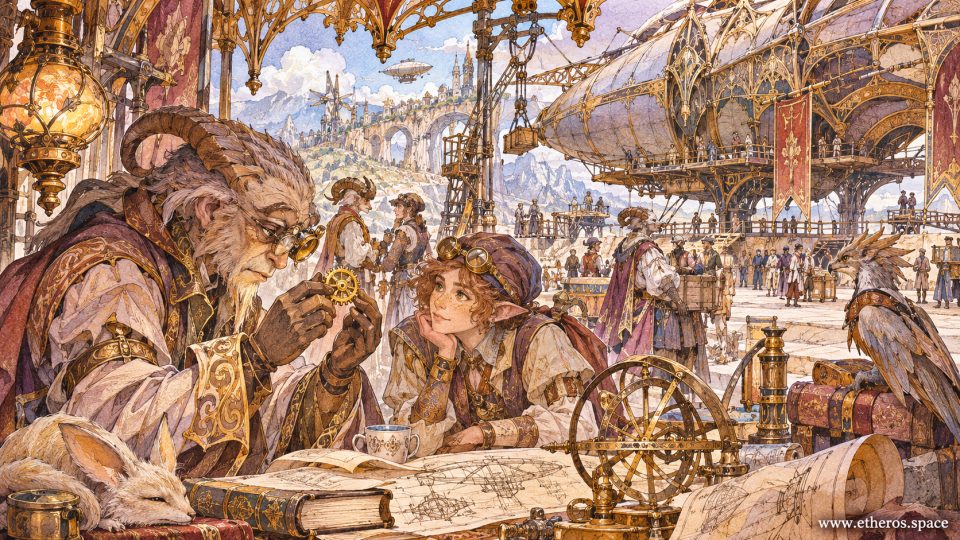
Before the morning bell rang at the High Exchange, the skyships were already breathing. Their vast buoyancy chambers swelled and relaxed inside ribbed hulls, and their living suspension tendons passed each change of weight into the dock's bronze-and-bone arches. Below the platform, a city climbed through the haze in tier upon tier of inhabited stone. Above it, the departure bridges shivered as porters carried trunks, instruments, bread, and the little precious things no manifest could adequately describe.
Erel had checked their tickets three times.
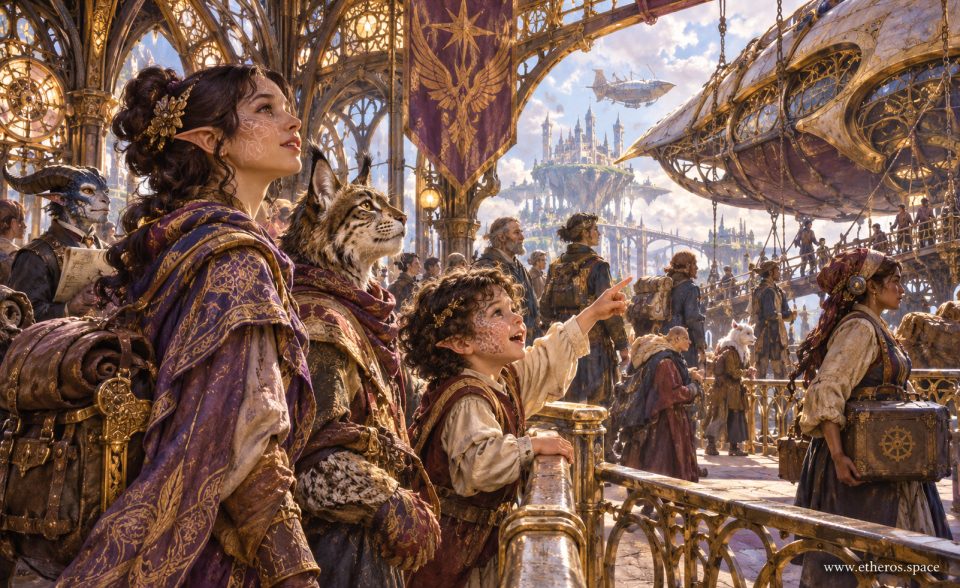
She stood beneath a violet banner with a travel pack strapped across her shoulder, her dark hair caught back by a small gilded clasp. Pale ornamental tracery followed the curves of her cheeks. Beside her, little Tavi leaned over the balustrade and pointed at the enormous waiting vessel, its purple belly gleaming where sunlight entered the docking hall.
“Is that the whole ship?” he asked.
“Only the part that hasn't flown away,” Erel answered.
The child laughed, not because he understood the joke but because his mother's voice had finally lost its tightness.
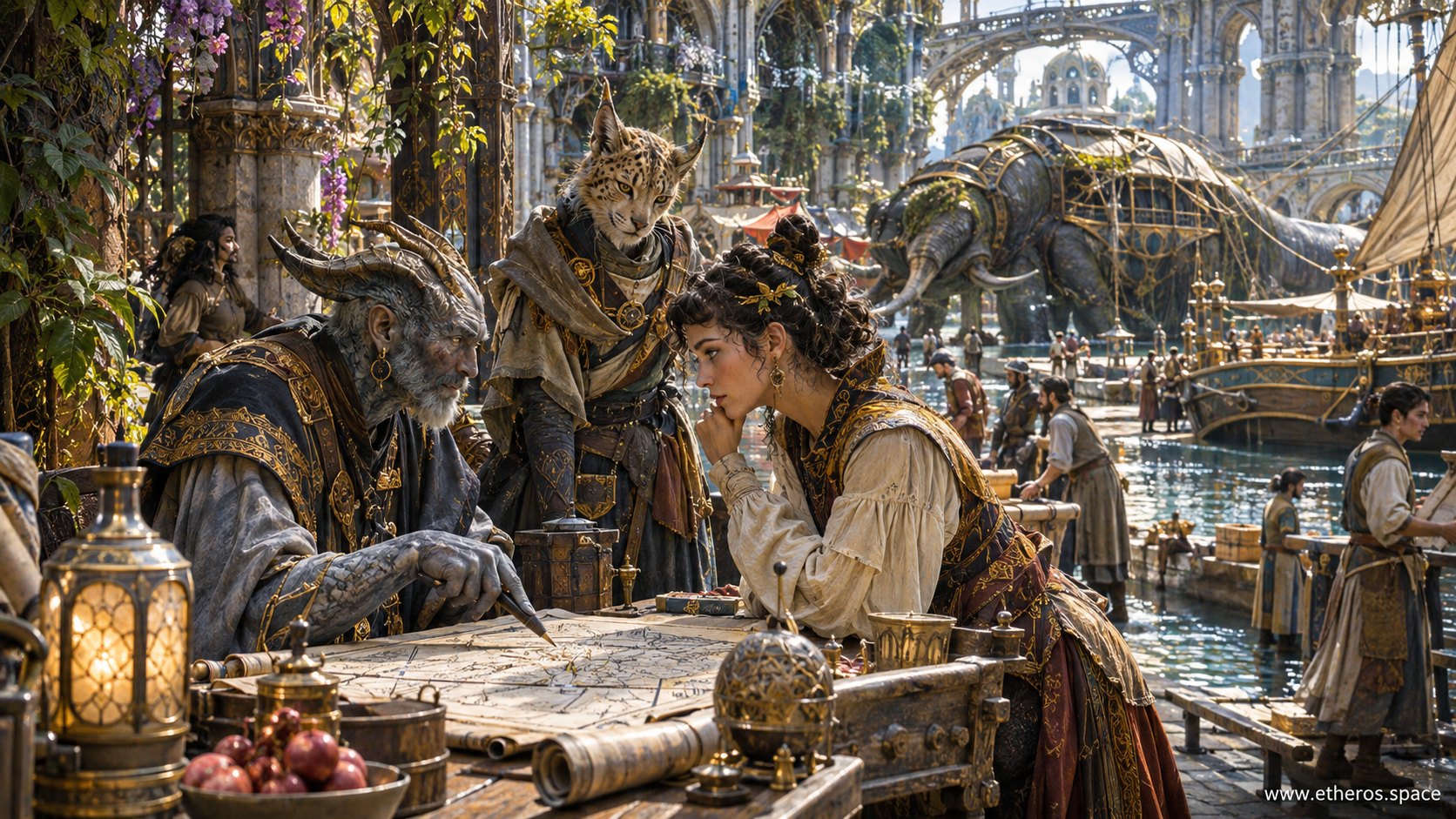
Marr, their lynx-faced traveling companion, watched the docking cables rather than the sky. His tawny ears moved at each change in the machinery's pitch. He had served aboard cargo vessels before the white fur appeared at his temples, and he could tell from the minute tremors of a gangway whether the loadmaster had distributed the freight properly. He wore a heavy patterned cloak and carried no baggage except a narrow roll of instruments beneath it.
It was not an adventurous voyage, by the standards of Etheros. An ordinary midday crossing would take them beyond the outer terraces to the dry uplands of Ilven, where Erel had once learned to mend woven neural membranes for the district's small transport organisms. She was going home to settle the remaining contents of her father's workshop. Tavi had never seen the place. For him, Ilven existed as a collection of stories about warm stone courtyards, sharp winds, and an old man who could repair anything except the passage of time.
The old man had died during the winter.
Erel had postponed the journey until she could afford three passenger berths. Marr had quietly paid for one of them without telling her. She knew, and he knew that she knew, and neither had spoken of it.
At the nearby station rail, a horned inspector studied a sheet of cargo marks while a steady stream of travelers moved toward the mooring platform. A woman in a headscarf carried a riveted case past the passengers. Beyond her, stewards checked the boarding lines and passed signals through copper tendons running from the gantry into the ship. Every body aboard would become part of the vessel's calculation: mass carried by the lattice, lift supplied by its warm internal chambers, tension passed through its living spars, and strain registered in the dock before the last tether could be released.
Marr listened to the hum and nodded. “They're ready for us.”
Tavi was not listening. He had seen a second craft drifting across the bright opening beyond the arches, a small silhouette beside a settlement suspended above the city. He pointed higher, almost climbing the rail.
“Do they have streets up there?”
“Of course,” Erel said.
“Do they have people who are afraid to fly?”
“Many. Some of them are the pilots.”
The child thought about this with tremendous seriousness. “Then the ships must be brave for them.”
Marr's whiskers twitched in a smile. “Maybe that's what a good machine does. It makes room for the courage we haven't found yet.”
Erel rested one hand on Tavi's shoulder. Inside her pack lay her father's oldest field tool, a little brass tension gauge with a cracked glass face. She had planned to return it to the family workshop and leave it there, a small honest weight among the many things she could no longer ask him. But that morning she had found Tavi trying to read its engraved numbers, asking what it measured and why its needle trembled when he breathed across it.
She had promised to explain on the ship.
A bell sounded from the loading bridge. The great vessel shifted; its canopy flexed against the restraint chains and caught the afternoon light. In the crowd, a woman waved to someone already aboard. A porter stopped to retie a bundle whose strap had slipped. A child farther down the line began to cry, and a stranger knelt to help fasten the child's shoe. The whole terminal moved with a thousand private departures, none of them large enough to appear on the official schedule.
Erel looked toward the suspended city, then down at her son. The sharpest part of grief, she was discovering, was not the absence itself. It was carrying the ordinary days forward when the person who should have witnessed them could not.
Tavi tugged at her hand. “Will Grandfather's workshop have a window?”
“Yes.”
“Can we sit there and look at the sky?”
“For as long as you want.”
Marr stepped toward the boarding queue, leaving space for them to follow. A stevedore released the last cargo catch, and the ship answered with a low, resonant pulse that traveled through the bronze railing under Tavi's fingers. He felt the tremor and grew suddenly quiet.
“It's alive,” he whispered.
“Everything here is trying,” Erel said.
They joined the other travelers. Behind them the city continued its work, the arches continued bearing weight, and the sky continued opening its distant roads. Nothing about their departure would alter the map of Etheros. Yet a small boy carried his grandfather's questions into the air, and a woman who had come to close a door found that she was bringing something home instead.