The Span Between Two Houses
20261106T155415002065Z_100percent.png
Story
THE SPAN BETWEEN TWO HOUSES
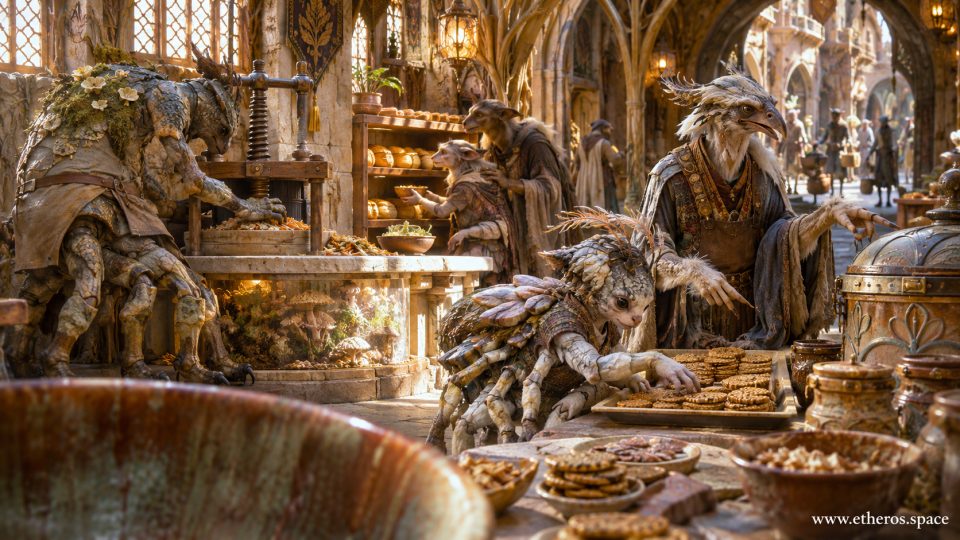
Pellis South Arcade, in the dry season of primordial Etheros
At the hour when the sun found the pale stone arches, the market grew loud enough to hide the sound of one small broken clasp.
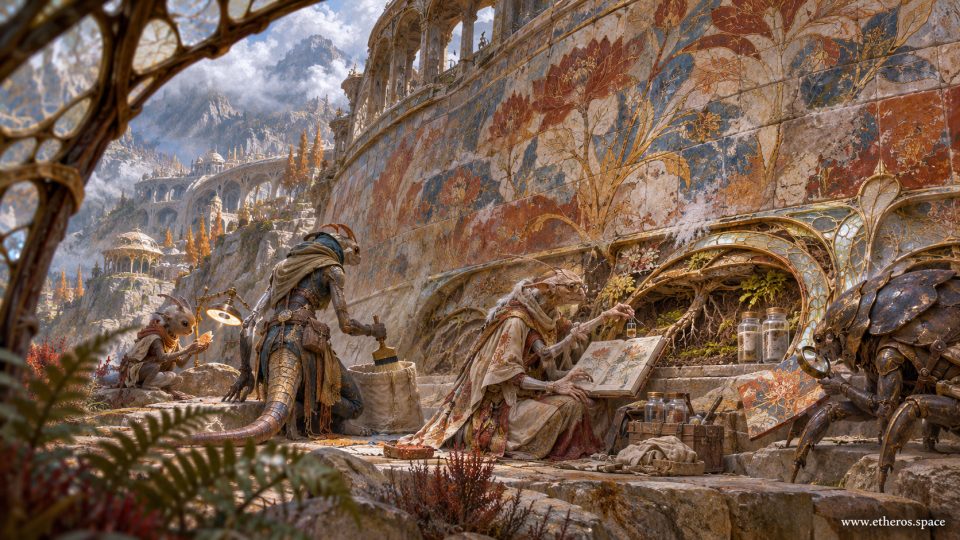
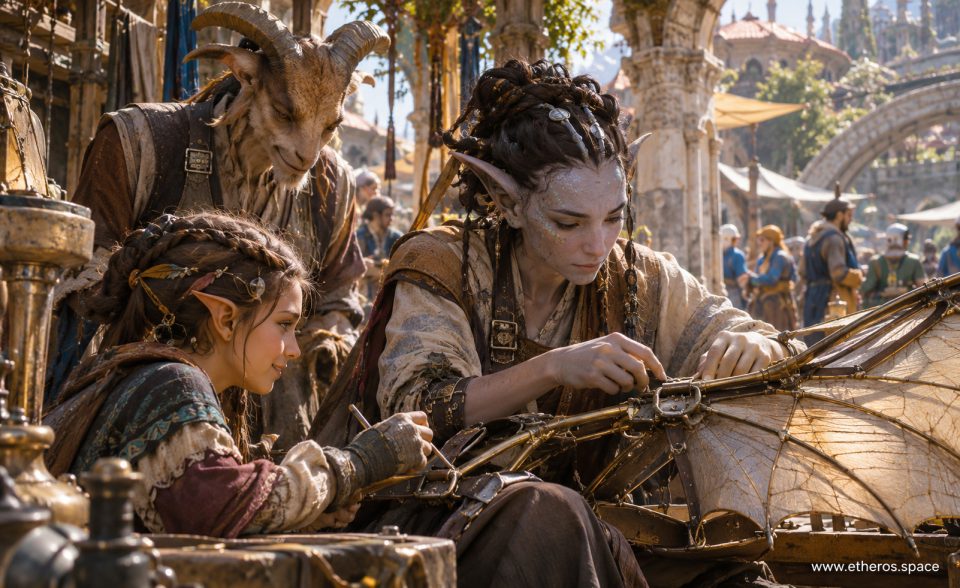
Seyra had been listening for it all morning. A bronze tooth set into the courier wing's lower joint kept clicking twice where it should have clicked once. She held the folded membrane against the sun, pressed a thumb below the brass collar and found the worn edge. A strand of thread had caught in it. At the next gust the strand would abrade the seam, and the next after that might take a whole rib with it.
The wing lay open across the repair bench, a veined panel of amber sailcloth held by narrow, curved spars and a lattice of wire. It was not a living bird, and its riders were not meant to fly. It was the light upper surface of a small tethered message carrier. At the ridge stations, the device traveled downhill along a pair of anchored guide-lines, using the wind to slow and steady its descent. At the far end, a crew caught it in a padded cradle and sent a return carrier from a higher shelf. A message could cross the ravine without asking a person to traverse the broken footpath.
Kima, too young to be licensed at a ridge anchor, sat close enough to see every movement of Seyra's hands. Her dark plaits brushed the edge of the bench as she held a thin awl against the next strap. She watched the older craftsperson remove the faulty pin rather than simply tighten the buckle over it.
"It still holds," Kima said.
"Here, it does," said Seyra. "Here nobody is pulling from the other side."
Behind them, Odren lowered his horned head to inspect the gap. He was broad in the shoulders and carried years of strain in a collar worn smooth by load straps. When the first towers of Pellis had been joined by couriers, he had hauled the wooden frames up the southern incline himself. He remembered the old service as a favor between families, before weight limits and transit levies turned favors into fees.
"I can lend you another strap," he said. "But not another afternoon. The ridge crew will close the northern catcher when the shadow reaches the fifth arch."
Seyra did not look up. In the crowd behind Odren, two distant neighbors stood bargaining over dried fruit. A porter crossed beneath the carved arch without noticing the little workshop. Such indifference was familiar. The city saw a shop; the people beyond the ridge depended on a passage that might close without warning.
The urgent cargo was no medicine, no official decree, no purchase worth a great fee. It was a packet of letters written by people who had moved to Pellis for work. Some described new rooms and apprenticeships. One contained the drawing of a child who had never met her grandfather. Several were addressed to old homes whose occupants might already have moved again. The uncertainty made them harder to deliver, not less deserving of a journey.
Since the southern trail shifted beneath the growing root terraces, walking to the upper settlements had taken three times as long. The council called the wing system a temporary convenience. The displaced families called it the only road on which their words could travel without a fare they could not pay.
Odren wanted a launch before midday. The courier union wanted proof the older fasteners could still bear a gust. The terrace households wanted a public service rather than a charity box on a shop counter. Seyra understood all three. The wing's fine membrane could be patched in an hour. Its reputation could be damaged in a single failed crossing.
Kima touched one of the translucent ribs. "What happens if the paper arrives and the house is empty?"
"Then the catcher keeps it dry," Odren said. "And the next carrier asks the neighboring houses."
"And if there isn't a neighboring house?"
Seyra looked toward the archway, then back to the wing. "We keep a record of where we tried. We don't say delivered when we mean sent."
She loosened the adjoining lacing, slid out the cracked tooth, and cut a replacement from a strip of brass reserved for instruments. The new piece was slightly wider; she filed it down until it rested without forcing the fabric's edge. Kima passed the awl and then a narrower needle. Together they stitched a short reinforcing loop, preserving enough slack for the wing to flex under load. Odren held the outer spar steady with a hand shaped by decades of carrying burdens.
When they were done, the small glow beneath the bench's metal fittings caught across the membrane in a pale network of lines. Seyra tested the opening joint five times, once in each direction and three times with a weighted cord. The old double-click had gone. That did not prove the carrier would cross the ravine safely, but it justified a controlled trial with an empty capsule. The ridge crew could measure the pull before any letters followed.
Kima wanted to paint the names of the families on the wing. Odren shook his head. Names on an exposed sail could be read by anyone standing beside the guide-line. Instead, they agreed to mark the return basket with small numbered tabs and keep the addresses within sealed sleeves. The system would have mistakes. Its operators could at least decline to make careless ones.
The market continued around them: bargaining, the clatter of cups, feet on warm stone. None of it stopped for the people who had left their homes, and none of it needed to. Seyra folded the repaired panel once, gently, and left the outer edge visible so the ridge keeper could inspect the seam without having to trust her word.
Odren gathered the empty test capsule. Kima asked whether she could come to the first launch, just to hold the chalk and write down what the cord did in the wind. Seyra said she could, provided she stood behind the low guardrail and wrote down failures as carefully as successes.
It was a modest promise. On Etheros, the living planet could move its roots beneath a town, and the town could rebuild its paths. But no intelligence in the rock could tell a distant family that they had not been forgotten. That part still required someone to carry the words—and someone at the other end to answer.