The Road Inside the Brass
20261106T105730529004Z_100percent.png
Story
THE ROAD INSIDE THE BRASS
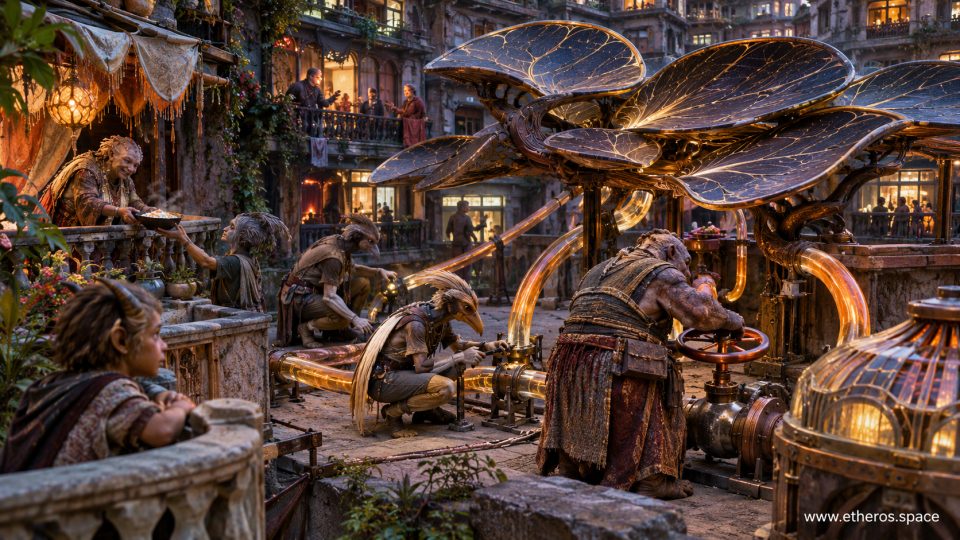
Orvet's south arcade, late market hour on primordial Etheros
Merev had opened the third brass rib when the light inside the sphere began to beat out of time.
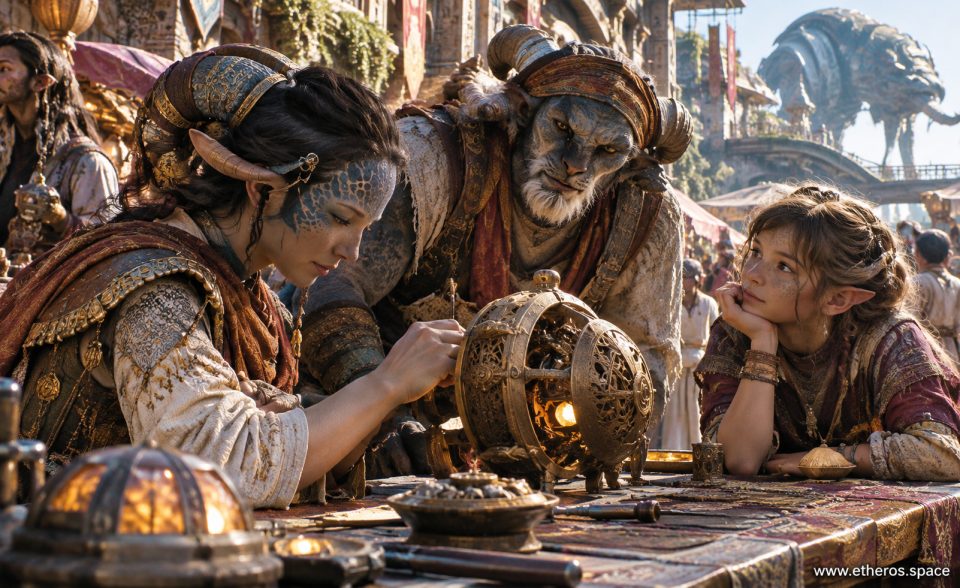
She kept one thumb against the outer hinge and let the other hand rest. The little machine was no larger than a winter melon. Fine lattices wrapped its glowing heart; rings of worn gold and dark metal enclosed a mechanism too delicate to be repaired by force. The market around her carried on—porters shouldering bundles, callers selling their last bread, banners stirring beneath stone arches—but at her small worktable the silence between two pulses mattered more than all of it.
Brael bent closer. His furred face was broad, with horns rising beneath a battered patterned headcloth, and his white beard caught the afternoon light. There was a time he could have repaired such a sphere without spectacles or a second pair of hands. Now he knew how to watch for the tremor in another craftsperson's fingers, and how not to mistake that tremor for doubt.
"It's trying to take the old road," he said.
"It only knows what someone taught it," Merev answered.
Across from them, Neyra rested her cheek on one hand and studied the glowing ribs. She had been silent for so long that Merev wondered whether she had fallen asleep. The girl's ears were turned toward the sphere, however, and when the faintest second pulse came she lifted her head.
"That one was different."
Merev nodded. There it was: a hard, brief flicker after the larger beat. The defect was not in the lightstone itself. A thin conductor underneath the brass caught on a place where the last owner's route had been engraved into a flexible memory strip. The strip was old enough that its ridges had softened, but not old enough for its owner to have forgotten why they mattered.
The sphere was a road lantern, not a magical compass. Its pulse could not choose a path, predict storms or keep a traveler alive. Under a properly calibrated reference lamp it preserved a sequence of measured turns and intervals. Caravans used such devices to retrace difficult land routes between dry upland settlements. At every station a porter checked the local marker against the instrument and made a new notch by hand. Without that work a glowing lantern could be confidently wrong.
Neyra's family had left a town called Hesh Vel after its old caravan road lost most of its trade. No flood, no battle, no prophecy had emptied the street where they lived. Workshop orders drifted elsewhere, the repair guild dispersed, and the household found itself paying to keep a building that no longer brought in enough work. Their departure had been a choice among choices none of them liked. The lantern had traveled with them, carrying the measurements of the road their elders once knew by heart.
"If you mend it," Neyra asked, "will it still remember our house?"
Brael had been prepared to say that a machine could remember only distances. Merev's glance stopped him.
"It will remember the sequence that leads toward the old street," she said. "It cannot tell you who is there now. That part belongs to the people who stayed."
A distant plated giant stood beyond the raised bridge at the edge of the market, partly lost behind stonework and haze. Neither its work nor its purpose could be made out from the little table. The sight reminded Brael that Etheros could rebuild towers, lift walls and carry stone across great distances without restoring every vanished neighborhood. The living planet was generous with matter, less simple with memory.
Merev loosened one pin, then another. When the outer ring tilted, she could see that a former repairer had joined two mismatched strips with a gold clasp. The clasp was beautifully made. It was also a fraction too high, so every rotation lifted the memory band out of its groove. Another maker might have filed the clasp flat and sent the customer away. It would have worked for a while, then slowly changed the distances it reported.
"Why not replace the whole strip?" Brael asked.
"Because someone made these marks before the road was abandoned." Merev looked at Neyra. "We can copy them, but not pretend the copy is the original."
Neyra slid a cloth pouch across the table. Inside was a single small copper token, worn smooth by years of handling. Her grandmother had pressed it into her palm before the family left Hesh Vel. It was worth too little to buy a new lantern and too much to her to sell. Merev returned it without weighing it.
They agreed on a slower repair. Brael would locate a conductor of the correct thickness; Merev would reshape the clasp without shaving away the route marks; Neyra would help record which parts had been tested and which remained uncertain. The fee would be paid in stages, with enough time for the family to remain housed. None of them called that arrangement charity. Brael needed to keep his stall open. Merev needed materials. Neyra needed a map that was truthful about its limits.
As she set the tiny conductor into place, the pulses steadied: one, another, then a hesitation before the third. Merev did not conceal it. She marked the imperfect interval on a narrow scrap of paper and laid it beside the sphere. "This is as far as today's test goes. At the next road marker you'll need a second measurement."
Neyra watched the slow light turn. She had imagined an instrument that would lead her straight back to a closed door and make it open. What lay before her was smaller, and perhaps more useful: a way to travel without lying to herself about where the road ended.
In the evening Orvet would close its stalls and the great bridges would fill with workers going home. Brael would stay to finish a second test. Merev would examine the lantern again in the morning when the reference light was steady. Neyra would take the copper token back to her family and tell them that the old road had not been erased, although it could not yet be safely followed.
She was still listening when the sphere gave one more imperfect beat. This time she did not flinch. She wrote it down.