The Step That Learned Another Rhythm
20261105T185756246684Z_100percent.png
Story
THE STEP THAT LEARNED ANOTHER RHYTHM
The rehearsal at the Nesral Steps began with a silence. Not the formal kind that opened a performance, when the audience knew to hold its breath, but the everyday silence of a musician who had found something wrong with his drum.
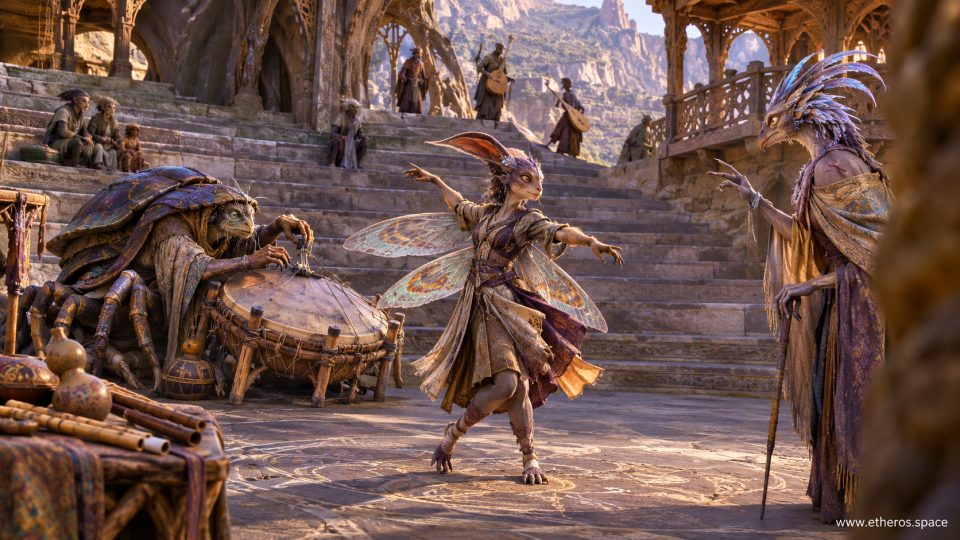
Kevar bent low over the broad hide stretched between the timber ribs. Beneath his blue-veined shell, his walking limbs settled firmly on the stone; his smaller working claws drew two cords through their loops and tested the resistance. For six generations, the hill people had made a drum like this. They had not, Kevar told anyone who asked, made one that kept its voice through the cold months without adjusting its skin.
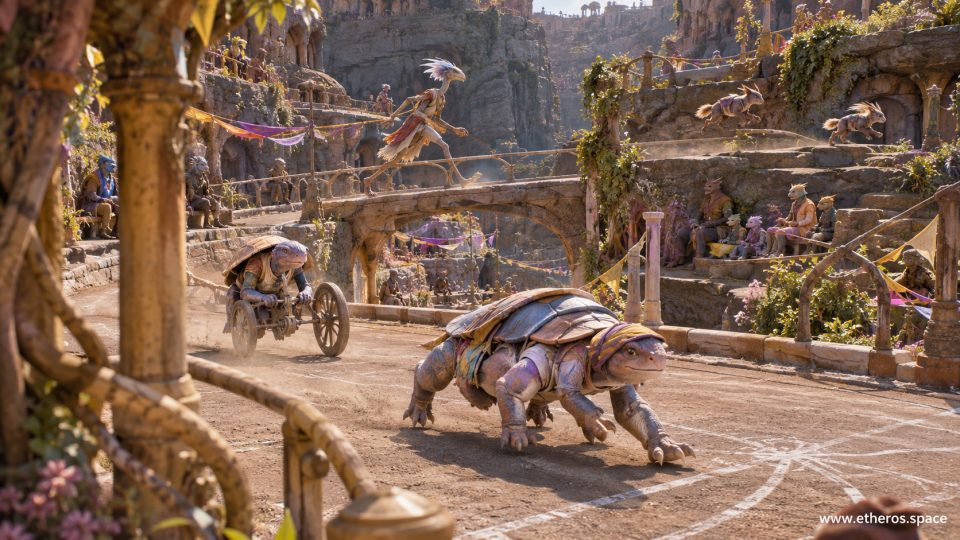
The stage was a terrace of old sandstone above the dry escarpment. Its concentric lines had been recut so often that no one could tell which marks were original. Steps rose behind it into vine-shaped rib arches. A family sat at the edge of the upper benches with their smallest child between them. Farther up, a pair of travelers carried long-necked string instruments toward the shaded galleries. No festival had begun. Everyone was here because the hour was pleasant, the seats were cool, and rehearsals were sometimes better than performances.
In the center stood Ilyra, a young winged member of the far-ridge Avenri. Her patterned translucent wings unfolded to either side, catching the slanting light without bearing her weight. The movements of this dance belonged to her feet: three small turns, one planted claw, a reached hand, and the final stillness. Her striped fabrics swung around her hips. She looked to Talven at the edge of the stage, whose blue plumes rose behind a worn violet shawl and whose staff rested against a carved ring in the paving.
Talven had taught the Three Returns for most of his long life. It began as a walk made by people who returned each season to their old winter homes. In the earliest accounts, the closing step faced the empty mountains. The dancer did not pretend to know who was waiting there. The open hand acknowledged the ones who had gone and the ones who might yet come back.
Ilyra had been instructed to finish with her right wing folded. Instead, in the last turn, she opened both wings toward the stairway.
Talven raised two fingers. Kevar stopped tightening the drum.
"Your left side moved before the third beat," Talven said.
"It had to," Ilyra replied. "My balance is different with the wings closed. If I force the old turn, I step across my own tail and fall."
Talven studied the shape her feet had left in the chalky dust. The dance had traveled long before any of them was born. In the villages nearest the dry north, dancers carried heavier crests and turned slowly. Some families had no wings at all. Others held the gesture with four arms. Talven's own people had standardized the movement when they built the first public terraces here. That decision had made the dance easier to teach, and it had also made certain bodies less welcome on the stage.
He could not simply say the form did not matter. An inherited practice needed a shape, a difference between care and indifference. But he could not ask Ilyra to injure herself in order to preserve a posture from another anatomy.
Kevar tapped the loosened membrane with one claw. The note was soft and round. "We say the third beat is the return," he observed. "What if the return is what it means, rather than which foot it uses?"
From the upper steps came the quick sound of a child trying the turn with both feet. One of the adults caught the child's sleeve before the child slipped. There was laughter, then silence again.
Talven walked forward a little. His staff touched the floor before each step. "It will not be the same dance," he told Ilyra.
"No," she said. "It will be the dance we can do together."
That answer troubled him. He had heard young performers use similar words when they wished to replace a difficult craft with a simpler one. He had also watched people be refused the dance because their limbs bent differently. Both memories were true.
He asked Kevar for the beat again. Kevar retied the last cord and began the rhythm, quiet enough that it did not disturb the musicians on the far steps. Ilyra crossed the marked circle. One claw pressed down. Her wings opened, not as an ornamental flourish but as a counterbalance. At the third beat, instead of turning away from the stairs, she allowed the movement to carry her across the open space between Talven and the family in the seats.
The elder did not applaud. He watched how her weight traveled and how her supporting foot held the ground. He watched the small child imitate the wingless portion of the movement without being told. Then he asked her to repeat it from the beginning, more slowly, so that Kevar could mark where the drum must breathe.
They tried three versions. One lost the pause that made the old form recognizable. One asked the dancer to hold an impossible angle. The third left an extra measure of silence before the closing gesture. The empty interval felt strange and exposed, like an unanswered question.
At length Talven said they would keep the old ending for the opening performance and try the new ending at the public rehearsal afterward. He would ask the elders from the north ridge what the gesture meant in their own homes. The families who had brought it here would be invited to answer, not merely to watch. No one would be allowed to call one variation authentic simply because it was easier to sell to visitors.
Ilyra lowered her wings. Her limbs were tired. Kevar smiled and set the drumstick aside, pleased that the membrane's newest knot was holding.
When the light began leaving the sandstone, the travelers on the upper passage tuned their instruments. The child on the steps tried the third turn once more, imperfectly, with the solemnity that children sometimes give to things adults have called important.
Talven leaned on his staff and looked toward the mountains. The old form had come from people who feared forgetting where they belonged. Perhaps that was why he had held it so tightly.
In the circle below him, Ilyra lifted a hand to begin again. The first beat sounded. The second followed. On the third there was a brief, deliberate silence, and in that silence nobody was excluded from returning.