The Wing That Remembered the Wind
20261103T190259122541Z_100percent.png

Story
The Wing That Remembered the Wind
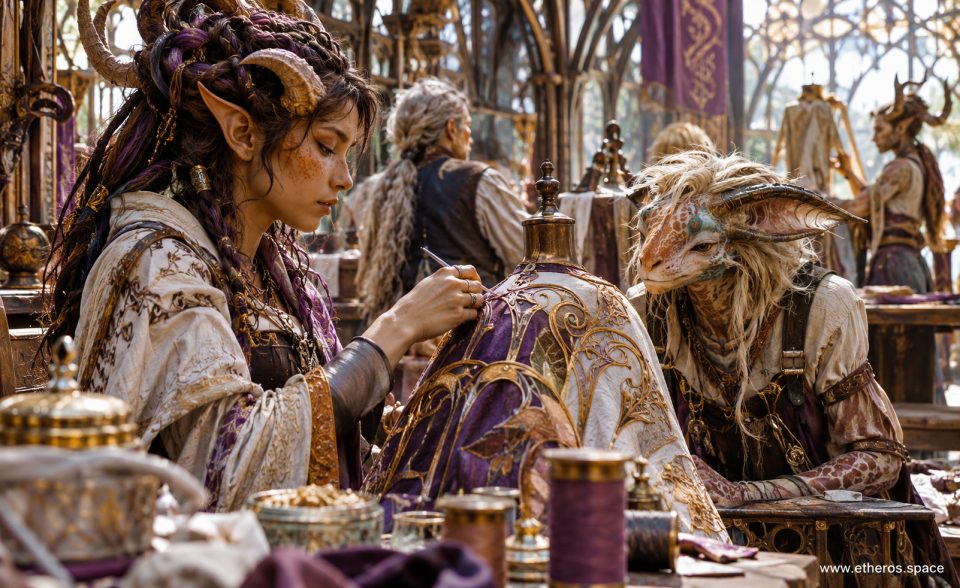
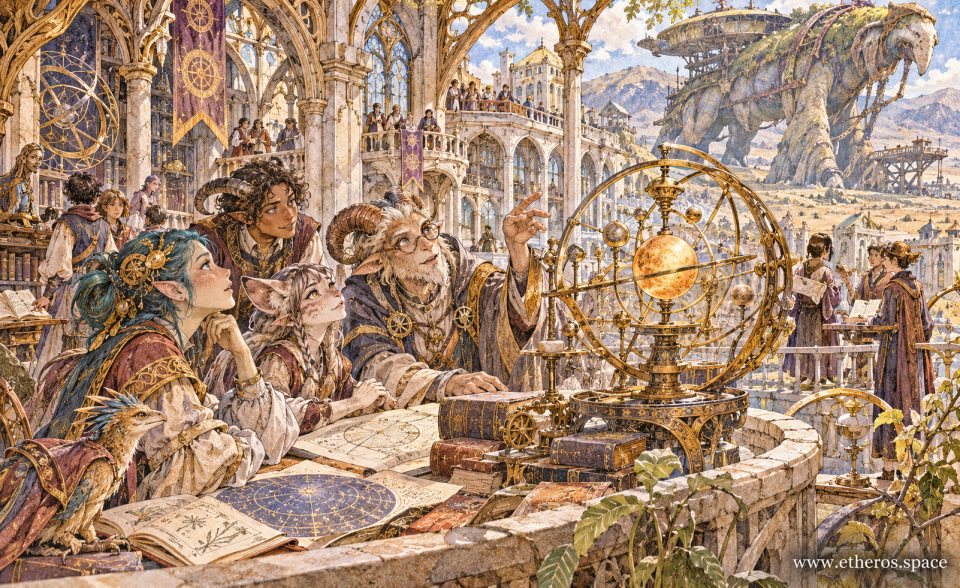
At the upper college of Vaer Nhal, the windows were so tall that the lamps seemed to hang among stars. Their iron tracery held the cold outside, while copper filaments carried warmth through the stone. In the back room, where apprentices learned to tend the small living instruments on which distant settlements depended, a single amber wing shone across a crowded table.
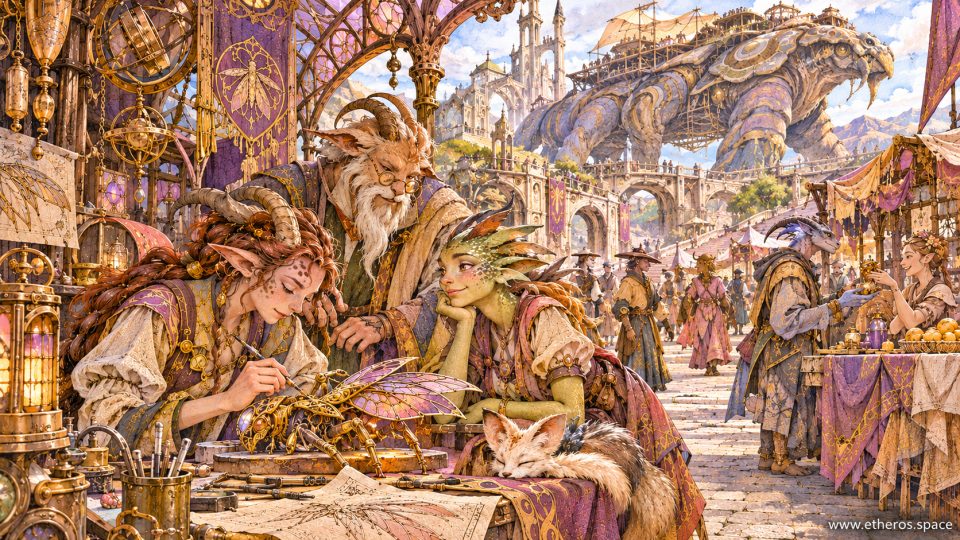
Rhael, the spotted-furred wingwright, held its brass shoulder joint between one broad paw and the finest driver in his kit. His own sleeve was threadbare at the wrist, although its embroidered vines still caught the lamplight. He had worked with these fragile machines for forty-seven winters; he could have tightened a mechanism like this without opening his eyes. That was precisely why he refused to do so.
Across the workbench, Meiri watched him with her chin resting against her hand. A faint pattern crossed her brow, and the pointed tips of her ears moved toward the tiny clicking of the mechanism. She had been assigned to the college only six months earlier, after the mountain village where she grew up had lost two roof crews in a sudden downslope wind. She knew what the amber wing was meant to prevent. She also knew what happened when the warning came too late.
Beside her stood Kesvek, a reptilian scholar whose glasses had begun to slip down his muzzle. He held a large sheet of parchment marked with the delicately branching anatomy of the device. He had brought the drawing from the older archive, where it had been filed as obsolete. The diagram showed an extra tendon no modern repair manual mentioned.
The wing itself was a remarkable thing. Under its gilded lattice, a living membrane had grown along veins as fine as the stems of winter leaves. When cold air flowed over that membrane, it changed tension by a fraction of a hair. Each change moved a tiny brass lever, turning a weather signal into a note that could be sent through the college's nerve-cable network to the villages beyond the ridge.
For three nights, the north signal had been sounding at the wrong pitch. It rang for harmless drafts, then went silent when the wind sharpened. Nobody could tell whether the flaw lived in the membrane, the metal, or the old belief that every instrument could be taught to behave as its maker intended.
"The spring is not broken," Rhael said, after a long examination.
Meiri leaned forward. "Then why does it tremble?"
He touched the smallest screw with the tip of his driver. The amber surface brightened as the mechanism took a little of the lamp's stored energy. A chain of delicate shivers crossed it, so faint that only someone watching with patience might have noticed.
"Because we've been asking it to pull against itself."
Kesvek turned the archival drawing sideways. There, almost lost among the flourishes, lay the forgotten tendon: a supple bridge between the hinge and the membrane's root. The modern replacement had been made rigid for easier maintenance. It was strong, uniform, and perfectly wrong. By holding the membrane too tightly, it concealed the subtle changes the weather organ was born to feel.
No one spoke for a moment. In the neighboring alcove another student bent over a ledger beneath a lantern. Farther away, metal lightly tapped metal. Outside the stained windows, evening settled on the upper terraces. The college continued its ordinary work while three people considered the quiet harm of a shortcut taken generations before them.
Meiri remembered how the warning bell had sounded in her village. The first note was always low. Children laughed and called it the mountain humming. Her father had kept working on the roofs until the second note. On the morning he never came home, there had been no second note at all.
"Can we put the tendon back?" she asked.
"We can make a new one," Kesvek answered. "But not from the stock wire. It needs to grow."
Rhael nodded, pleased that the scholar had understood the drawing instead of merely copying it. He eased his driver away from the hinge and reached for a small living coil kept in a glass vessel at the end of the table. This coil was cultivated from the same flexible tissue that lined Etheros's smallest transport organisms. Fed gently with warmth and minerals, it would root into the wing over several days.
Meiri did not ask whether the villages could afford the delay. Instead, she took a blank page and began composing a notice for the ridge watch: until the repaired wing was tested, each bell tower would keep two people on visual duty. She wrote the additional wages into the request without waiting for permission. A warning system that saved the municipality money by leaving its watchers unpaid, she thought, was another kind of broken instrument.
By the time the lamps burned low, the amber wing had not flown. It lay motionless on its stand, its delicate veinwork shining like a leaf held against the sun. Rhael had only begun the repair, Kesvek had found an error in the accepted design, and Meiri had arranged for human eyes to watch the weather while the living mechanism healed.
There would be no applause at dawn. The northern settlements would hear a bell that sounded when it should, and perhaps never know whose hands had brought its voice back.
Before extinguishing the nearest lantern, Meiri placed one finger beside the warm glass and felt the faintest answering vibration through the table. Not a message, not yet. Only the promise that the small and living parts of the world were still willing to speak, provided someone remembered how to listen.