The Hour Kept in Shadow — An Afternoon at Asterfell Observatory
20261103T190909232484Z_033percent.png
Story
At the Asterfell Observatory, a day could be measured three ways: by the great amber sphere at the center of the teaching orrery, by the tall bells in the west arcade, and by the slow dark footprint of the creature that crossed the plain below. On most afternoons these measures agreed well enough that nobody mentioned the difference.
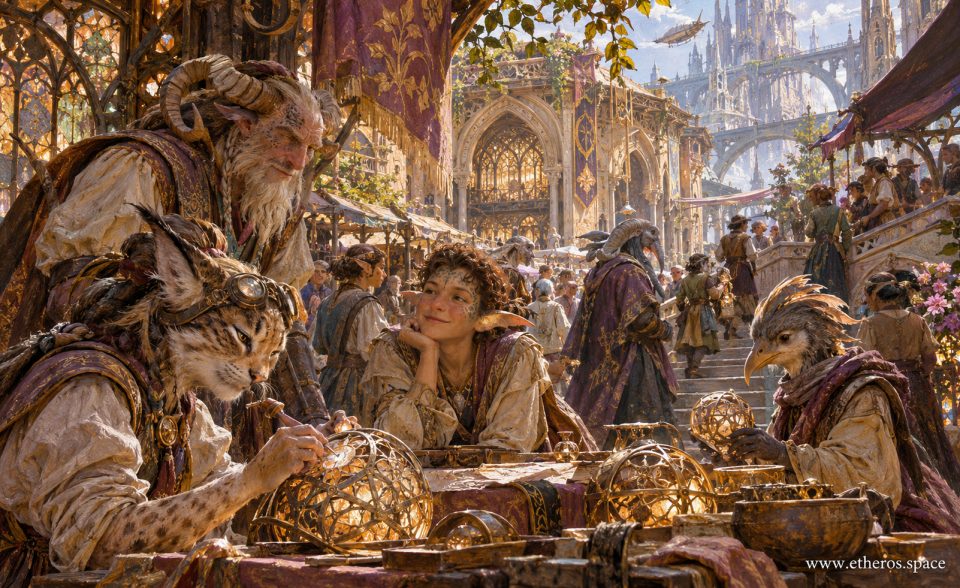
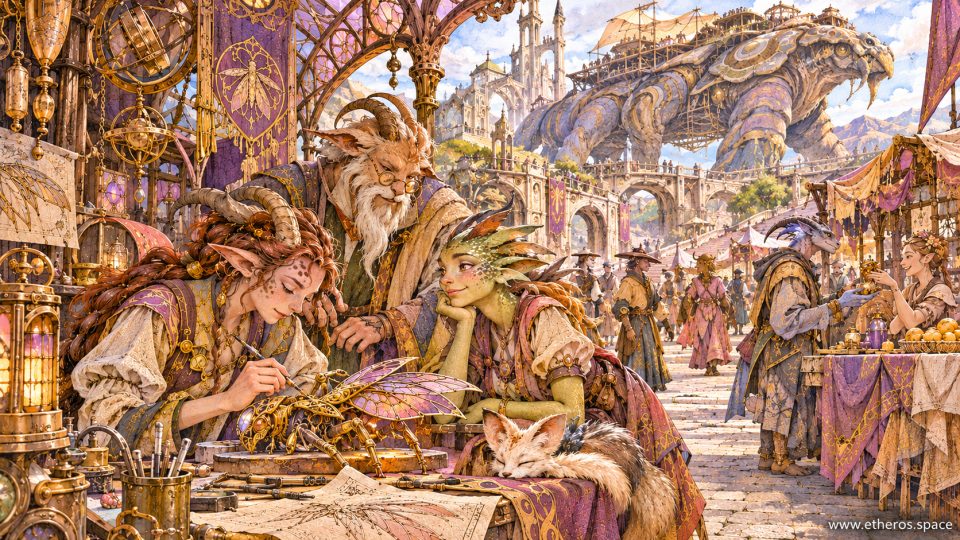
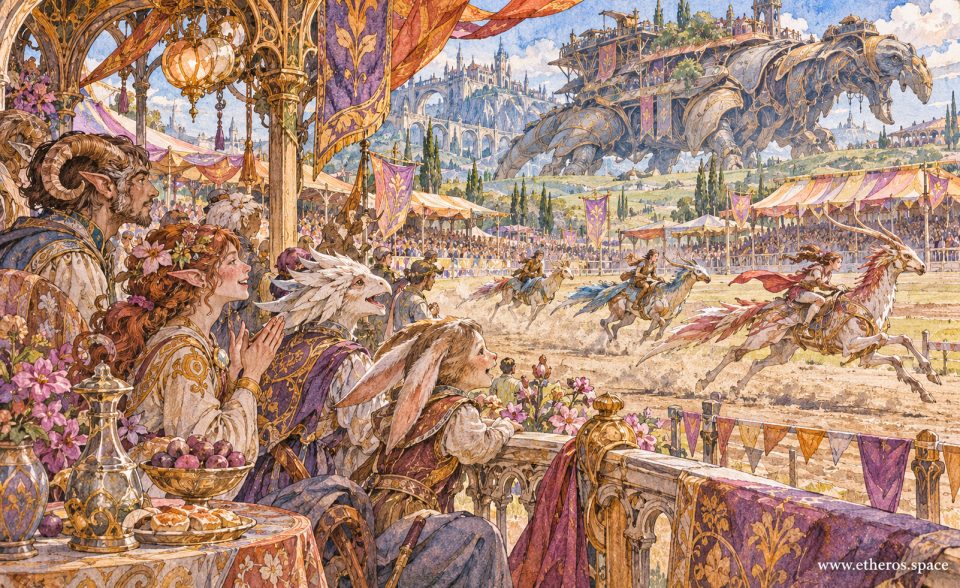
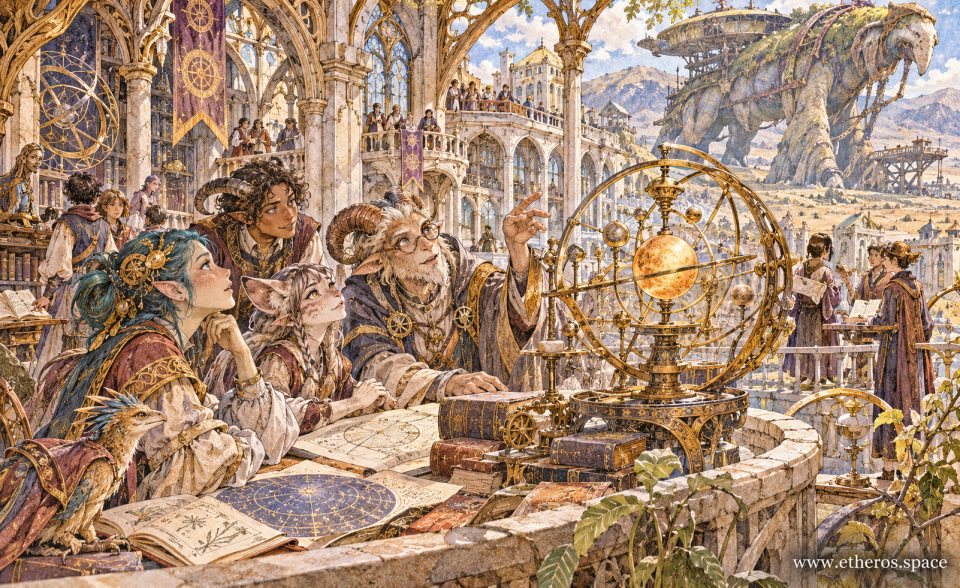
On the afternoon the discrepancy finally mattered, the observatory was full of pupils. They crowded beneath the gilded arches, along the upper balconies, and beside stone tables where old diagrams lay beside fresh ink. A cloth banner bore the academy's ringed emblem. The mountains beyond the open colonnade were the color of flour and old bone. Farther out, the great carrier Namar moved on its many jointed limbs, an inhabited platform riding the protective architecture of its back. It bore trees, passengers, and the equipment of a settlement that could never remain in just one place.
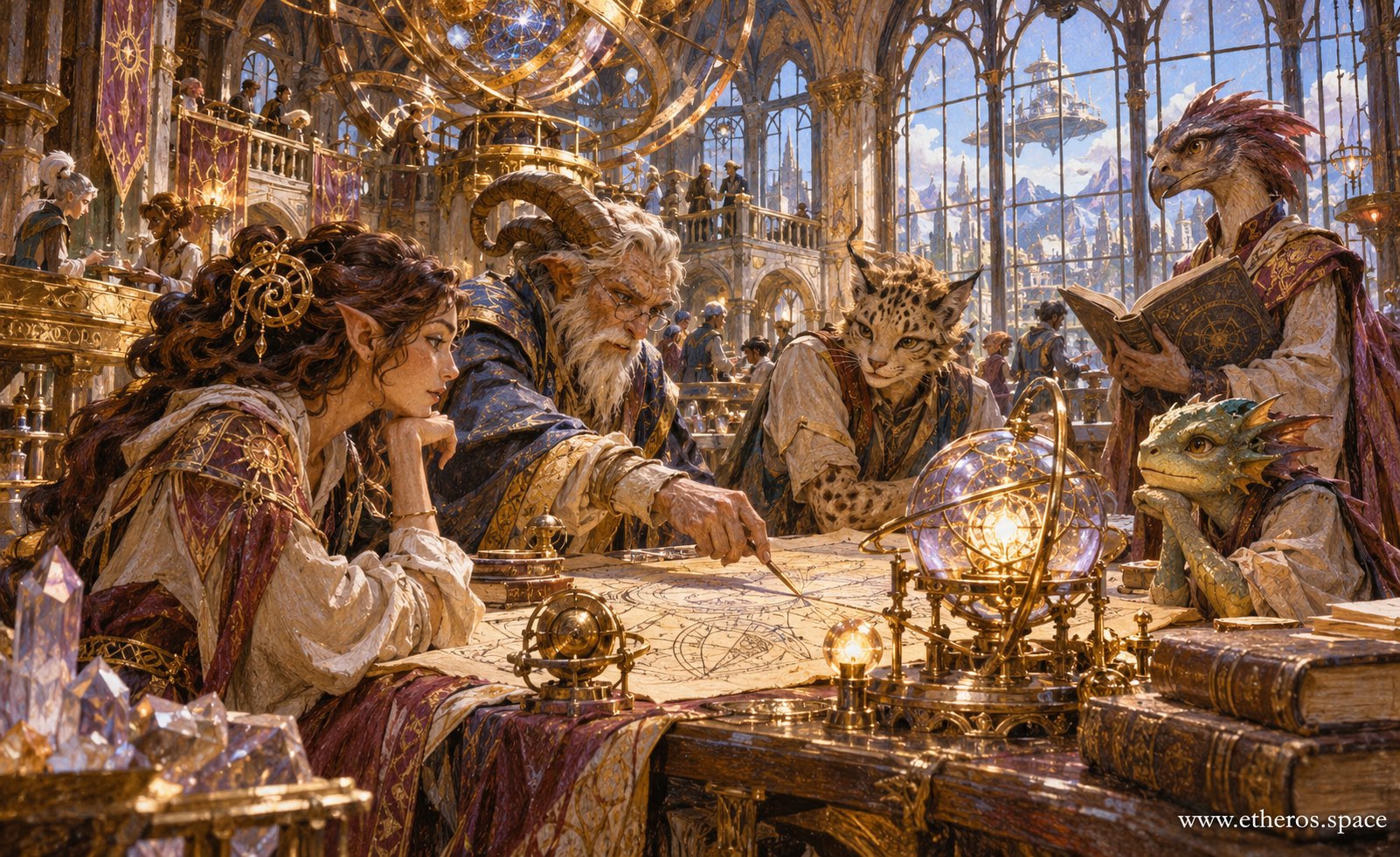
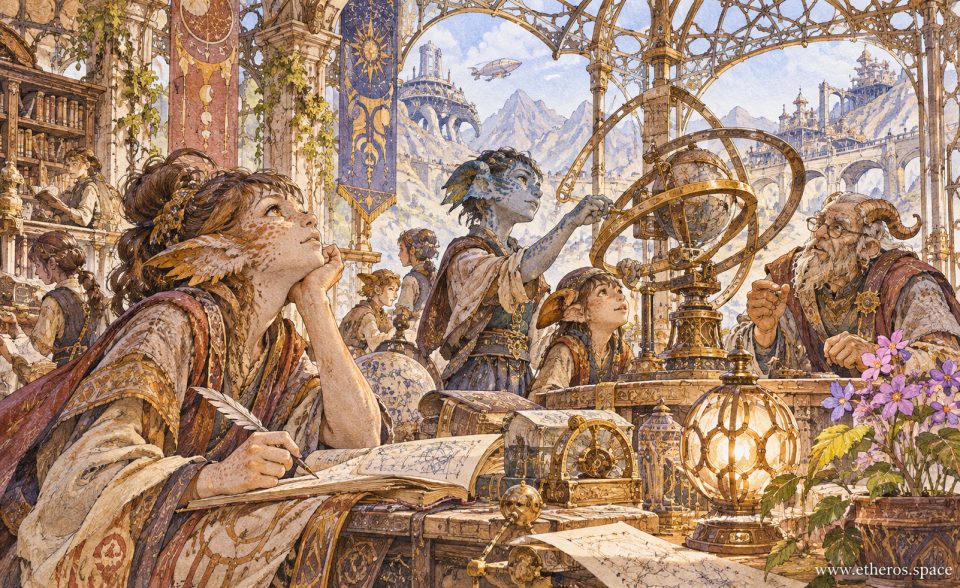
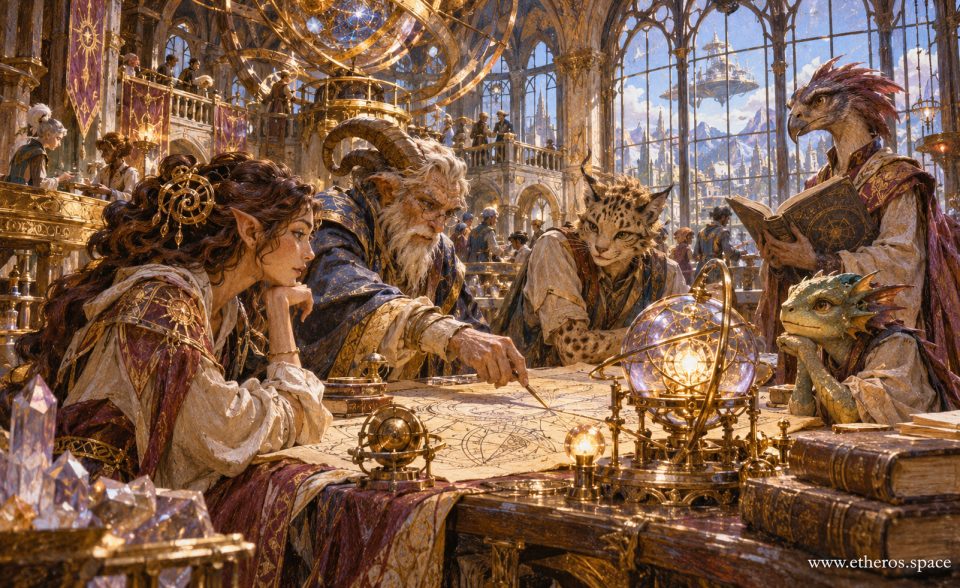
Professor Oren Thale stood at the near table, a gray-haired, ram-horned scholar whose spectacles had been repaired so often the bridge was mostly gold wire. His task was to demonstrate the turning of the planetary calendar, but he had the particular expression of a teacher who knew a lesson had already escaped its plan. In front of him the orrery held a luminous copper-colored globe within nested circles. Books and star charts sprawled below it, weighted against the dry valley wind. A small crested bird watched from the edge of an open volume, seeming to take attendance.
At Oren's elbow waited three students: Nila, who tied her dark teal hair behind a brass clasp; Yven, a young cat-faced map apprentice with ink on one cuff; and Sorren, who had spent a full year pretending not to worry about his father's assignments on Namar. The older students along the balconies were supposed to calculate the angle of the winter light. The younger ones had been given a simpler problem: why did the academy dismiss its children before the lower quarter received the last sun?
Nila had brought a petition from the workers' houses. For nine days the lower steps had fallen into shadow earlier than the school bells acknowledged. Children traveling home could no longer see the painted hazard marks along a narrow road. The academy clock was accurate, Oren had been told by its keeper. That, Nila replied, was exactly the trouble. Accuracy was not the same thing as noticing who had to walk in the dark.
Oren turned the small demonstration globe. One loop represented the planet's steady rotation. A second indicated the path of the seasonal sun. He did not use it to claim the behemoth had moved the heavens; the great creature did nothing of the sort. Its long body and inhabited deck simply cast a broad moving shadow across the lower terraces as its route curved closer to the city. The time on the dial had not changed. The light available to a child carrying books had.
Yven laid a ruler across a chart and calculated the width of the shaded interval. Sorren moved a brass marker along the projected route, tracing where Namar's shoulders would meet the bright afternoon sky. Their answers differed by six minutes. They recalculated. One of them had measured the head and forgotten the upper transport deck, whose overhanging supports prolonged the shade. The ornately ribbed architecture on Namar's back was not decoration alone: its load-bearing members held trees and passengers high above the plain, and these same members had a practical effect on the world below.
Across the terrace, people continued their ordinary business. Some listened; some compared notes; a couple in the far colonnade argued about the winter term. Namar walked, slowly and without menace, carrying its own obligations eastward. Its movement was neither an error to correct nor a service to suspend. It was part of the neighborhood's life.
Sorren finally spoke. His father maintained the carrier's platform joints, and each time the city complained about its shadow the maintenance crews were blamed as though their work were an inconvenience rather than the reason the eastern settlements had medicine and grain. He had been afraid this new petition would mean another order to change the creature's route. Oren asked him to draw the route again, without moving a single point. Then he asked the others to move the school dismissal bell instead.
They found a smaller solution than anyone had expected: on the days Namar passed the southern ridge, the lower-quarter pupils would leave one bell earlier. The city watch would repaint the hazard marks with a dull mineral pigment visible in the shade, and the academy would add a second, local-light scale to its public calendar. The observatory could keep its accurate clock. The children could keep their safe walk. The carrier could keep the path that supported distant households.
Nila wrote the agreement in the margin of the sky chart, beneath measurements of distance, angle and load. Yven insisted on adding a place for later corrections, because the world would continue to move. Sorren, still anxious, watched the enormous figure in the valley and realized that the problem had not been his father's machine at all. It was a city that had been counting only the light visible from its highest rooms.
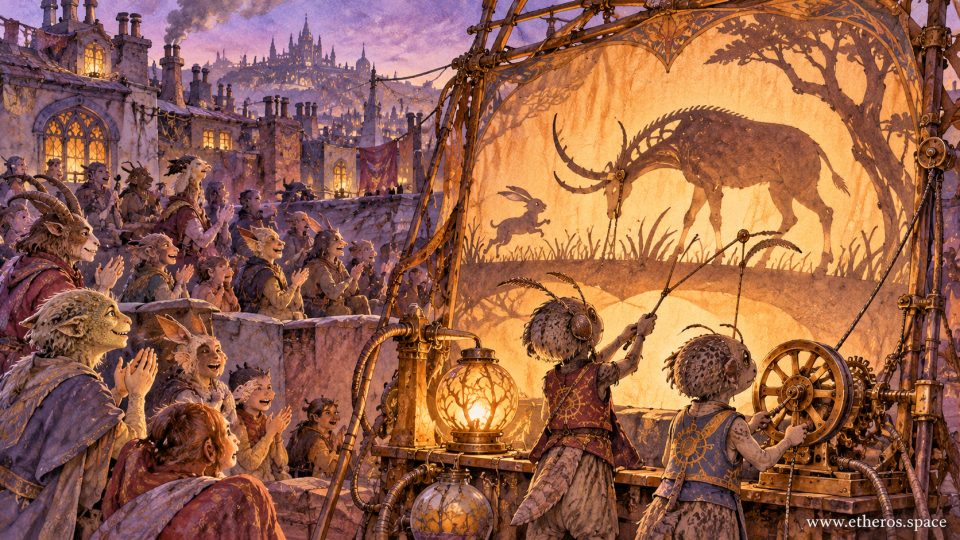
At the end of the lesson Oren drew his students close to the orrery and covered the bright globe with one hand. A soft shadow ran over the gilded rings. The little bird shifted its feet on the open book. No bell sounded yet. In those quiet moments the children could see what the demonstration had been for: not to command the planet into a perfect diagram, but to make a diagram responsible to the lives beneath it.
The next day the lower-quarter bell was struck early. Namar crossed the plain at the same patient pace, and a girl with a satchel reached her doorway before the path lost its gold. No one called it a new hour. On Asterfell's revised chart, it was written simply as the hour kept in shadow.