Where the Thistle Stayed — An Afternoon on the High Grazing Road
ETHEROS_20261104T092458904253Z_066percent.png
Story
Where the Thistle Stayed — An Afternoon on the High Grazing Road
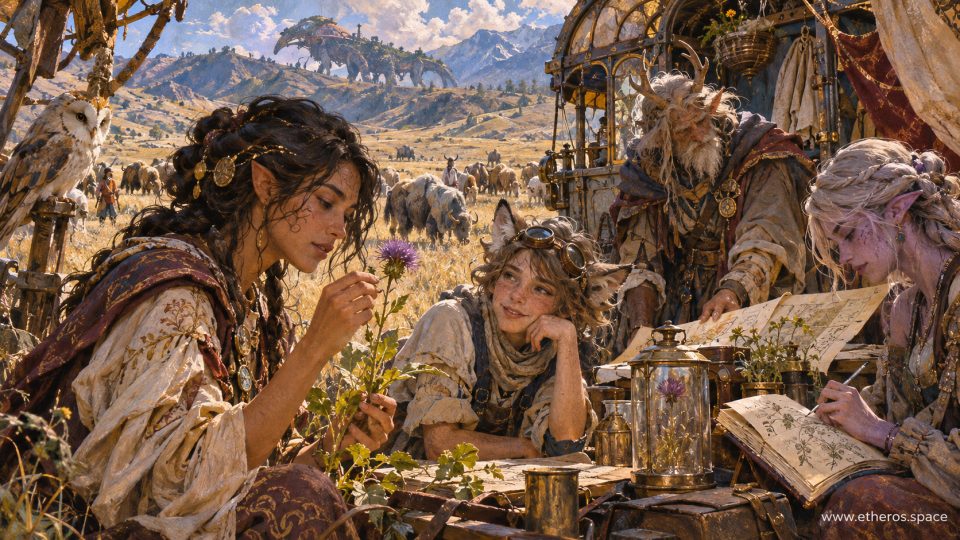
The wind crossed the high fields without asking permission of anything built there. It ran through the pale backs of grazing animals, rattled the dry grass against the wheels of the survey caravan, and stirred the tiny yellow blossoms tangled in its awning. Under that awning, four travelers were making a question of one violet flower.
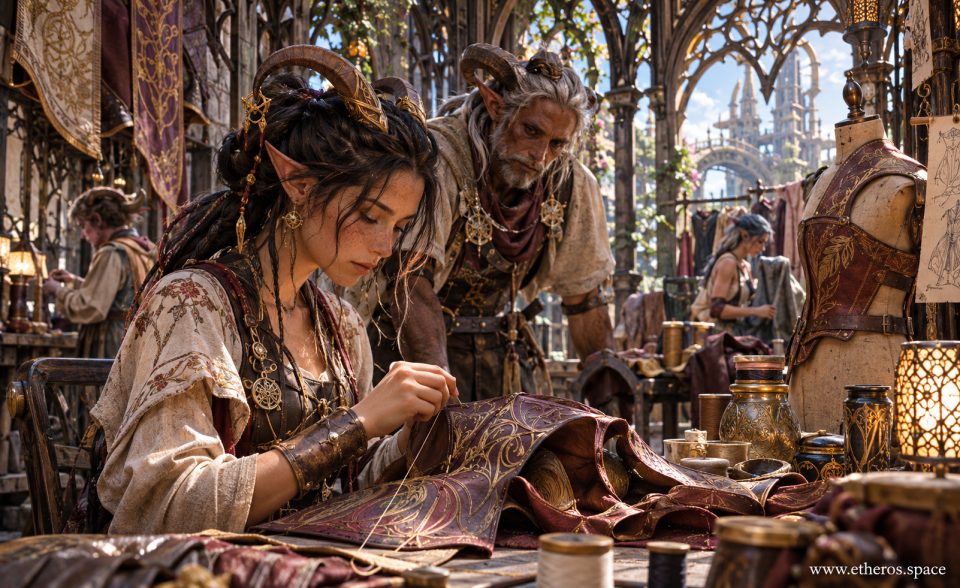
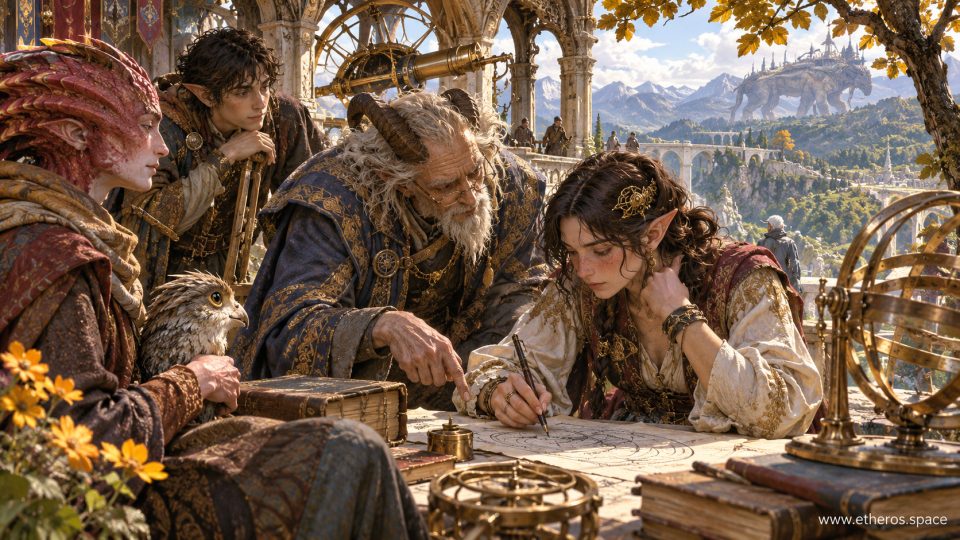
Reni Soril held the stem below its thorny head, careful not to pull it free. Her black hair was pinned away from one pointed ear, and the embroidered sleeve of her field coat kept brushing the long grass. Beside her, Tavi, a young, wide-eared apprentice with goggles on his head, watched her fingers with an expression that had made adults underestimate him ever since he could speak. A pale owl sat on the carved upright of the traveling station, calmly tracking movement over the hill.
“It's flowering late,” Tavi said.
“Or the others flowered early,” Reni answered. “A description is not yet an explanation.”
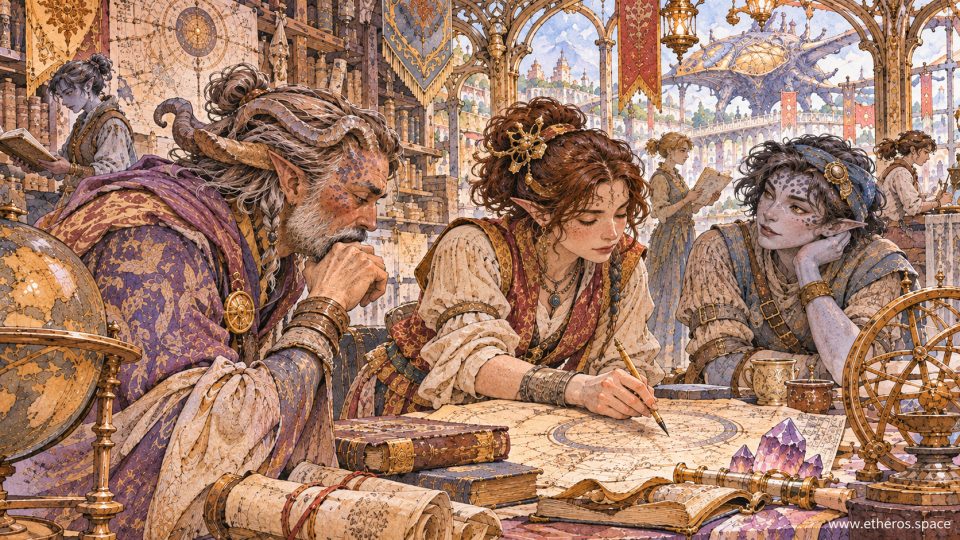
At the other end of the table Vessa, whose lilac-toned skin showed through the loose strands of her silver hair, bent over a notebook. The page contained careful drawings of the same small flower at three ages, and the names of two grasses growing beside it. The little brass-and-glass vessel among her papers held another specimen where the sun could reach it. None of them had brought it to the hills for decoration.
A map rasped against the side of the wagon. Orren Halewick, the elder route keeper, pressed its lower edge flat with a weathered hand. His curling horns, pale beard and heavy traveling shawl made him familiar to the high-road people; the map made him useful. On the preceding journey he had already learned to prefer the comfort of an aging pack animal named Yara to the shortest line in a ledger. Today he had come to ask whether the herd path ahead was as sound as it looked.
Beyond the station, pale shaggy grazers passed through the yellow grass in loose groups. Each animal chose its footing independently, then fell into the unspoken rhythm of the others. Two distant herders followed at a respectful distance. Against the upper ridge a gigantic plated, many-legged form crossed or stood beneath a hazy pale sky. No one at the table could determine its work from so far away, and no one tried to turn that uncertainty into an answer.
The previous season, caravan wheels had hollowed a shortcut below the ridge. It appeared firm, especially in the dry months. The route led to the lower communities without the extra climb around the eastern slope. A trade factor had proposed widening it for the next animal passage. Orren had not approved the plan. He knew too well how a road could look generous to the person holding the pencil and cruel to the creatures asked to walk it.
Reni had noticed thistles surviving in a strip that lay just beyond the compacted trail. Their roots seemed to bind the powdery soil where the hoofprints grew shallow. The neighboring strip, scraped bare by repeated traffic, had the same stones and the same afternoon sun, yet its dust shifted with every gust. That contrast was worth recording, not yet enough to call the ground unsafe.
Tavi had been sent to count the flowering stems. He returned with an inconvenient number: there were fewer on the apparently easier slope, not more. He had counted twice, marking each plant with a fallen seedhead to keep from making the same mistake. Reni looked from the flower in her hand toward the animals farther down the valley.
“Maybe the grazers have eaten them,” Vessa suggested, still writing.
“They don't favor the spines,” Tavi said. “I've watched them pass.”
“Then perhaps the wheels did the eating,” Orren murmured.
No one laughed. The four of them had spent enough afternoons in fields to know that a good question often sounded foolish for a while. They walked the short distance to the edge of the track, tested the loose surface with a plain wooden rod, and compared notes on grass cover, hoof depth and the visible small cracks. There was no hidden oracle in the violet flower. Its value was that it pointed them toward a difference they might otherwise have stepped over.
By the time they returned to the awning, Orren's map had acquired a new penciled bend. It curved away from the most worn ground, then rejoined the road near a shallow rise where the grasses still held together. The detour would cost a caravan part of an afternoon. It might also keep the trail usable for years if they stopped sending every wheel and hoof through its weakest section. Before endorsing it, Orren would ask two local herders to walk the line and would have the soil checked again after the next windstorm.
Vessa drew the new path beside the flower's profile. Tavi wrote his own count beneath the adults' measurements, not as a favor but because it belonged there. Reni pressed a loose strand of hair behind her ear and lowered the thistle into its protective sleeve. She left the living plant rooted where it stood.
When the sun began slipping toward the western ridges, the caravan remained still a little longer. The owl shifted its feet on the post. A child among the far herders ran after a drifting scarf; one of the shaggy animals stopped to examine an unremarkable patch of grass. Life went on without waiting for the map to be completed.
Orren looked once more at the pencil line. There was nothing heroic in it, no ancient mystery solved, no grand machine summoned to do work that a few attentive travelers could manage. A road was a promise repeatedly revised by those who lived along it. They had listened to a flower, but they had not mistaken listening for proof. Tomorrow, somebody would test the new route with tired feet and real weight. Today, it was enough that the question had been asked before the ground was broken.