The Window That Stayed Lit
20261106T125841520349Z_100percent.png
Story
THE WINDOW THAT STAYED LIT
Veylen Common Roof, primordial Etheros; the last interval of evening.
From the little balcony nearest the old stair, Keru could see the city going amber one window at a time. The houses clung to each other in layers of stone and living timber, each floor built to accommodate a different kind of body. Horned neighbors ducked through one arch. Long-limbed residents used shallow outer steps. Below them, on the common roof, the dark leaf-shaped collecting vanes were opening their ribs to the cooling air.
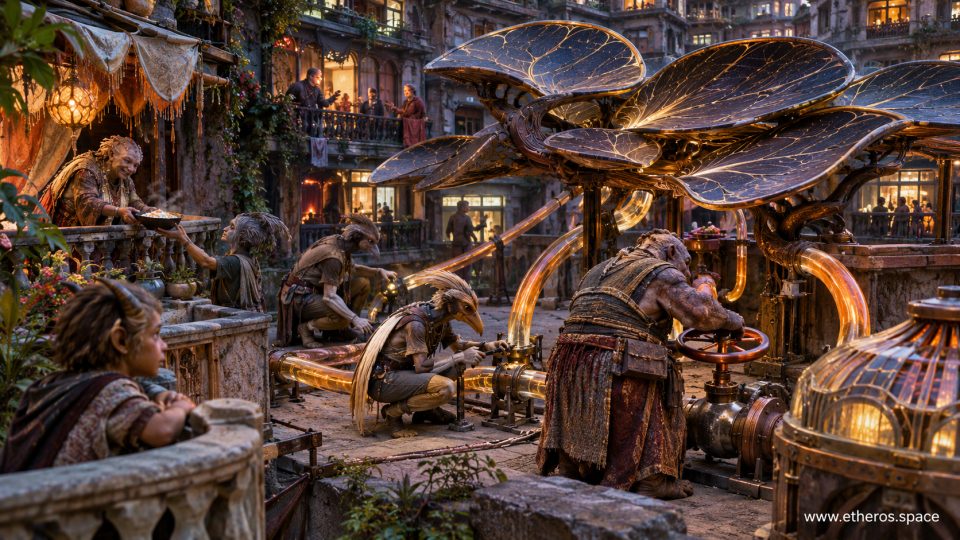
The vanes did not manufacture light after sunset. All day their veined surfaces had stored energy from the sun in the roof's buried mineral cells. At dusk, the reserve passed through branching glass conduits to the lanterns of the surrounding dwellings. The warm tubes looked almost liquid from above, but the energy traveled through a contained lattice. Every luminous branch was clamped to stone; every support needed inspection. The roof belonged to the residents, and so did its occasional failures.
Dorsa had one hand on the old red regulator and the weight of both shoulders against its resistance. Her broad back was braced over the valve; she was not posing for anyone. Near the lower conduit, Issik, a feather-crested coupling fitter, knelt with a tool in the seam of a brass collar. The smaller assistant behind him kept the loose tail of a service strap clear of the pipe. The pressure indication was within tolerance, but one branch had begun to pulse instead of shining steadily.
'It is the night stair again,' Dorsa said. 'The old joints always choose the hour people come home.'
'Not the stair,' Issik replied without looking up. 'The narrow return from the upper rooms. If you force that wheel, the whole terrace will have a brighter lamp and a hotter joint.'
Dorsa relaxed her grip. The glowing artery beneath the collector petals steadied and then flickered once. Beyond the roof, figures leaned over crowded balconies, watching through curtains and between the flowering pots. None looked frightened. They had lived through a hundred ordinary repairs. A resident across the courtyard carried on talking to a neighbor, indifferent to the minor drama under the vanes.
The question was not whether the line could be fixed. It was what would be supplied first when the repair was complete. The workshops on the south passage had paid for most of the new collector surfaces and wanted stable evening energy for their tools. The older households had contributed labor, space and the structure beneath the panels. They asked for enough reserve to keep the stairways lit for those whose eyes, knees or feet did not suit the narrow dark turns. Both claims were real; neither would fit completely into the remaining stored charge.
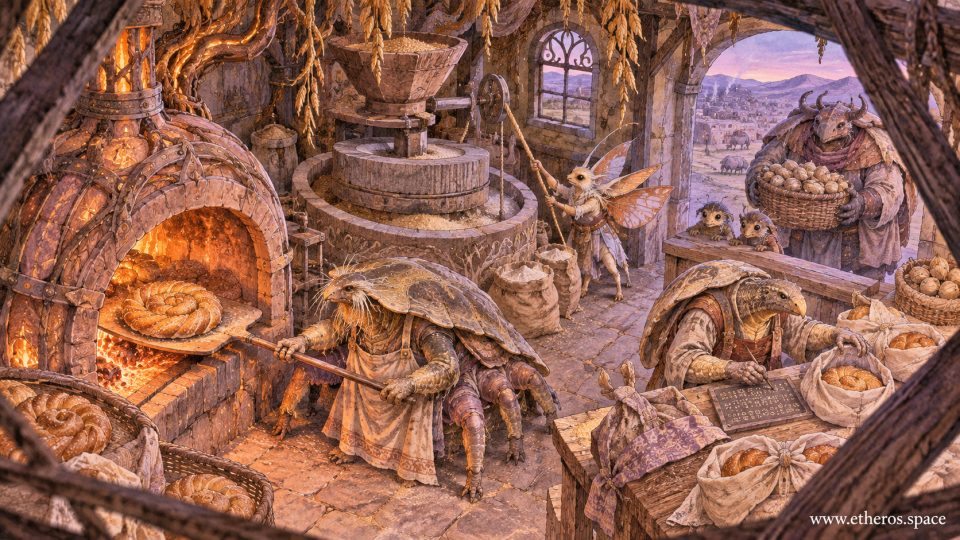
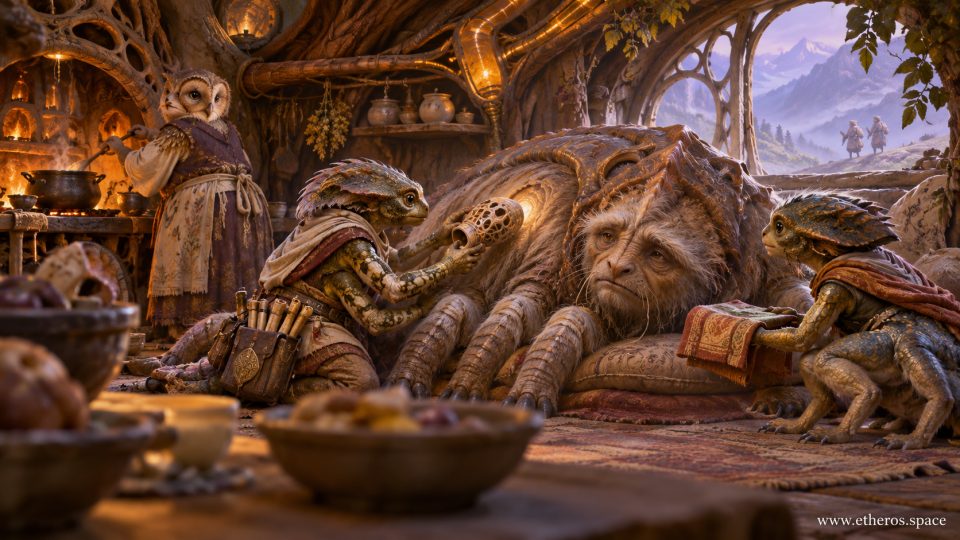
From a left-hand balcony, old Vorra leaned through the railing with a shallow bowl of warm supper. Rell, the dust-haired helper standing on the adjoining ledge, reached carefully to take it. The food did not solve the argument; it kept the workers from trying to finish hungry. Vorra had been feeding the crews for as long as the roof had belonged to the neighborhood. When Dorsa called that there would be another inspection, she answered only, 'Then they need another bowl.'
Keru watched Issik draw a short mark in the condensation on the brass collar, then touch the lighted tube with the back of a gloved finger. No leak. The pulse came from a tiny piece of grit lodged where the returned branch entered the common manifold. He slipped out the service plate and dislodged it with a hooked instrument. The amber line ran evenly from the rooted column into the wall. Somewhere upstairs, the first step-lamp came on.
Dorsa turned the wheel back only a fraction. A little light returned to the workshop openings; another little stream climbed into the stair lanterns. The full allotment was still beyond reach. Dorsa asked the southern makers to accept a lower draw until morning. Their representative, watching from across the roof, asked who would reimburse their lost hours. Dorsa had no sum to offer. She promised an accurate reading of the store at dawn, made in front of whoever wished to attend.
As the old keeper passed another bowl across the balcony gap, Keru counted six windows bright enough for an evening meal and three still in a patient darkness. 'Why not make everyone equal?' the child asked.
'Because light is not measured only by how much is given,' Vorra said. 'It is measured by what each doorway needs to be safe.' She nodded toward the higher steps. 'And because a neighbor who has paid for the roof's ribs should be heard, even when she has no one waiting on those stairs.'
The city did not become fair before supper. At the meeting tomorrow, they would argue about the workshops, the elders, the price of new storage cells and who had repaired the terrace without a wage. Tonight the common stair burned steadily. A worker could descend to the street; a child could find the next landing; a craftsperson could finish one small piece before closing. Dorsa stood back from the regulator. Issik folded his tools, and the broad dark collector petals rose above the roof like quiet leaves.
From the balcony, Keru could still see the unlit windows. The child decided that remembering their number might be the first useful thing to bring to the meeting.