The Lesson with No Gate
20261106T040015163966Z_100percent.png
Story
THE LESSON WITH NO GATE
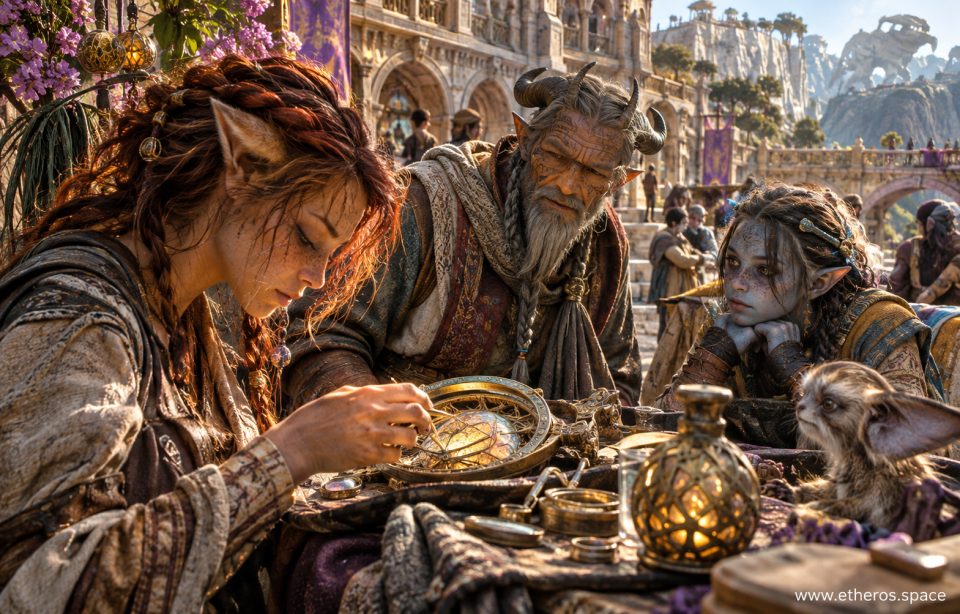
There were four hands around the brass sphere and four opinions about what it was worth.
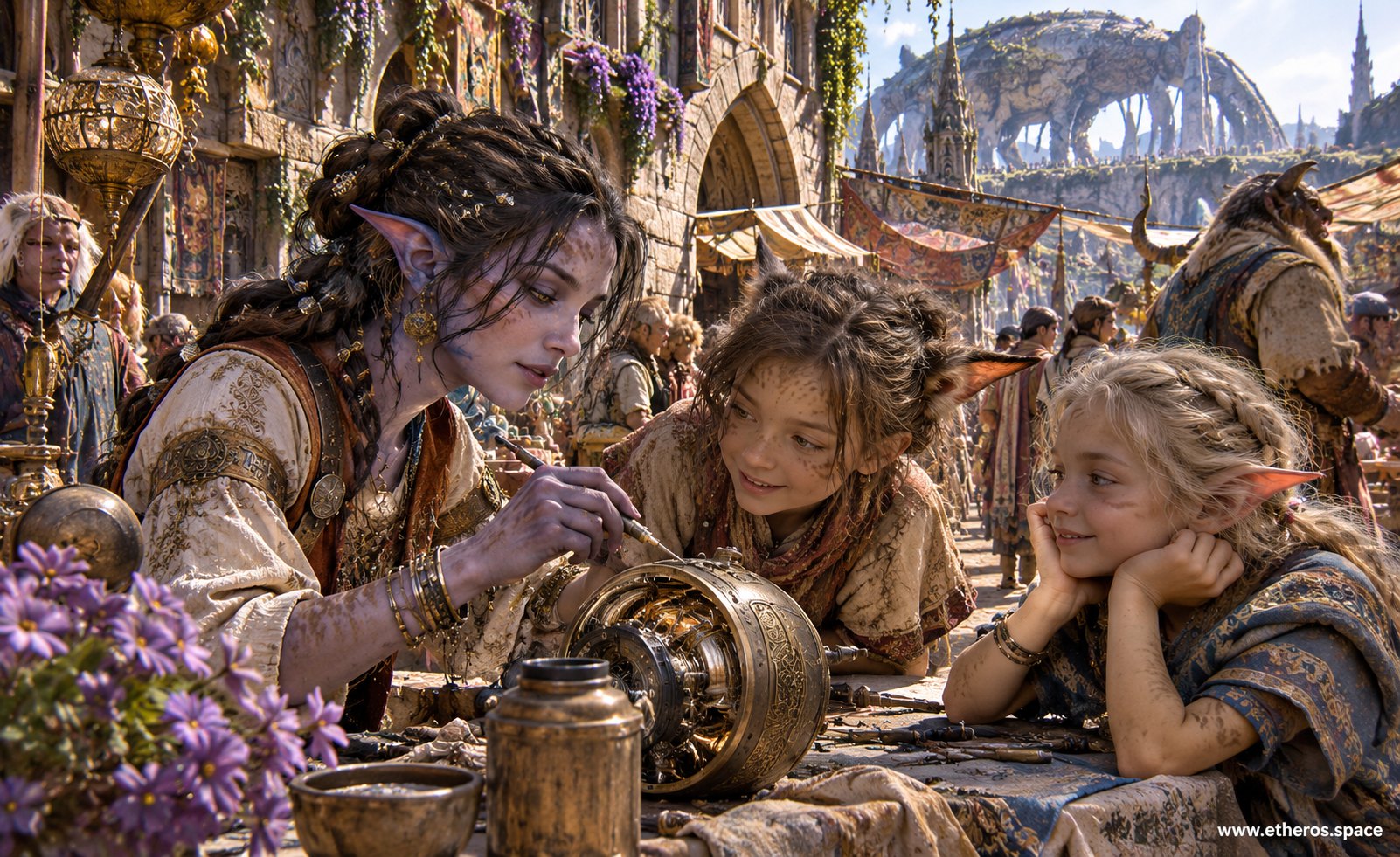
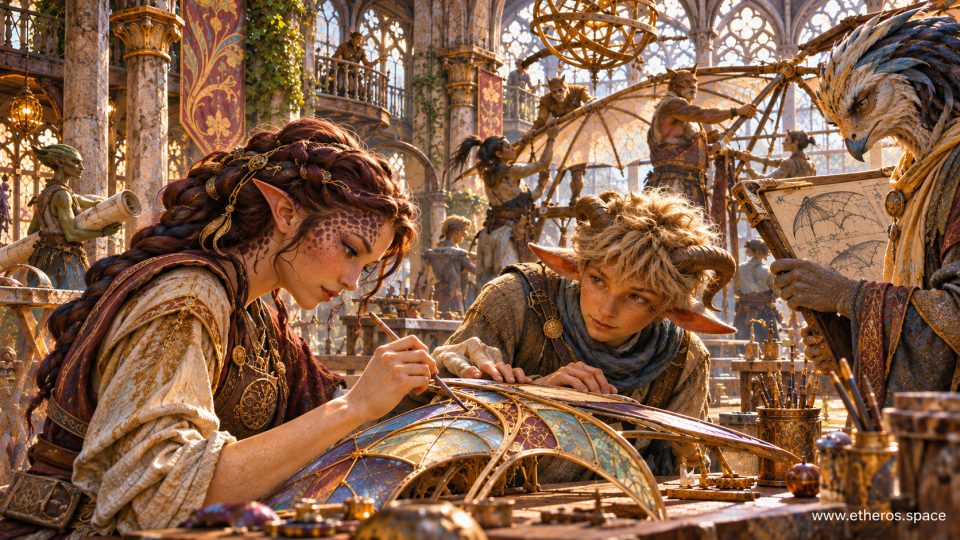
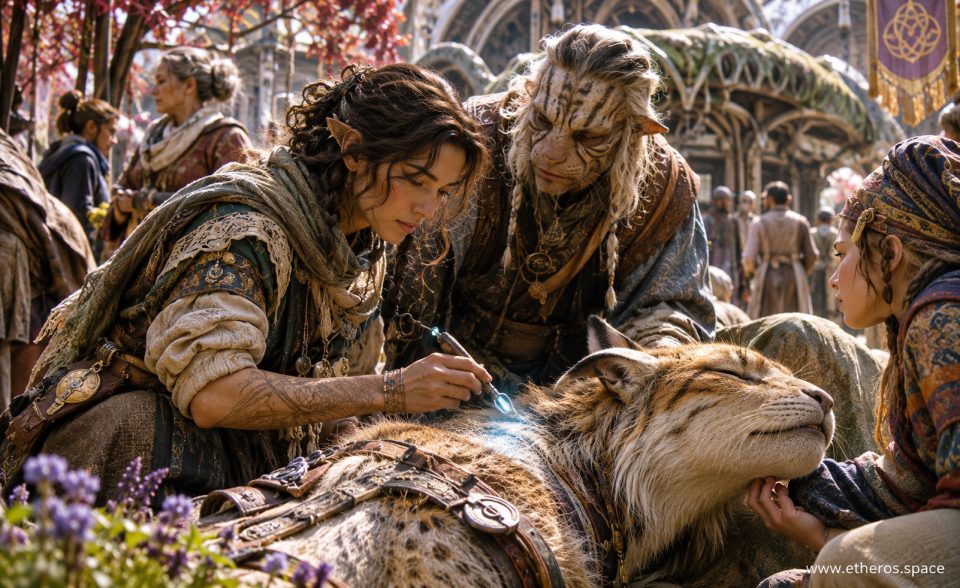
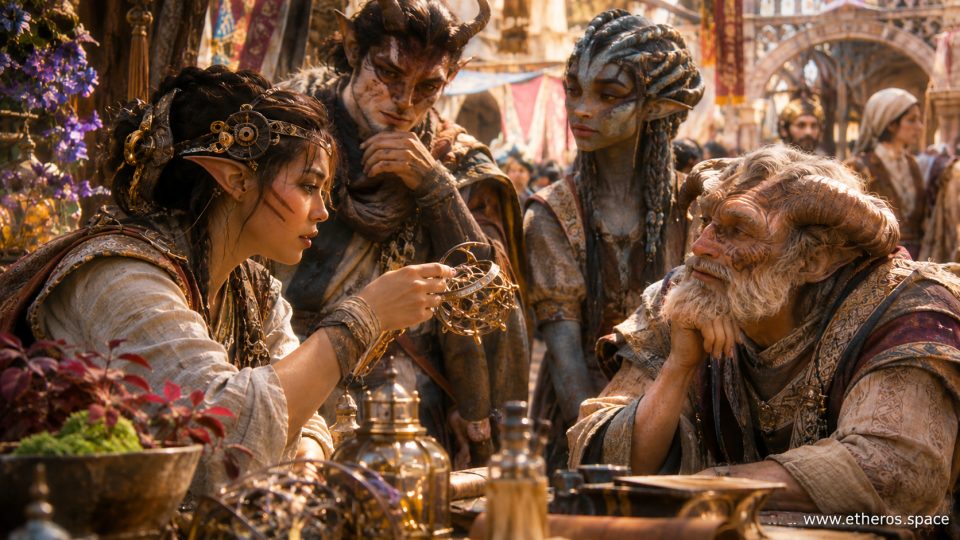
The first belonged to Keir, who had assembled the little instrument from flawed circular ribs and glass that other shops had discarded. Keir had pointed ears and dark hair caught under a worn brass headband. She stood at the front of a crowded stall in Thessra's Day Exchange, turning the small ringed apparatus until the afternoon sun could pass through its narrow opening. Behind the stall, banners stirred between stone arches. People with baskets of flowers and parcels of food kept moving past without knowing that a decision about the city's schools was being made beside the brass jars and rolled patterns.
The second pair of hands belonged to Vaer, a young horned porter. He did not touch the sphere. He leaned forward, one knuckle tucked beneath his chin, watching the reflected mark travel across the filigree. Years ago Vaer had learned to measure distance by counting the length of his own stride. A calculation made with a borrowed tool was usually a calculation someone else could take away. He did not want to be impressed merely because the light looked beautiful.
Taless, whose skin held the blue-grey sheen of old slate, watched from just beyond his shoulder. Her black braided hair carried dust from the eastern road. In her home district the apprentices learned to read mineral strains by listening to stones placed on a wooden bench. They had never been offered a formal course in the optical arts. The city said that anyone could enroll. It meant anyone who could afford three seasons away from work and find a master willing to sign the first page.
The fourth observer was Orem, an older horned instrument dealer, whose pale beard spilled across his embroidered collar. He had spent most of the morning listening to extravagant claims. Other vendors promised that similar devices could settle disputes over harvest boundaries or predict the cracks in a bridge. Orem could see, without setting aside his elbow, that Keir's creation was nothing so powerful. The two outer rings were slightly crooked. A lens had been held in place with an uneven repair. The sphere could demonstrate the changing angle of light, but it could not know what a stranger meant by the angle.
"Show us the mistake," Orem said.
Keir turned the innermost frame once more. A small golden reflection crossed a tiny marker and stopped. She put her thumb against a bent rib and the reflection moved. Nobody could have mistaken the change for a miracle. It was the kind of error that an attentive student could reproduce with patient fingers.
"If you know where it goes wrong," Keir said, "you know where to begin."
Orem's license covered instruments of high precision, not public lessons. He paid for materials, workbenches, storage and lost stock; a free demonstration might bring a crowd that bought nothing. Still, he remembered learning as a boy from an elderly glassworker who demanded no fee for the first afternoon, then charged him fairly for the years that followed. The glassworker had not believed that a craft remained alive when its doors were locked so tightly that the next generation could not enter.
Taless asked whether the lesson would be available beyond Thessra's upper quarter. Vaer wanted to know who would pay Keir for the time spent teaching. A passerby suggested that the council could simply purchase the finished sphere and place it behind a clear window in the civic hall, where everyone could admire it. Taless shook her head. An instrument admired through glass was not a skill learned with one's own hands.
Keir had already tried the council's method. The hall permitted the public to look and forbade the public to touch; visitors left knowing only that the city possessed something they did not. She had built the flawed sphere because its imperfect parts were replaceable. If a student broke a rib, there would be a lesson about tension, a repair that could be made, and no expensive secret to protect.
Orem lifted his head. He proposed a trial, not a gift. The guild would lend two tables and maintain a ledger of materials. Apprentices from different districts could visit on alternating market days. The first hour would be open, the next paid if the learner chose to pursue the craft, with a reserved share of the guild fund for those who could not. The teachers would keep their wages. Every learner would be allowed to record both what the instrument showed and what remained uncertain.
Vaer counted the proposed hours on his fingers. There would not be enough spaces for all who wanted them. A paid second hour could still exclude a talented child whose family needed her labor. And a guild could use an open class merely as an advertisement for its most expensive training. Orem did not deny any of this. His proposal could be judged only after actual learners had used it.
Taless took a folded piece of paper from her road pack and drew the rough form of the rings. She offered to carry a copy to the eastern district, provided the first class made its measurements public. In return, she would bring a stone-listening exercise that required no glass or gold. There would be something for the privileged students to learn from her as well.
The market kept moving around them. Purple flowers brushed the outer edge of the stall. A group in travel cloaks crossed under the arches. Keir adjusted the damaged ring, and a narrow oval of light arrived where it ought to have been. Nobody clapped. The mark was too small for anyone beyond the table to notice.
Orem said he would sign for the tables before the week ended. Whether the council would release the money was another question. Whether Keir could keep a workshop open while teaching was a third. They had not solved the economics of learning simply by making one lesson possible.
But Taless took her copied drawing, Vaer offered to carry the tables, and Keir put the little sphere into a cloth bag. She would bring it back on the next market day. In Thessra, a door had not been built. A path had been marked through a place where a door had always stood.