The Hour That Belonged to No One
ETHEROS_20261103T182246303600Z_100percent.png
Story
The Hour That Belonged to No One
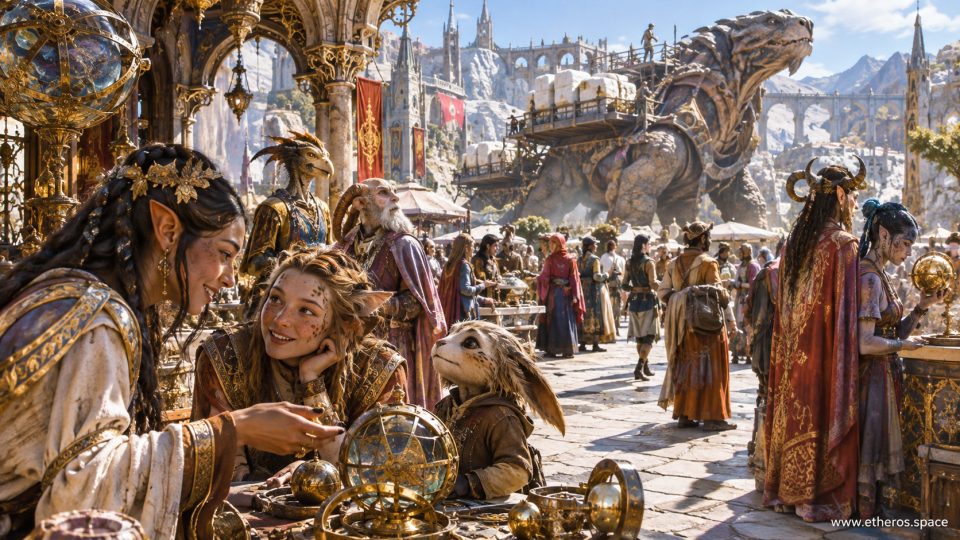
Every morning in the city of Isara, a thousand small agreements were made before the public clocks reached noon. Vendors claimed their paving stones. Couriers borrowed the narrow lanes. Flower-sellers negotiated with the keepers of the shade. Those who could speak loudly usually received the best of everything.
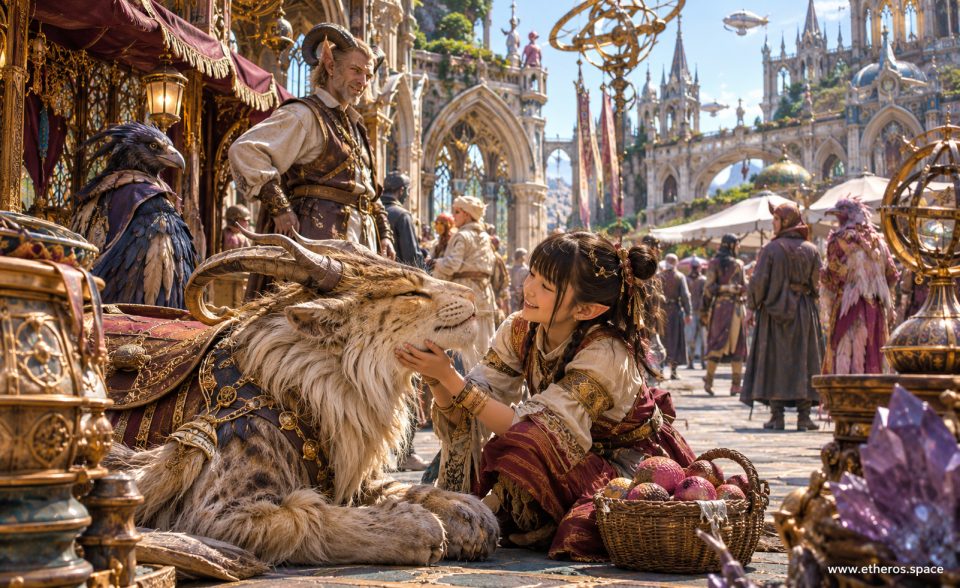
At the western entrance of the Sunward Exchange, a horned, long-furred creature named Halven had become an exception to all those rules. He was older than most of the buildings around the square, or so the children liked to say. In truth he was thirty-six, very old for a ridge-runner, and his white mane carried the dust of more journeys than even his own keeper remembered. Under the embroidered harness lay the little weights of his history: a bronze tally for each difficult winter crossing, a worn leather ring for the medical caravans, and a dark patch repaired by an apprentice long since grown into a master.
On this bright market day he was doing nothing. He lay on a padded cloth beside a fruit basket while crowds flowed around him, the stone warm beneath his enormous paws. A dark-haired child, Mina, knelt at his side and scratched the soft place beneath his jaw. Halven leaned into her hand and closed his eyes.
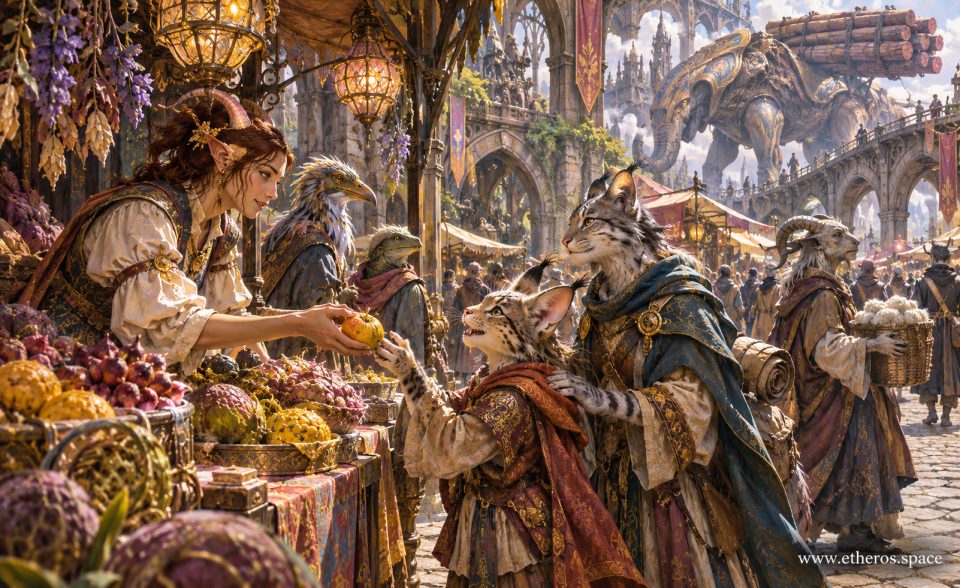
Her father, Corven, watched from beside the stall with one hand on his belt. His ram-like horns and precise merchant's vest made strangers assume he was the animal's owner. He had spent half his life correcting them. Ridge-runners accepted human contracts through a system of scent, gesture, and pressure; a keeper could speak for a route or a load, but not for the creature's willingness to carry it. After too many winters in service, Halven had simply stopped taking journeys. Corven had not argued.
A blue-feathered registry clerk waited beside the stall's brass instruments. The clerk's name was Thir, and the book tucked under his wing contained every scheduled motion of the Sunward Exchange: deliveries, watches, celebrations, repairs, even the changing position of the great public astrolabe above the square. There was no column for resting.
'It needs a designation,' Thir said. 'If he stays here without a permit, tomorrow the porters will have the square cleared.'
Corven took his eyes from the crowd. 'Designate him retired.'
'Already done. That answers who is responsible for him. Not what occupies this space.'
Mina was listening without seeming to. In one hand she held a piece of red fruit from the basket; her other hand remained beneath Halven's chin. She had promised herself she would not use the word *ride* again. The first time she'd asked to climb onto his back, she had been six, and her father had told her that asking was not the same as receiving permission.
'This is the place where he can watch us,' she said.
Thir opened his beak, then shut it. Around them the exchange moved on. A hooded traveler crossed between the columns. A woman carried a folded canopy through the crowd. Above the roofline a small airship followed the outer walls, its shadow briefly touching the gilded instruments. From the city towers came the sound of an hour-wheel turning.
'I can't write that on a freight form,' Thir replied.
'Then use a different book,' Mina said.
Her father smiled at this, though not at the difficulty it would cause. The city's public ledgers were made from an old assumption: every named place was for selling, passing through, working, or storing something. A stone where a creature chose to lie was considered empty until someone found a productive use for it. Yet Halven had spent decades carrying medicine through snow, timber for roofs, and frightened children from villages where the passes had closed. All the useful places in Isara had been made possible, in part, by the days he had given away.
Corven knelt so his eyes were level with Thir's. 'What would it take to enter one new category?'
'A hearing. At least three witnesses. A boundary in the paving that does not obstruct trade.'
'We have witnesses.' Corven gestured toward the stalls, the curious people, the child and the ancient runner. 'And we can move the baskets back a handspan.'
Thir regarded Halven for a long moment. The creature opened one golden eye, not in expectation but with the tired curiosity of someone who had already chosen how the day would pass. The clerk drew a line across a blank page.
By afternoon, a little circle would be marked in the cobbles, and the city would have its first formally recorded Resting Place. There would be arguments about precedent. Someone would insist such circles multiplied faster than cobbles could be laid. Others would ask why so many routes and buildings had been planned without room for the bodies that sustained them.
None of this interested Halven. Mina scratched beneath his jaw again. The animal's breath warmed her wrists; beside them the fruit shone red and gold in its basket. Corven returned to his work. The blue-feathered clerk wrote carefully, making the letters small enough to leave room for the next impossible thing.
And for the first time in the history of Isara's ledgers, a space was recorded because someone needed nothing from it.