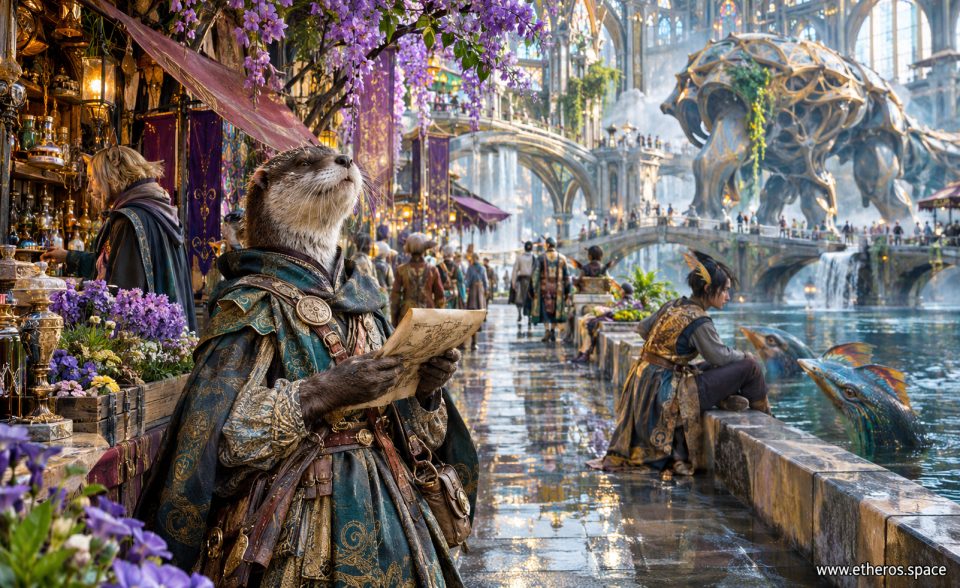
The Mercy of the Second Current — A Morning at Vellune Gardens
20261103T021141018195-0800_033percent.png
Story
The Mercy of the Second Current — A Morning at Vellune Gardens
The second current had arrived seven minutes late. In most cities, seven minutes could disappear between a market bell and the purchase of bread. At Vellune, where orchards floated on the shoulders of aqueducts and every root had its share of measured water, those minutes could be felt through the soles of a gardener's shoes. The lower terraces had begun to turn their leaves toward the wrong sun.
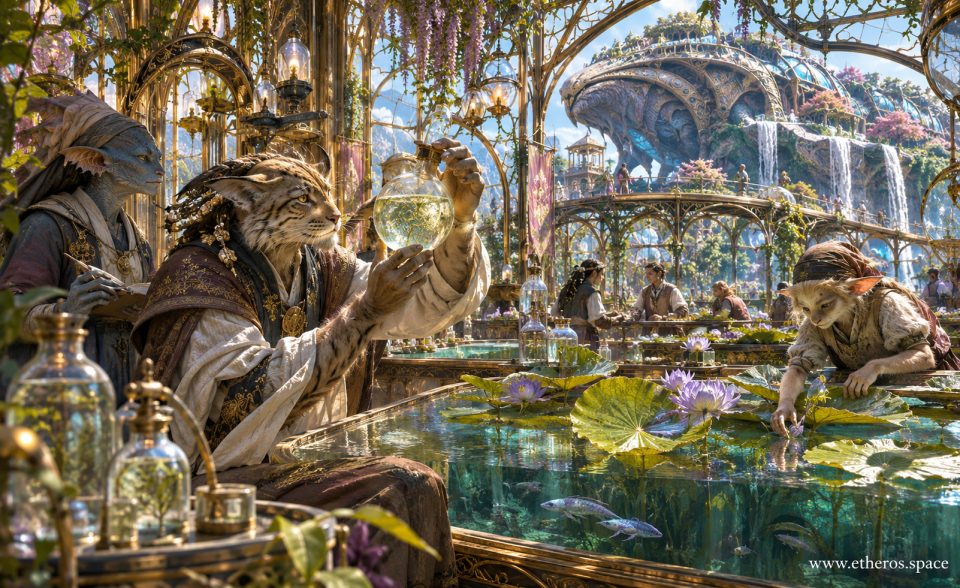
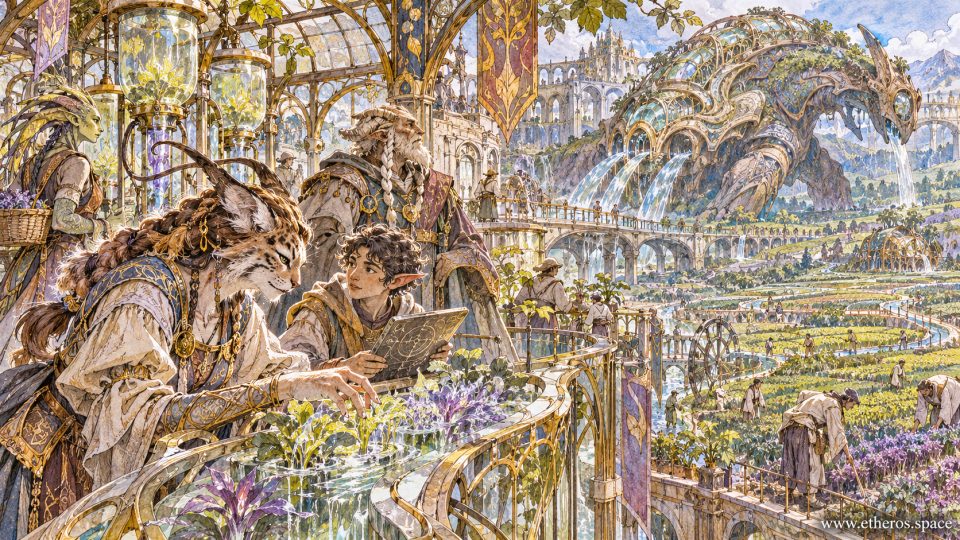
Sarel, an older lynx-faced keeper of the botanical locks, rested two tattooed fingers in the water winding through the brass-lined observation table. The current curved past small purple water-lilies and a stand of silver-green reeds. It was clean, remarkably clear, and much too cold. Neither the color nor the temperature alone would explain the faint shivering of the seedlings; taken together, they told him something had changed before the water reached the gardens.
Across the channel, his apprentice Neri held a thin engraved survey tablet against their knee. Neri had come from the dry uplands, where every drop of water came by cistern and every mistake was counted in days. They were accustomed to asking questions before lifting a tool, and Sarel had learned that this was not the same thing as hesitation.
"It isn't the bridge-wheel," Neri said, checking a diagram that showed the two return paths beneath Vellune's greenhouses. "Its rotation has been constant since dawn. The second current is arriving late because it has farther to travel."
"Or because something is holding it," Sarel answered.
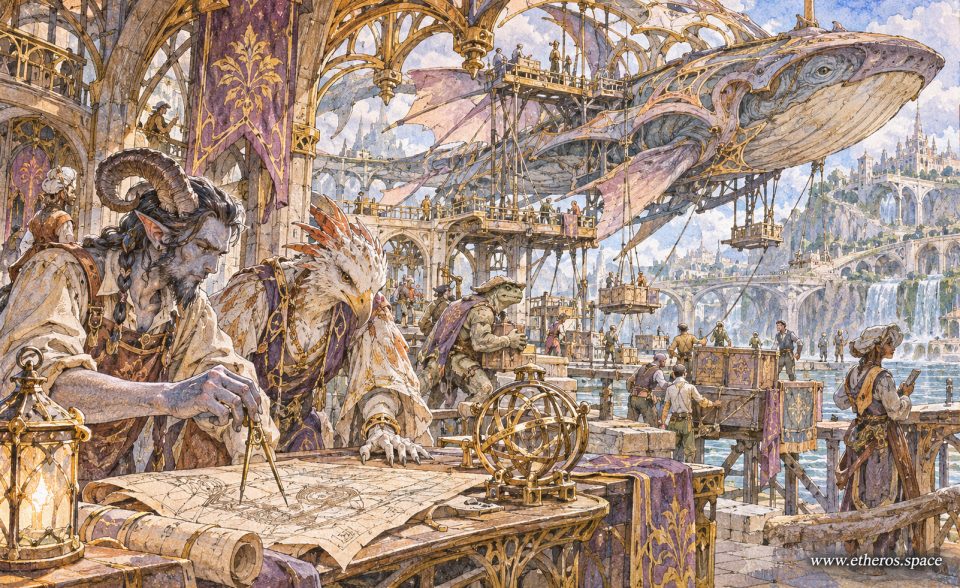
Behind them, Master Odran, broad-shouldered and horned, watched the bridges through the tall gold-ribbed windows. He kept the distribution accounts for the public terraces, a calling less picturesque than tending flowers and more necessary than any festival. The water was not owned by the greenhouse. It belonged in turn to the seed nurseries, the outer allotments, the communal kitchens, the sleeping chambers whose living walls drank away the heat, and finally the wetlands that returned it to the sky.
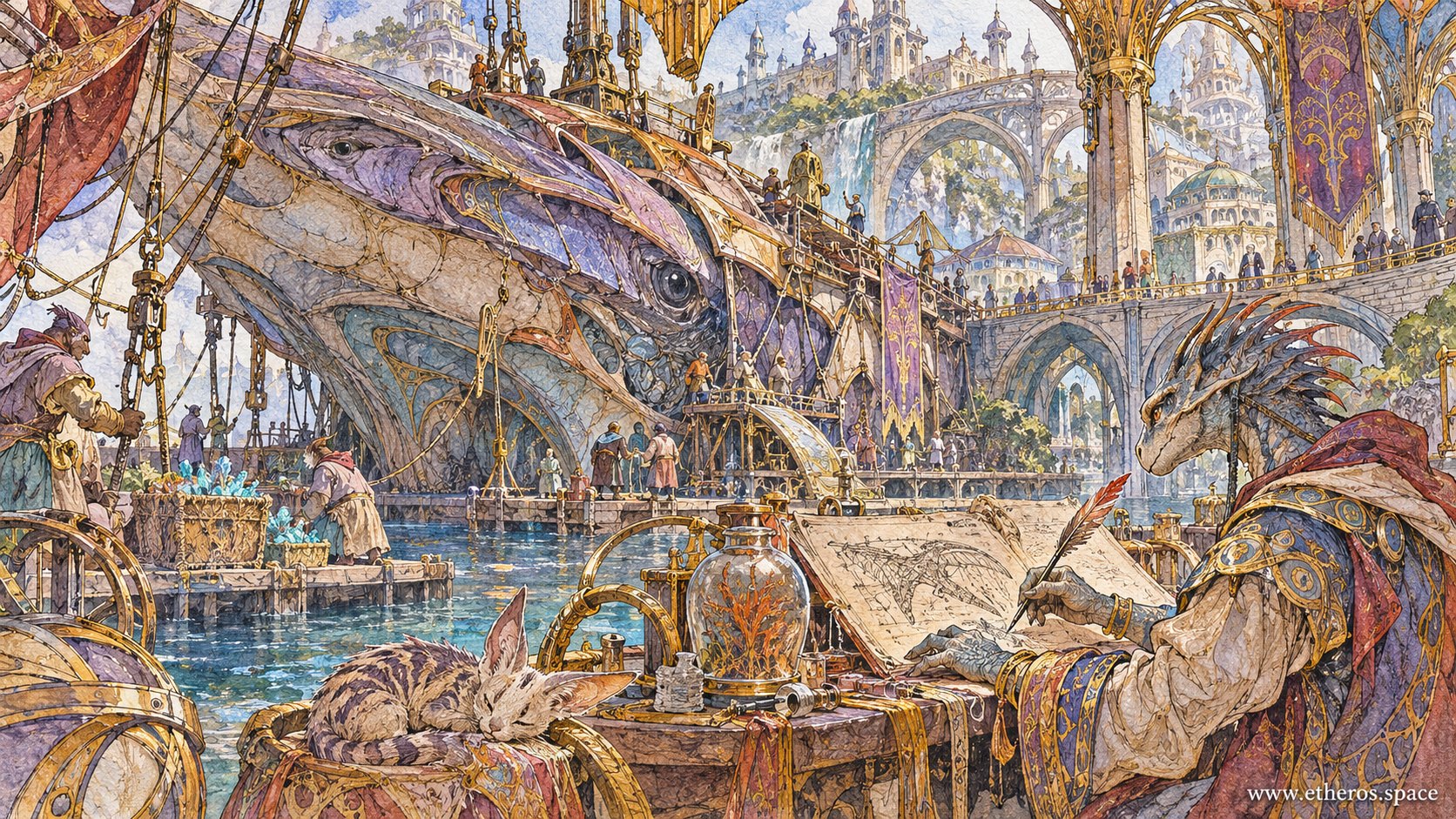
Outside, countless people were already at work among the terraced fields. A green-skinned botanist passed the glass vessels with a basket at her arm; workers bent over purple leaf beds near the lower railing; others crossed the slender bridges between irrigation gates. In the distance, the great garden-bearing animal-machine of Vellune lowered its armored neck over the valley. Silver water poured from its flanks through the curved discharge ribs, falling into the upper channels below. A vast glasshouse rode its back, full of vines and the patient maintenance of people too small to see clearly from this room.
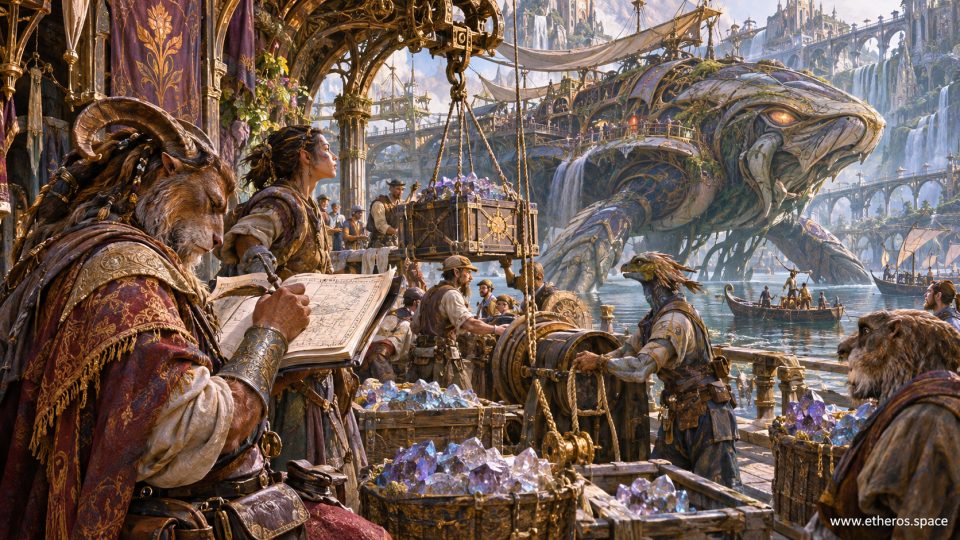
The creature was called the Rillmother, although it had never been anybody's mother and was older than the oldest map. It grew from Etheros's mineral tissue and had been persuaded, rather than conquered, to carry water for the city's farms. Its hydraulic chambers took in runoff from the higher cascades, filtered silt through living membranes, and used each careful step to pump the cleaned flow uphill. Beneath its ornate shell, pressure vessels opened and closed like a patient heart. The water it gave was not magic; it cost motion, mineral salts, a thousand tiny repairs, and the agreement of thousands of lives not to take more than they needed.
Sarel lifted one dripping hand and drew a small spiral on the surface of the channel. The return flow held the spiral for too long. "One of the membranes is conserving heat," he said. "The Rillmother is protecting its own body from the chill. The gardens are receiving yesterday's cold water while the warm current is being stored inside."
Odran's gaze moved from the behemoth to the furthest seedbeds. "We can order the southern sluice opened," he said. "But those channels supply the household baths by noon."
"Then don't order it," Neri replied. The apprentice pointed at a narrow return pipe in the tablet's engraved schematic. "We can release warmth from the seedhouse reservoirs. Just for one cycle. The beds that need the warmth are the beds that made it."
It was a solution so modest that nobody had commissioned a monument to it. They would let water pass through the greenhouse roots a second time, give it their gathered warmth, and send it back through the Rillmother's outer vessels. The behemoth would feel the shift in its own sensors, relax the cold-protection membranes, and return the second current to its proper hour. No district would lose its share. The seedhouse would sacrifice a little of its carefully held comfort; by evening the behemoth would repay it in cleaner water.
Sarel's mouth curved into a small, private smile. He had spent thirty-two seasons teaching people how to tune living machinery. It still surprised him how rarely the answer required a stronger engine.
Neri recorded the adjustment as the gardeners moved toward the minor gates. Odran took the account book downstairs and began informing the kitchens and the households. The purple plants in the trough had not yet recovered; that would take time. But Sarel felt the first hint of a warmer pulse touch his fingertips. Beyond the glass, the Rillmother continued its immense, deliberate walk, indifferent to the city's clocks but responsive to the quiet negotiations of those who lived with it.
There was no applause when the second current returned. A woman continued harvesting beneath the aqueduct; a child crossed the footbridge with a basket; someone somewhere baked the day's first bread. Sarel rinsed the last of the cold from his hands. In the observation channel, the little violet lilies turned toward the light, not because a hero had saved them, but because the city had remembered how to share.