The Toll That Was Not Collected
20261106T195801240613Z_100percent.png
Story
THE TOLL THAT WAS NOT COLLECTED
The Keshar Switch, the dry western road, primordial Etheros
The caravan had stopped for a broken tether, not for an injury. Its pack creature stood patiently beyond the shade awning, head bent against the wind, while the repair crew searched for a replacement pin. Then Varrin stumbled back from the wagon with one sleeve darkened and his arm held stiffly away from his chest. He had caught the load before it fell. The cargo survived; his skin had not.
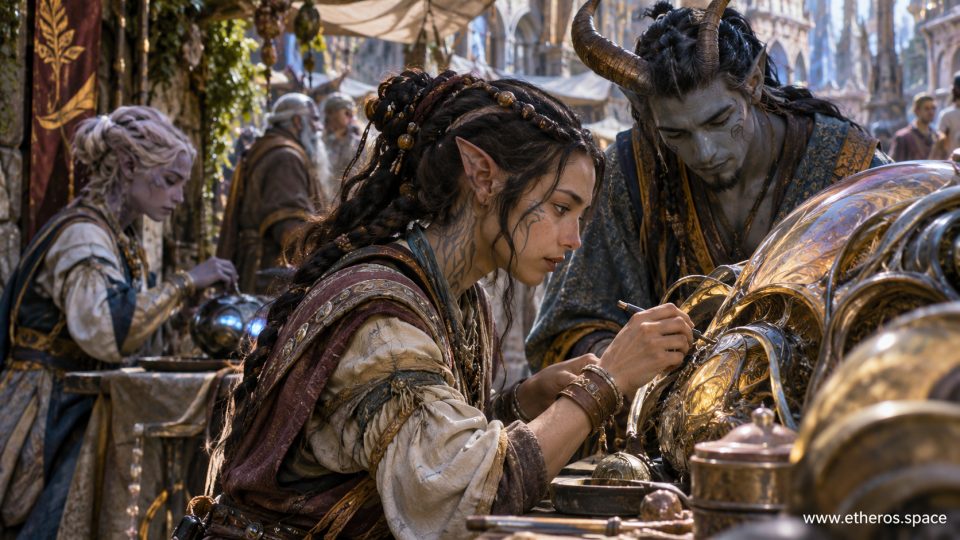
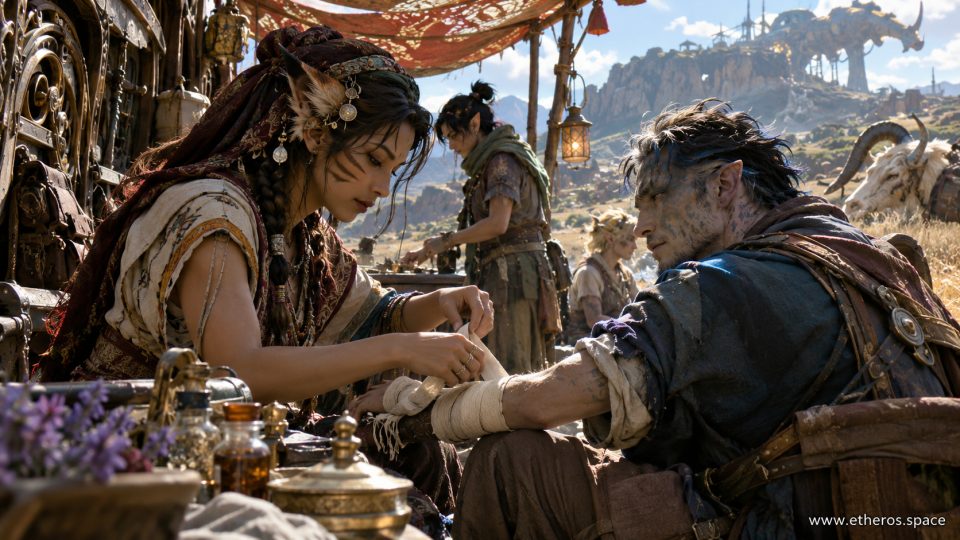
Nareh pulled a stool beside the brass-sided wagon and sat opposite him. The striped markings along her cheek were almost lost in the shadow of her braided hair. She had already washed the wound and laid a clean linen strip over it; now she drew the bandage around his forearm with small, practiced turns. Varrin, his blue-gray skin marbled with darker plates, watched her hands instead of the injury. He was accustomed to being useful. Being still in front of other people embarrassed him more than the pain.
Behind them, Ilven sorted jars at the narrow preparation table under a lantern. Beyond the posts, sunlight fell on ochre grass, the curved back of a horned pack beast, and a distant ridge where an immense service creature stood among structures that appeared no larger than thorns. There was work everywhere the eye could go. The little shaded treatment place looked temporary, but the wagon had followed this road for nine seasons, carrying splints, dressings, dried medicine, and a register of names that belonged to no town.
“Does this go on my freight bill?” Varrin asked.
“No,” Nareh said. “You were injured before the next toll mark.”
“That isn't what I asked.”
The bandage stopped moving. Everyone who traveled the Keshar Switch knew the argument. Three hill communities maintained the route, and each demanded a different contribution from passing wagons: spare metal, time on the road crew, or a counted measure of cargo. The roadside healers were paid from the remainder, when there was any. People with light loads often had no remainder at all. Some returned home untreated rather than confess what they could not afford.
Ilven approached carrying a shallow cup and set it beside the folded cloth. “There are eleven clean strips,” he said quietly. “Nine, after this one and the one we promised the northbound team.”
Nareh nodded. It was not an emergency shortage. It was the ordinary arithmetic of another difficult season. The next settlement had offered to send more cloth but required the healers to collect signatures from every beneficiary. The southern town would contribute herbs, but only if a share of the wagon's services remained reserved for its own households. Each plan sounded reasonable when spoken by the people who proposed it. None made the road shorter.
Varrin shifted. “I can pay with my harness buckle. It's sound metal.”
“I have a buckle,” Nareh replied. “What I need is someone who can keep a hand dry for two days and tell me if it begins to swell.” She tied the final knot and tested the tension against his breathing and the movement of his fingers. His hand remained warm; the wrap supported without pinching. “You can do that. And you can bring back the empty cup.”
A younger traveler seated in the shade looked up at the exchange. The others pretended not to listen. They had all, at one time, needed something before they had earned it. Nareh knew that a gratuitous gift could feel like another kind of debt. So she asked Varrin to teach Ilven how the caravan's new load straps failed. The buckle he had offered was not taken as payment. It became a lesson, inspected together after the wound was protected.
By dusk, the tether would be repaired and the wagon would move again. The ridge behemoth would continue whatever distant labor its long limbs had been made for. No grand accord would be signed at the roadside. But Ilven would mark a change in the register: a care visit could be balanced by knowledge, a future return, or no repayment at all, without recording a person's poverty. He did not know whether the three hill councils would accept this new line. Nareh did not know whether the supplies would last to the next settlement. Neither pretended certainty.
Varrin lifted his newly bound arm and flexed his fingers once, slowly. When he stood, he did not reach for his cargo. He went to the pack creature and laid his good hand against its dusty neck. The animal pressed back, and for a moment the two of them leaned together beneath the lowering sun. What Nareh had given him was not a waiver of the road's costs. It was a little time in which to heal without having to prove he deserved it.