The Brake Between Two Bells
20261104T232431176508Z_066percent.png
Story
THE BRAKE BETWEEN TWO BELLS
The mountain had three ways of telling a traveler to stop. The first was the silence of birds. The second was the change in the tension of the lift cable. The third was a sound like a spoon striking a cup, made when the old bronze safety ratchet found a tooth it could not pass.
Tonight, in the upper reaches of Kelva Gorge, the first warning had passed unnoticed. The second ran through the suspension rail and into the soles of the passengers. The third was still waiting to happen.
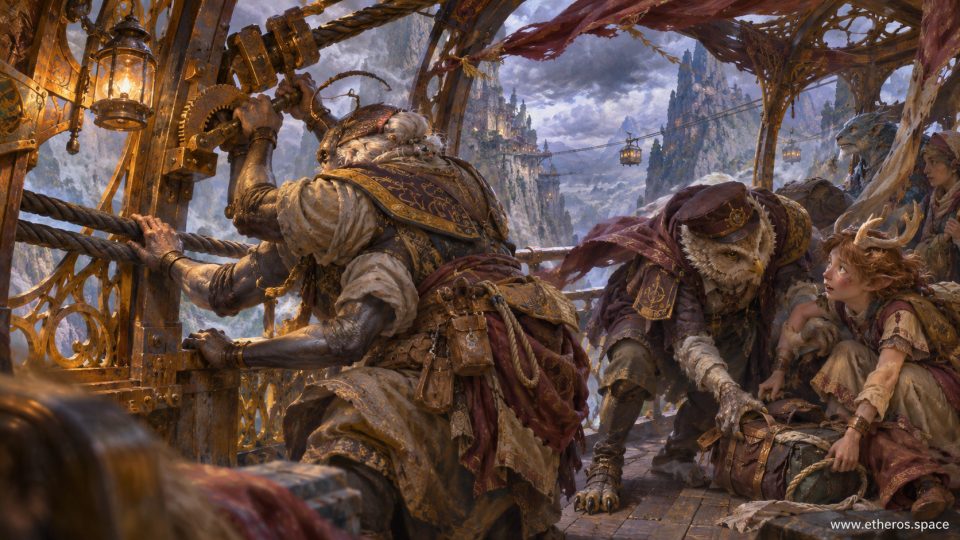
Dorrik Venn had climbed onto the exposed mechanism at the forward end of the carriage before anyone asked him. He was a broad, white-maned, horned mechanic whose work mantle had been patched more often than the tram's upholstery. One hand held a bracing rail while another reached above his head to the geared control. Beyond the ironwork, a cable vanished into cloud. Two distant cars glimmered against towers that seemed to have grown directly from the rock.
The vehicle leaned almost imperceptibly. Dorrik felt the lean anyway. He had learned the route by spending thirty-seven windturns listening to the shudder of its cables, though no one could agree how many years a windturn meant beyond the mountains.
'No sudden pull,' he told Eldet. 'Make the luggage fast first.'
Eldet, the tawny-faced owl-kin conductor, was already kneeling beside a child on the wooden floor. Her purple traveling cloak had blown across a satchel. The child, Maeli, had small branched antlers, a loose red braid, and both hands on the bag as though it held the only valuable thing in the world. It held one wool blanket, three letters and a broken clay whistle.
'Will the other people leave without us?' Maeli asked.
'Only if they find a road through the sky,' Eldet said, fastening the strap to the carriage's low cargo ring.
A little farther back, an older scaled passenger bent his head beneath the torn wind awning. Beside him, a traveler in a faded scarf kept one shoulder against the timber upright. Neither spoke. Even the small lantern above Dorrik's head seemed to be guarding its flame.
The transport guild had proposed replacing the old manual watch with an automatic tension governor. The new device could stop cars at regular intervals, spare labor and make the journey cheaper. Dorrik had supported most of it. A reliable machine could keep tired workers from spending their lives clinging to cold controls.
But the proposal had deleted the final human inspection at the crossing where two weather channels met. Here, rock-shaped turbulence arrived sideways. The load gauge could be correct while the awning caught a gust and shifted the carriage's weight across its hangers.
The guild's calculations had not been foolish. They had merely been done on a calm day.
Dorrik touched the grooved pawl with the heel of his glove. It trembled, then steadied. The upper cable was still bearing the weight. The safety mechanism was meant to engage a separate toothed wheel and distribute its force into a reinforced hanger; hauling directly against the main suspension rope would make an already strained system less predictable.
'There,' he said to Eldet. 'See the catch? We take one tooth, not the whole turn.'
Eldet leaned her weight into the floor. The child watched her face rather than the distant drop. Together they waited for the gust to ease. Dorrik seated the pawl gently. Bronze met bronze with a clear small note. The carriage's motion settled to a slower, controlled drift.
No passenger cheered. The cold had not vanished. The towers were still far away, and somewhere ahead a maintenance crew would have to test the rail before releasing the crossing. But the roughest movement stopped, and the bag no longer slid toward the open edge.
Maeli reached toward the broken whistle inside her satchel. 'My father said if I made it sing, I could find him in the upper houses.'
Eldet considered the whistle, then the rows of lit windows on the opposite cliffs. 'You can find him without fixing it first.'
The little antlered child seemed dissatisfied by this answer. It suggested that some things might remain broken when a person finally arrived.
Dorrik lowered his hand from the brake. 'In my village,' he said, 'we never threw away a whistle for being cracked. The wind taught it a different note.'
Maeli smiled despite herself. The conductor loosened the straps only enough for the child to hold the parcel on her knees.
At the first safe landing, Dorrik would write the event into the inspection book: lateral gust; awning load transfer; manual pawl engagement; no confirmed injuries; departure delayed until the hanger was checked. He would not accuse the guild of malice. A lower fare mattered to people who traveled to work, and some of the young crews trusted the governor because it had rescued them from long, exhausting watches. He would ask them to improve it with him, rather than demand the whole device be discarded.
For now, the travelers remained suspended between two distant bells. The cable hummed in the wind, the city carried on lighting its windows, and an old worker kept his hand near a mechanism that still needed to be understood.
The sky was not a poster of courage. It was a workplace. Everyone in the carriage was part of the load, and everyone had a name.