The Warmth That Had No Address
ETHEROS_20261104T175236132823Z_100percent.png
Story
THE WARMTH THAT HAD NO ADDRESS
On Etheros, the last light came late to the Varrash Caldera. The sky above the basalt was blue, but the cracks in the cliff had already begun to glow. Inside the heatworks, ceramic stones stood in rows on a shelf, drinking warmth from the mountain. Their engraved faces were rough enough to grip through thick gloves, and each would release its stored heat slowly through the first hours of the cold.
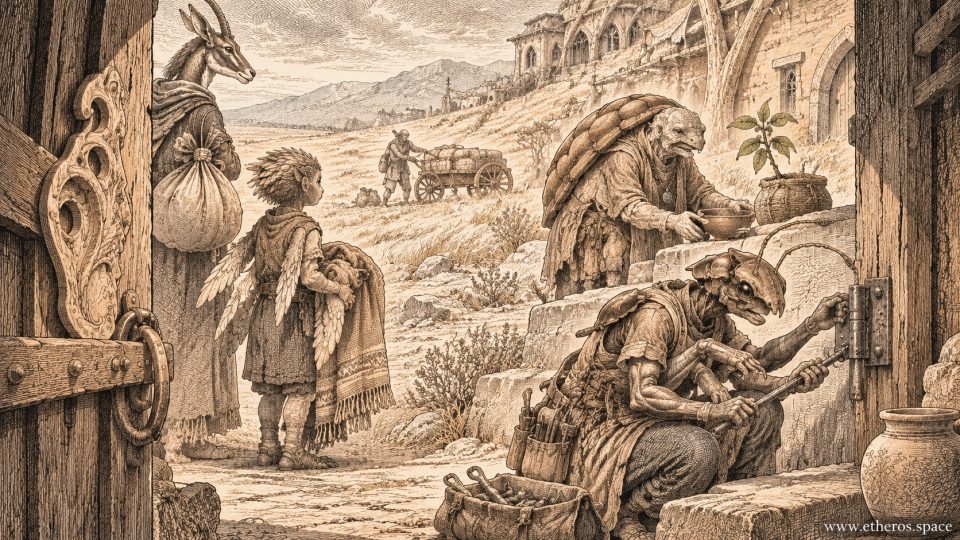
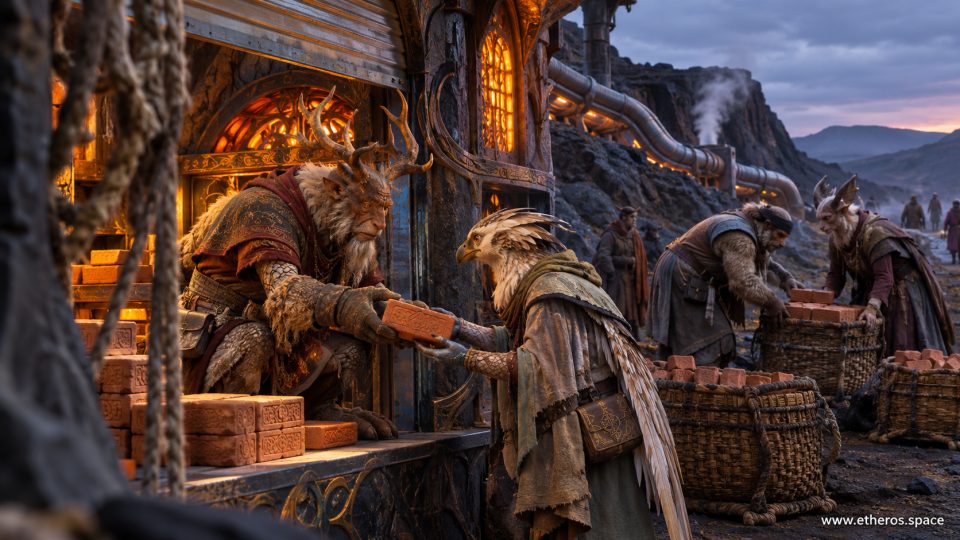
Korven lifted one from the rack. He was old enough that his antlers had become a nuisance at the doorway; one tine bore a pale scar from the winter he had tried to climb into a collapsed duct himself. White fur spilled over his work collar. He tested the brick by holding it an instant between his padded hands, then offered it across the sill to the feather-crested courier waiting below.
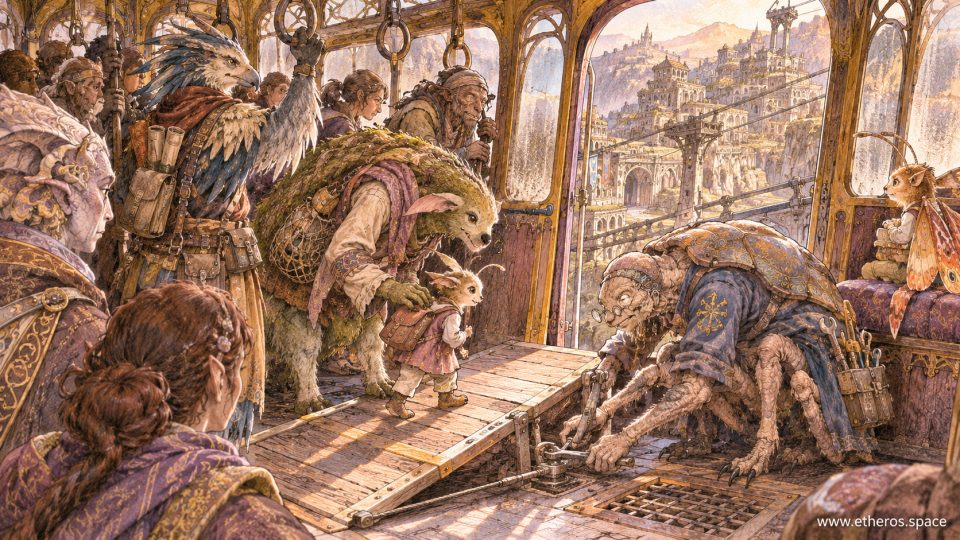
The courier was called Tev. Her great pale wing-feathers lay folded beneath a short, weather-stained traveling cloak. She held out both hands because a warm brick weighed more than its modest size suggested. At her back, other workers stacked their allotments into woven carriers, separated by strips of insulating fiber. A long metal pipe followed the rock beyond the heatworks and vanished around a broken ridge. From the vent above it, a thin plume rose into the dimming air.
"That is the last one for the upper lanes," Korven said.
Tev looked at the brick, then at the basket behind her. "The houses nearest the old wind cut are colder than the upper lanes. The mothers there sent me to ask for another carrier."
Korven had heard the same request twice that week. The allocation tablets were simple: every address registered a fixed number of heat stones; the high galleries had paid to strengthen the old conduit and held the earliest claims. The lower nests and narrow worker shelters received their share from a later batch. There was not enough ceramic in the heatworks to make everyone equally comfortable at once.
"I can't invent a new batch," he said.
"I'm not asking you to. I'm asking why the warmth is already named before we know where it is needed."
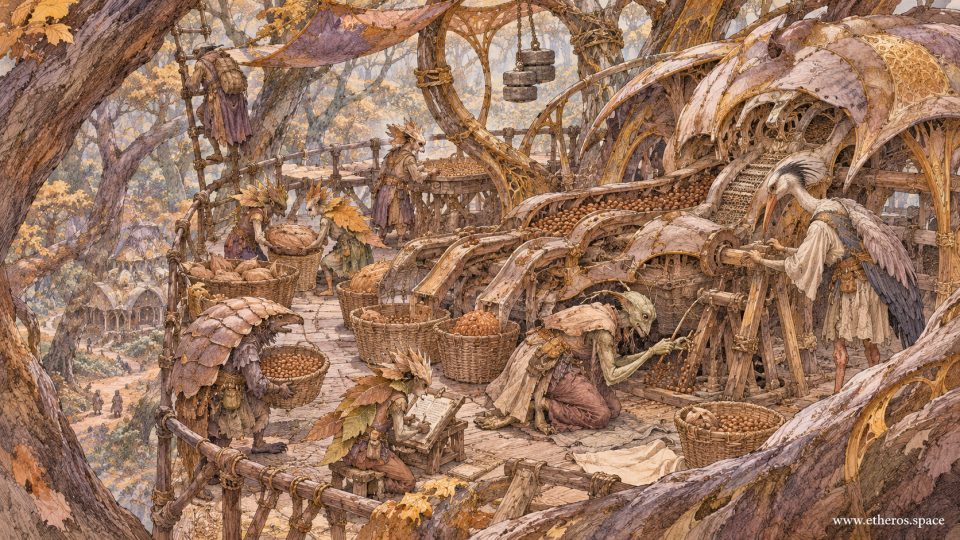
Nearby, Besh and Orra worked side by side over a pair of broad baskets. Besh had heavy arms and a long, furred neck that made bending difficult; Orra's shorter, fine-jointed fingers arranged the bricks so they did not strike each other in transit. They had done this together for years. Neither looked up, although they were listening.
Korven set his palm on the sill. The stone was warm from the furnace, and the familiar heat traveled into his wrist. He had helped build this place after an ash season that buried the old road. The heatworks was not a miracle machine: volcanic warmth entered a lined duct through a pressure-controlled intake, warmed a rack of fired porous stone, and returned through a cooler passage. The vents needed tending, the chimney needed clearing, and the bricks had to be carried before they lost their charge. The mountain provided energy; neighbors provided everything that turned it into shelter.
He knew something else the tablets did not say. The wealthy ridge houses had thick walls of living stone and shared internal flues. The cliff-side worker shelters were made of thinner construction, exposed to the night wind and crowded with smaller bodies whose feathers and scales retained heat differently. Equal numbers of bricks did not produce equal warmth.
"If we change the allocation," he told Tev, "the upper households will ask why they should continue to repair the intake. And they would have a fair question."
"Then ask them," Tev said. "But ask them after they have seen the wind cut."
Behind her a porter lifted a basket, adjusted the load against a shoulder strap and stepped onto the rocky path. Farther along the plateau, a few travelers were already moving home. No one beyond the doorway could have heard the argument, and the cold would not wait for a vote.
Korven took out the small tally plate that hung beneath his apron. He marked two bricks as temporary loans from the unused upper-gallery reserve, not as a permanent reassignment. Orra wrapped them separately in salvaged lining. Besh tied the lid with extra cord and promised to escort the basket as far as the cut. The next morning the neighboring households would be invited to inspect the different shelters, compare how long each stone stayed warm, and decide whether the table itself needed changing.
"Two tonight," Korven said. "And no promises that tomorrow will be easy."
Tev accepted the new basket without thanking him too quickly. She knew a decision could be kind and still leave someone dissatisfied. She knew, too, that Korven had not solved the winter. He had only refused to let a fixed rule become a substitute for looking.
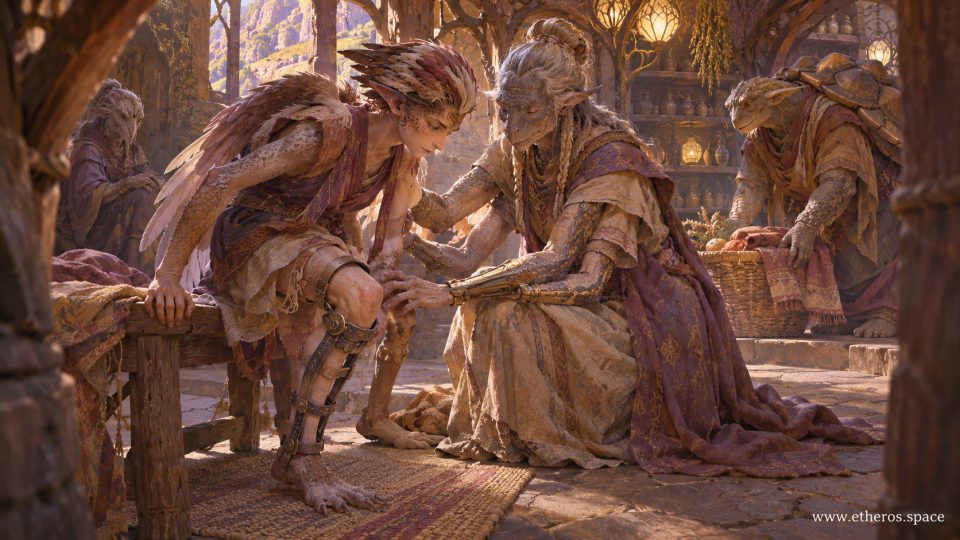
At the edge of the heatworks she turned once. The elder was already back at the shelves, counting carefully with his gloved finger while the workers readied the next carrier. Orange light filled the carved doorway; beyond it, the land darkened into violet and slate. The little warm stones had no knowledge of addresses or debts or generations. They could only hold and surrender what had been given to them.
The rest was the work of a living society.