The House of Returning Notes
20261105T103934944976Z_022percent.png
Story
THE HOUSE OF RETURNING NOTES
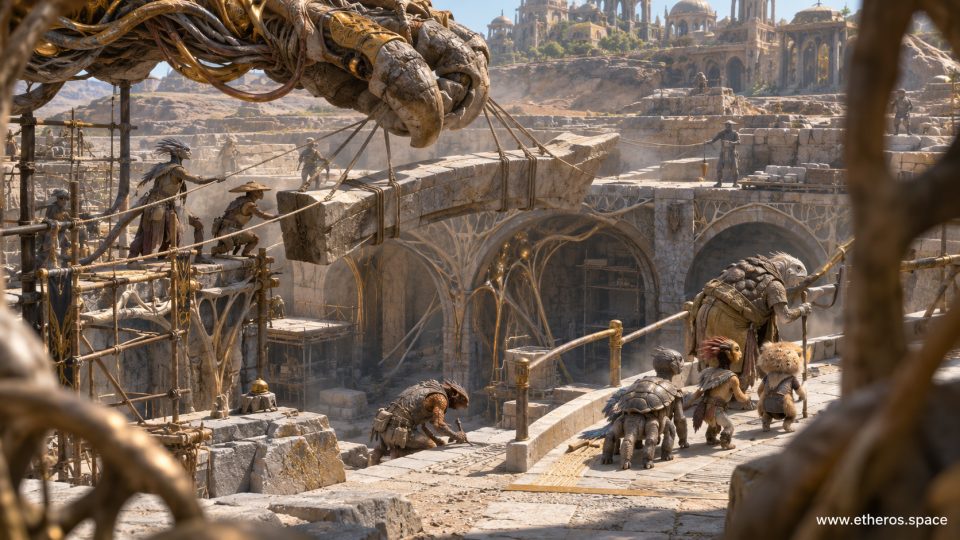
In Vareth Hollow the first instrument was the stair. Every footfall on its pale limestone treads ran downward through the natural arches until someone seated in the lowest ring could tell whether a visitor had arrived in haste, in sorrow, or carrying a sleeping child. The people who built the amphitheater had never thought of that sound as music. It was only when the eastern district closed its public gathering rooms that the hollow learned to listen to itself.
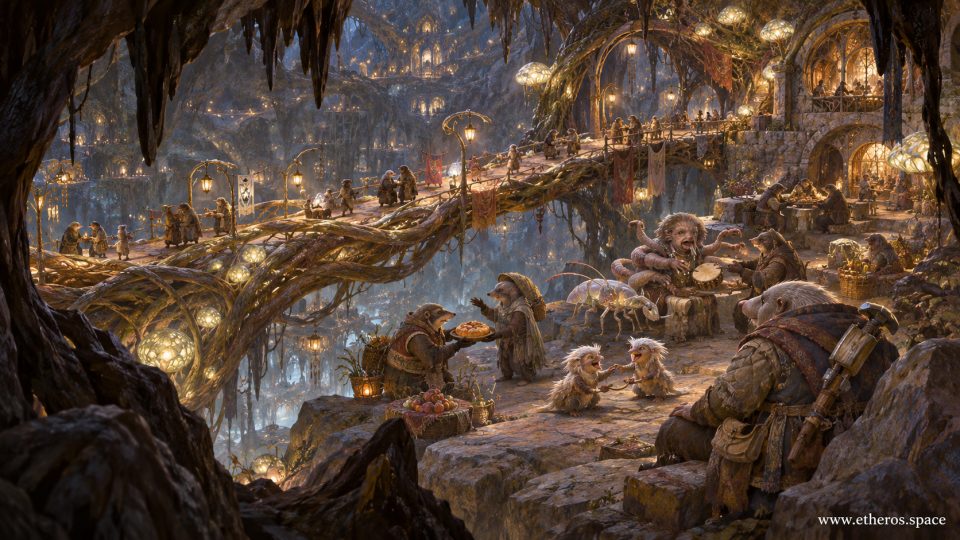
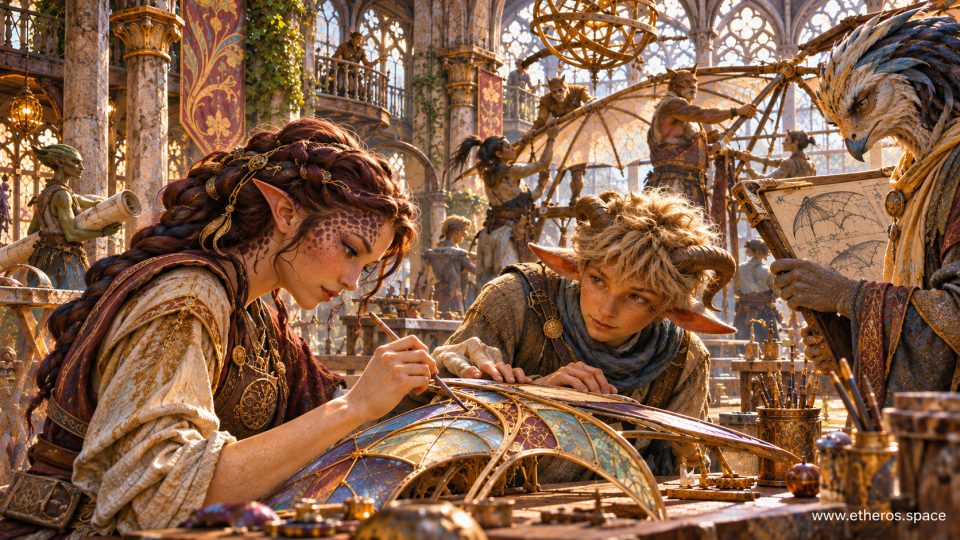
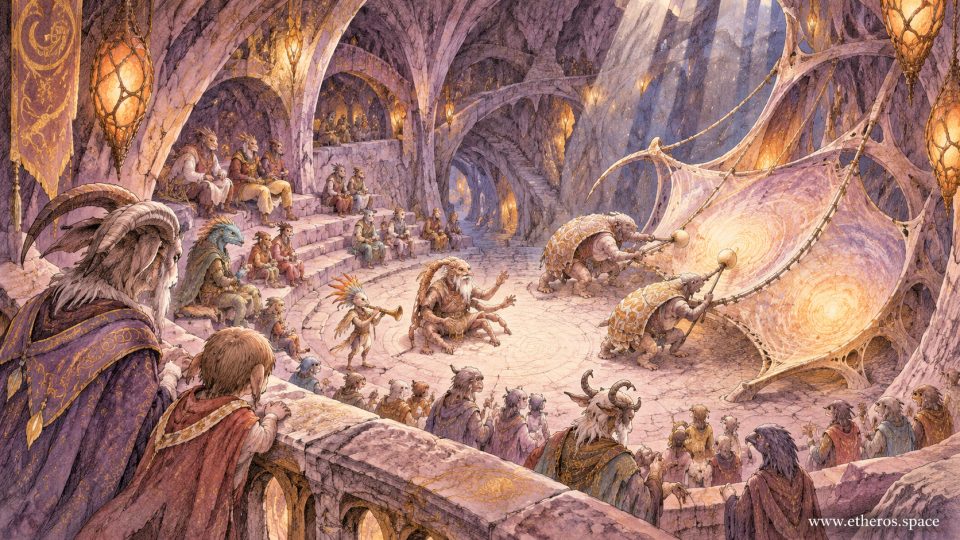
On the sixth evening of the amber-lantern season, the steps were full. Horned elders sat with cloth folded carefully under their knees. Fur-backed travelers held places for neighbors with different shapes of feet. Small people with pointed ears and others with long feathered necks leaned over the upper ledges. No one arranged them for a ceremonial portrait. The gallery had filled by acquaintance, by curiosity, and by whoever happened to arrive before the lamps were lowered.
From the old balcony, the floor looked like the inside of a seashell cut from rose-colored stone, although the cavern lay far from any shore. The shafts of dusty light made the great ribs of the ceiling seem to grow out of the ground. Thin cords led toward two enormous stretched membranes at the right side of the hall. Their luminous amber surfaces were held under tension by carved buttresses and a lattice of living, fibrous supports rooted into the rock. When struck, they answered through the stone rather than merely into the air.
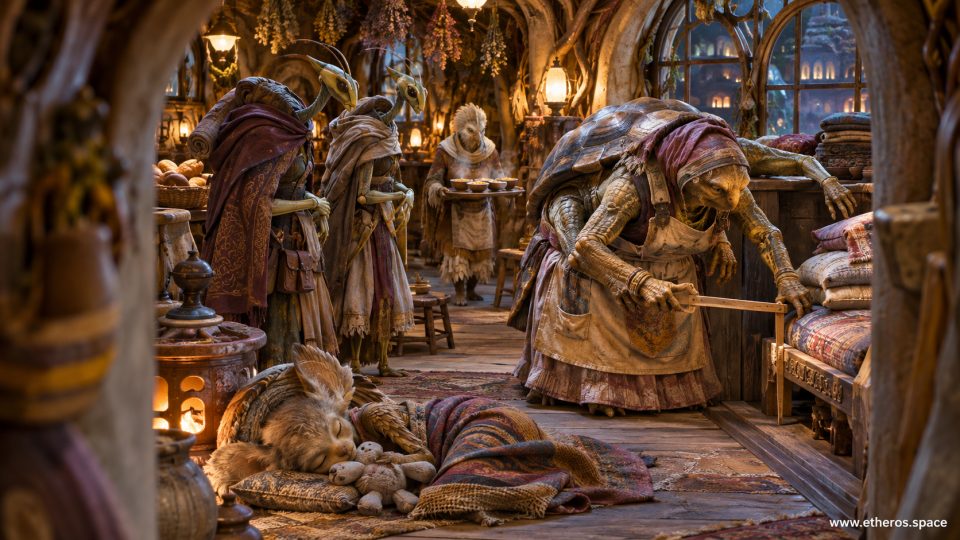
Ruun and Ortha had spent nine days repairing the resonator. The two broad, shell-backed players wore patterned mantles over their shoulders, both to protect their sensitive plates from the taut lines and to keep the dust out of the carefully mended seams. Ruun bent toward the upper membrane with a padded striker. Ortha braced one foot against the lower frame and lifted a second mallet. The instrument did not float, nor did its beautiful light excuse careless construction: its weight came down into the floor, its pull was taken by the arches, and the faint glow was fed by the colonies of lantern-moss cultivated along its skin.
Between the audience and the resonator sat Tavren, an old, many-armed keeper of songs. His weathered hands rose in different directions, not like a conductor trying to command an obedient army, but like a mason measuring several loads at once. The first pair marked the slow pulse. The next described the space left for a younger voice. His lowest hand rested briefly on the floor. He had spent his adult life studying how sound traveled between the inhabited chambers; he could feel a wavering anchor through the stone before anyone else heard the trouble.
A small feather-crested child stood to his left, holding a narrow horn almost as long as an arm. Piri had asked to play the opening note and had been refused twice by the senior ensemble. The reed was unfamiliar to a player whose breath came in brief, quick bursts. At rehearsal the note had cracked, and a visitor had laughed. Tavren had said nothing at first. He had only shifted the pulse and asked Piri to try again where the cavern would help instead of punish the sound.
Tonight the child placed both feet against the pale circular markings, lifted the horn, and played. The note was thin, uncertain, and unmistakably alive. Ortha answered with a low membrane beat; Ruun sent another through the arch. The audience did not cheer at once. They listened for the little tone to return from the upper galleries, and when it came back, changed by distance and rock, several listeners smiled. A horned elder at the balcony gripped the parapet. A young spectator beside him leaned forward as though a new path had opened in the floor.
There had been a quarrel about the evening's cost. The owners of the largest galleries wanted the hall reserved for private patrons next season: their dues would pay for the cracked upper anchor, new cords, and reliable food for the musicians. The lower-ring households insisted that no one should have to purchase the right to hear a public song. Ruun, who had worked through two nights to keep the skins playable, refused to pretend the players could live on gratitude. Even Tavren, who loved the hall without measure, knew that stone was not repaired by affection alone.
So the settlement had tried a smaller, less splendid agreement. The upper galleries would fund the first anchor stone; ordinary listeners could contribute grain, wages, weaving, transport, or nothing they could not spare; the ensemble would be paid before new gold leaf was purchased. The terms were written on a plain board outside, where a passing child could ask what each symbol meant. No one called the arrangement a victory. The rich families complained of uncertainty, the players worried about next season, and the hall-keepers still had to count every contribution by lamplight.
But for this one evening, the instrument held. The lamps continued their soft amber breathing. The membranous walls trembled and settled into their stone frame. From ledge to ledge, strangers began marking the returning rhythm with claws, fingertips and the tips of their tails. They were not all the same species, nor all agreed about the hall, the price of work, or the memory carried by the song. Yet the echoes belonged to none of them alone.
When Piri lowered the horn, Tavren left his hands open a moment longer. Far above, in a place almost lost behind the ribs of the cavern, he had heard the imperfect upper anchor answer one beat too late. He would speak to Ruun about it after the listeners went home. A room that welcomed everyone also owed its builders the truth. For now the child was smiling, the crowd was still listening, and the old stone was giving the little note back.